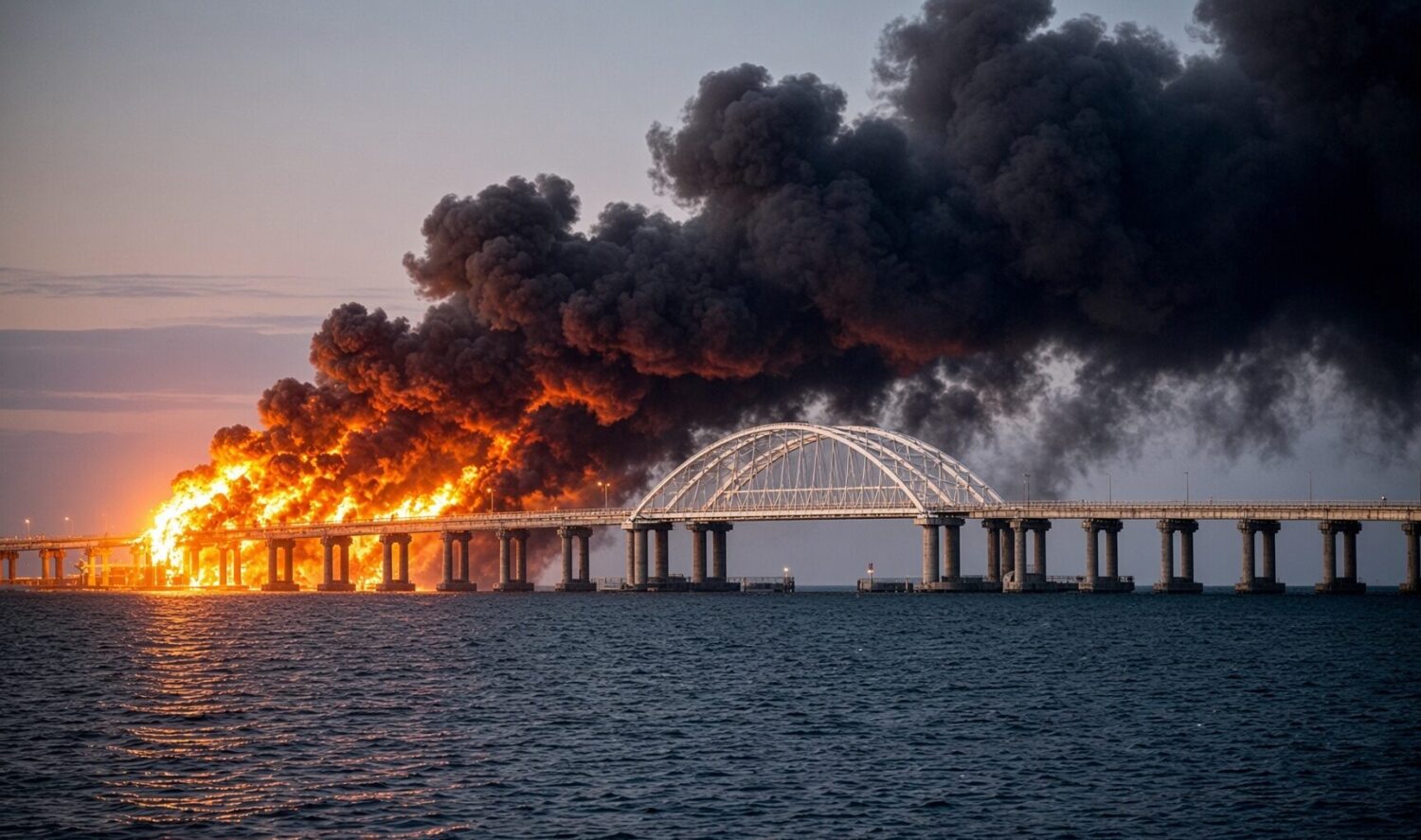
Ukraine has once again successfully targeted the multi-billion-dollar Kerch Bridge, the fourth major strike on the bridge, which is not only a vital logistics link between Russia and the Crimean Peninsula, but also serves as a physical and psychological anchor of Vladimir Putin’s 2014 annexation.
Ukraine launched a fresh wave of attacks on the Kerch Bridge on November 16 and 17, using an array of domestically developed drones and cruise missiles. The second attack reportedly brought down a major section of the bridge, damaging the strategic crossing and forcing Russian authorities to suspend road and rail traffic.
However, the strike did more than damage concrete and steel; it also wounded Russian President Vladimir Putin’s pride, who has long showcased the Kerch Bridge, also known as the Crimean Bridge, as a symbol of Russia’s engineering and a physical embodiment of Russia’s 2014 reunification with the Crimean Peninsula.
Given the Kerch Bridge’s symbolic, strategic, and economic significance for Russia, it is one of the most heavily defended infrastructure assets.
Notwithstanding Russia’s unprecedented defensive measures around the bridge, Ukraine has repeatedly targeted the bridge. This is, in fact, Ukraine’s fourth major strike on the bridge since the war started in 2022.
So, why has the Kerch Bridge become one of the most contested sites in the Russia-Ukraine War?
Ukraine’s Kerch Bridge Campaign
Ukraine’s first strike on the Kerch Bridge came within months of the beginning of the war in February 2022. Later, on October 8, a truck carrying a large quantity of explosives detonated on the bridge, damaging two sections of the road bridge and igniting a fire in the fuel train on the parallel railway section.
Ukraine’s Security Service (SBU) later publicly claimed responsibility for the high-profile attack, which marked the arrival of the war on the Crimean peninsula.
Following Russia’s 2014 annexation of Crimea, the peninsula remained under Moscow’s control for eight years.
However, Russia’s invasion of Ukraine in February 2022 transformed Crimea into a critical target for the Ukrainian military. The October 2022 attack on the Kerch Bridge was among the most notable demonstrations that Kyiv could strike infrastructure deep inside Russian-occupied territory.
Following the October attack, Mykhailo Podolyak, an adviser to the Ukrainian President Zelenskyy, tweeted: “Crimea, the bridge, the beginning. Everything illegal must be destroyed, everything stolen must be returned to Ukraine, everything belonging to the Russian occupation must be expelled.”
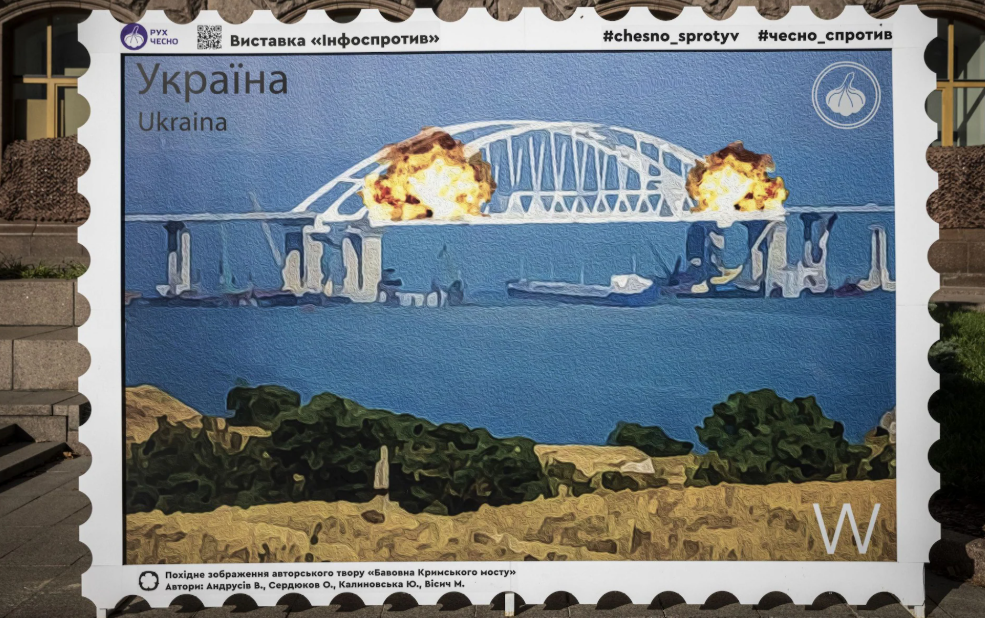
Notably, nearly a month after the attack, Ukraine’s state postal service issued a commemorative wartime stamp dedicated to the strike on the Kerch Bridge, underscoring the psychological significance of the attack for Ukraine.
Following the attack, Russia heightened security and introduced mandatory ID checks to enter the bridge. However, the next major attack on the bridge in 2023 surprised the Russian military establishment.
Ukraine used domestically developed “Sea Baby” unmanned surface vessels loaded with explosives to attack the bridge. Multiple drones were used in the attack, and at least two hit the bridge, damaging a section of it.
Ukraine again attacked the Kerch bridge in June 2025. This time Ukraine targeted the underwater supports of the Crimean bridge. SBU claimed that it mined the underwater piers of the bridge with over 1,100 kg of TNT in a multi-month-long special operation.
Following the attack, the SBU released a statement: “God loves the Trinity (Ukrainian saying used when something occurs for the third time, – Ed.), and the SBU always finishes what it starts and never repeats itself. We struck the Crimean bridge twice before, in 2022 and 2023. Today, we continued that tradition – this time from underwater.”
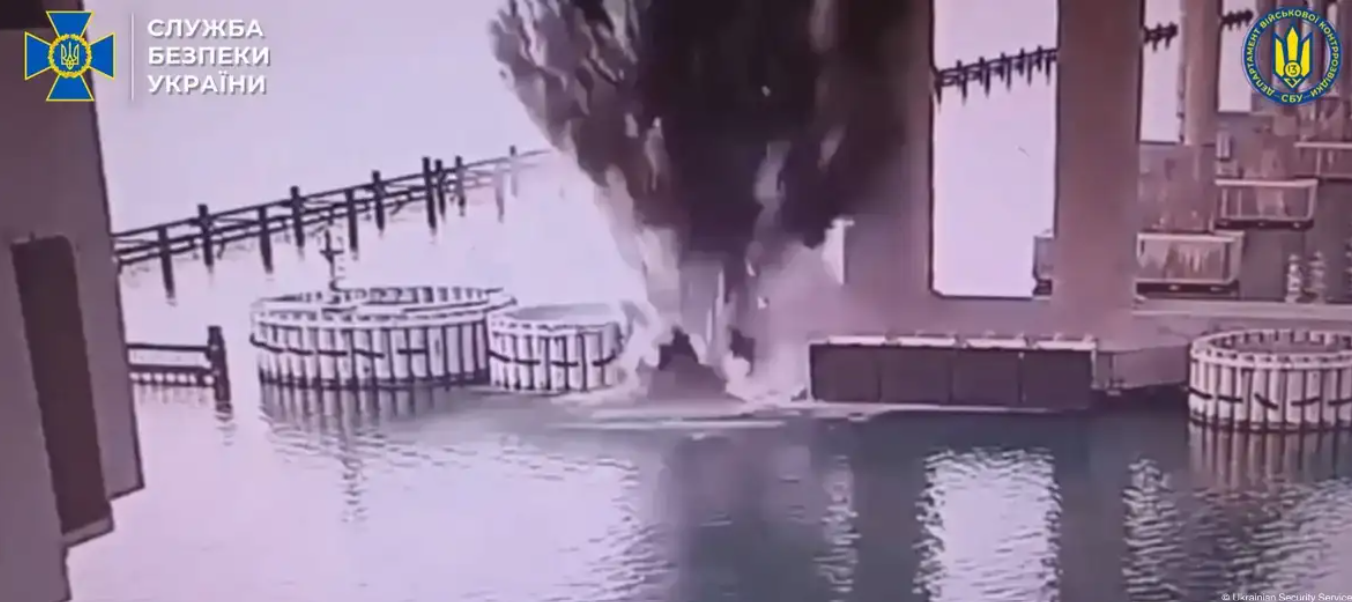
In the latest attack (November 16-17), Ukraine has targeted the bridge from the air, using domestically manufactured missiles and drones.
“Today, at the key stage, the ‘Palianytsia’ drones performed exceptionally well, striking the road section of the bridge, while ‘Neptune’ missiles, ‘Ruta’ drones, and FP-5 drones struck the railway section,” Zelensky said in a statement posted on X.
This is not only the fourth successful strike on the bridge, but coming just days ahead of a high-stakes diplomatic summit between Russia, China, and the US, Kyiv has sent a blunt message: it cannot be sidelined from the negotiating table.
Notably, Ukraine targeted the bridge despite Russia’s unprecedented security measures around it, including dense air defense coverage with S-400, S-300, Buk, Tor, and Pantsir battery deployments on elevated towers near the structure.
Russia’s layered defenses also include maritime protections, including lines of barges, boom barriers, floating obstacles, nets, concrete piles, and other anti-USV measures, as well as naval patrols.
Ukraine’s repeated strikes on the bridge highlight the impossibility of fully safeguarding a long, exposed bridge in the era of dense drone warfare. However, these strikes also raise the question of why both Ukraine and Russia have made this bridge a prestige issue.
The Significance Of The Kerch Bridge
When Russia annexed Crimea in 2014, there was no direct physical land connection or bridge linking Russia to Crimea.
The peninsula was nevertheless crucial to Moscow’s strategy to dominate Ukraine and the Black Sea region. Therefore, a bridge across the Kerch Strait connecting Crimea to the Russian mainland became crucial.
Putin announced his plans to build the bridge soon after a controversial referendum unified Crimea with Russia.
The bridge cost nearly US$4 billion to build, and in 2018, Putin inaugurated it, famously driving a Kamaz truck across it in a high-profile ceremony.
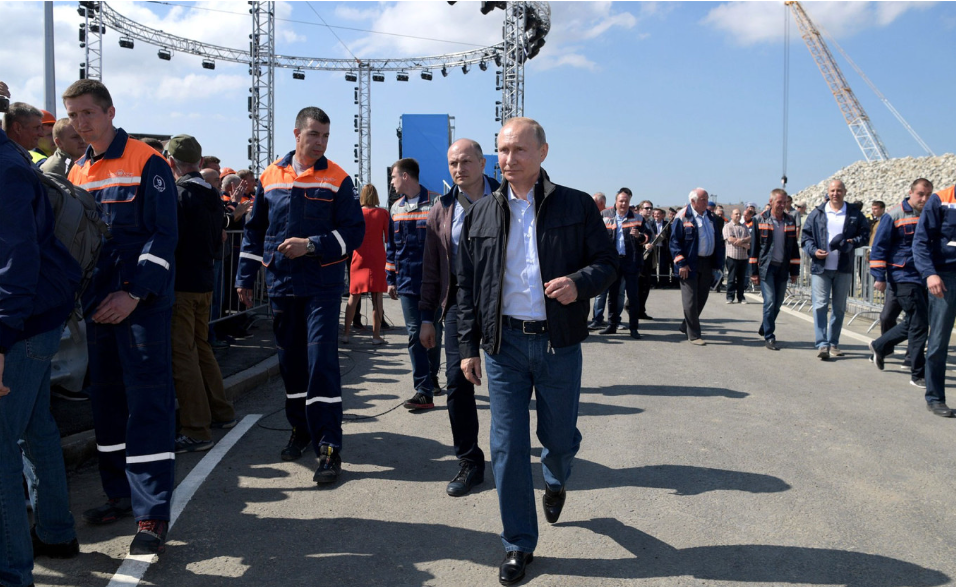
Footage of Putin driving the truck, with a Russian flag by his side, was beamed across Russian television screens as a sign of imperial victory.
The bridge opened for railway traffic in 2019.
Notably, at 12 miles, it is Europe’s longest bridge and a proud symbol of Russian engineering.
It also physically embodies Russia’s reunification with the Crimean Peninsula, the umbilical cord connecting the Russian mainland to Crimea and its historic port city of Sevastopol, founded in 1783 by Empress Catherine the Great.
For Ukraine, however, the bridge is the symbol of Russia’s illegal occupation of the Crimean Peninsula.
The bridge also has significant military and economic value.
The Kerch Bridge is a major supply line for Russian military personnel and weapons, as well as a route into Crimea, which then allows access to southern Ukraine.
The bridge facilitates the rapid movement of troops and equipment, strengthens Russia’s position in the Black Sea region, and provides a strategic foothold for projecting power into Eastern Europe.
Economically, the bridge plays a crucial role in integrating Crimea into Russia’s economy by enabling the rapid movement of goods, services, oil, and tourists between the peninsula and the mainland.
For instance, in 2018, 6.8 million tourists came to Crimea, or 28% more than in 2017 (5.4 million), of whom half came via the Crimean Bridge.
The bridge could boost Crimea’s economic development.
For Russians, the bridge also symbolizes the ineffectiveness of Western sanctions, as Moscow finished Europe’s longest bridge in record time, despite thousands of sanctions.
It symbolizes a resurgent Russia unafraid to fight the West to reclaim historic Russian lands.
Ukraine’s successful strikes on the bridge and Moscow’s inability to protect it, therefore, symbolize the vulnerability of Putin’s imperial project and Russia’s greatness.
The strikes deliver a powerful message: the Kerch Bridge is vulnerable, and so is Russia’s control of Crimea.
- Sumit Ahlawat has over a decade of experience in news media. He has worked with Press Trust of India, Times Now, Zee News, Economic Times, and Microsoft News. He holds a Master’s Degree in International Media and Modern History from the University of Sheffield, UK.
- He can be reached at ahlawat.sumit85 (at) gmail.com