Pakistan has experienced a massive resurgence in terrorism, ranking first on the Global Terrorism Index (GTI) 2026 as the country most affected by terrorism.
One such attack occurred this week when three Pakistan Coast Guard (PCG) personnel were killed in a first-ever attack on a patrol boat in the Arabian Sea, as recently reported by Reuters. The attack occurred during a routine patrol near Jiwani in the southwestern Balochistan province, located about 84 kilometers from the China-funded Gwadar port.
According to intelligence and law enforcement agencies, all three personnel aboard the patrol boat perished in the attack.
The Balochistan Liberation Army (BLA), the outlawed outfit based in insurgency-hit Balochistan province that borders Iran, claimed responsibility for the attack.
This is the first of its kind attack by the insurgent group, particularly as the BLA has historically concentrated on land-based attacks against foreign workers in Balochistan, particularly Chinese targets, infrastructure projects, and Pakistani security personnel.
Notably, there has been a sharp rise in Baloch militia attacks on Pakistan in recent times, such as the daredevil hijack of the Jaffar Express in March 2025.
However, a bigger irritant for Islamabad, which essentially keeps the entire country on edge, is the Tehrik-i-Taliban Pakistan (TTP) that has seen a resurgence since the Taliban takeover of Afghanistan. For example, between September and October 2025, at least 19 Pakistani soldiers died fighting TTP attackers in the Khyber Pakhtunkhwa province, which lies on the border with Afghanistan.
According to the Islamabad-based think-tank, the Center for Research and Security Studies, 2025 was the most violent year in a decade for terrorism in the country.
Earlier this year, Pakistan announced an “open war” with the Afghan Taliban on the pretext that it harbors the TTP. In fact, Islamabad has conducted multiple air strikes on Afghanistan, targeting military installations and what it refers to as terrorist support infrastructure, and killing scores of civilians.
According to Pakistan, it is taking on TTP and its alleged patrons head-on to ensure that the “hard-earned successes” achieved in the battle against terrorism are not squandered. However, the horrors of the past—many of them inflicted by the TTP—persist.
When TTP Attacked Pakistan’s Mehran Station
PNS Mehran, commissioned in 1975, served as the primary hub of Pakistan’s naval aviation. The base was critical for maritime surveillance and counter-terrorism and housed hangars for multimillion-dollar aircraft, training facilities, and support for multinational operations, including the Combined Task Force.
On 22 May 2011, about 4-20 men (exact figures remain disputed) launched a massive terror attack at PNS Mehran to avenge the killing of Osama Bin Laden in the country. According to publicly available information, the men attacked the Mehran base shortly before midnight, catching the personnel off guard.
These militants, armed with rocket-propelled grenades (RPGs), automatic weapons, and explosives, were dressed in naval uniforms, were allegedly aware of the base’s security protocols, and behaved like real soldiers, some sources reported.
After the attack came to light, the then Interior Minister of Pakistan, Rehman Malik, said that the attackers had managed to cut through barbed wire on the perimeter fence and entered through a vacant patch of land that ran parallel to the rear of the base.
They avoided CCTV coverage by staying close to the wall and using mapped blind spots.
Upon securing entry into the facility, the attackers targeted three aircraft hangars and the tarmac, firing RPGs at parked planes and setting fires to everything of value in sight. According to reports from the time, two US-supplied P-3C Orion maritime surveillance aircraft were destroyed, and a third was reportedly damaged, along with minor damage to a helicopter and a jet fuel tanker that exploded during the attack.

The militants opened indiscriminate firing at Pakistani personnel stationed at the base, focusing on aircrew and unarmed officers.
While explosions and gunfire erupted throughout the city, television footage showed flames and heavy smoke rising from the base as aircraft caught fire.
The Pakistan Navy’s Special Service Group (SSG-N) launched a full-scale counter-operation approximately 6 hours after the initial assault began. Elite commandos, using night-vision equipment, moved in to clear the base, rescue personnel, and neutralize the attackers. The Commandos were reportedly instructed to prioritize foreign nationals on the base, including 11 Chinese technicians and 6 US advisers, for evacuation.
The attackers reportedly took positions on the roof of a two-story building and fired from there. “A building in the premises is still under their occupation from where they are exchanging fire with our soldiers,” Malik told reporters as the counter-operation got underway. “It is not just an attack on the Navy establishment, it is an attack on Pakistan.”
Heavy fighting ensued, with commandos storming buildings and the roof positions. In fact, multiple explosions were heard during the counter-operation as forces used grenades and engaged militants holed up in hangars and structures.
The Pakistani Taliban eventually claimed responsibility for the attack. “It was the martyrdom of Osama bin Laden. It was the proof that we are still united and powerful,” TTP spokesperson Ehsanullah Ehsan told Reuters through a phone call.
Further, he added that the militants had enough supplies to endure a three-day siege. “They have enough ammunition and food, and they can fight and survive for three days.”
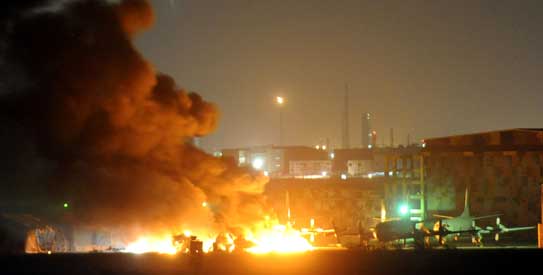
The fighting persisted throughout the night.
The attack ended after 18 hours of fighting and resulted in about twelve fatalities, including 11 naval personnel and a paramilitary ranger. All militants were reportedly eliminated, though the exact number cannot be verified.
It must be noted that the attack came as a major embarrassment to the Pakistani security establishment, particularly since it came just weeks after the American SEALs entered Pakistani airspace and assassinated Osama Bin Laden.
After the attack, it was revealed that Naval Intelligence had alerted the Navy of potential TTP attacks on naval facilities in Karachi. In fact, in the run-up to the PNS Mehran attack, the Pakistani Navy had already faced two attacks that killed around 12 people.
Before this, a small number of extremists had stormed the army’s General Headquarters in Rawalpindi in October 2009, taking several people hostage at the base. After a day-long siege, three hostages, eleven soldiers, and nine gunmen had perished.
However, for the Pakistani military, which had already been unable to explain how the al Qaeda commander had been hiding in the nation for years or how the Americans could launch the operation deep within their territory without their knowledge, the PNS Mehran attack came as the ultimate humiliation.
In the aftermath of the attack, several Pakistani Navy officers faced trials and court martials, as reported by Reuters at the time.
- Contact the author at sakshi.tiwari13 (at) outlook.com
- Follow EurAsian Times on Google News