
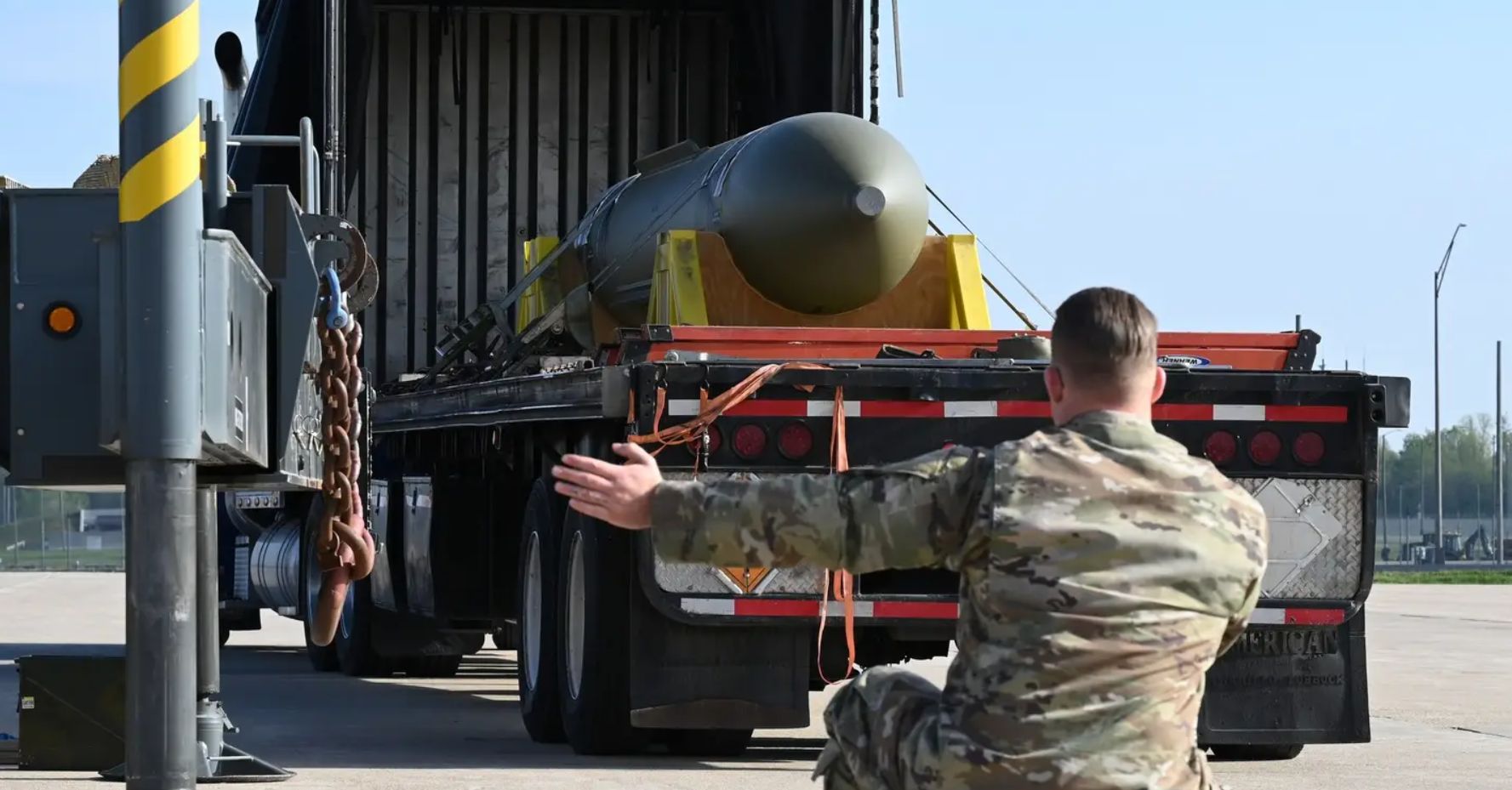
The successor to the GBU-57 Massive Ordnance Penetrator (MOP) — the bunker-buster famously used in devastating strikes on Iran’s nuclear facilities in June 2025 — has been officially designated the GBU-76/B, the US Air Force has confirmed.
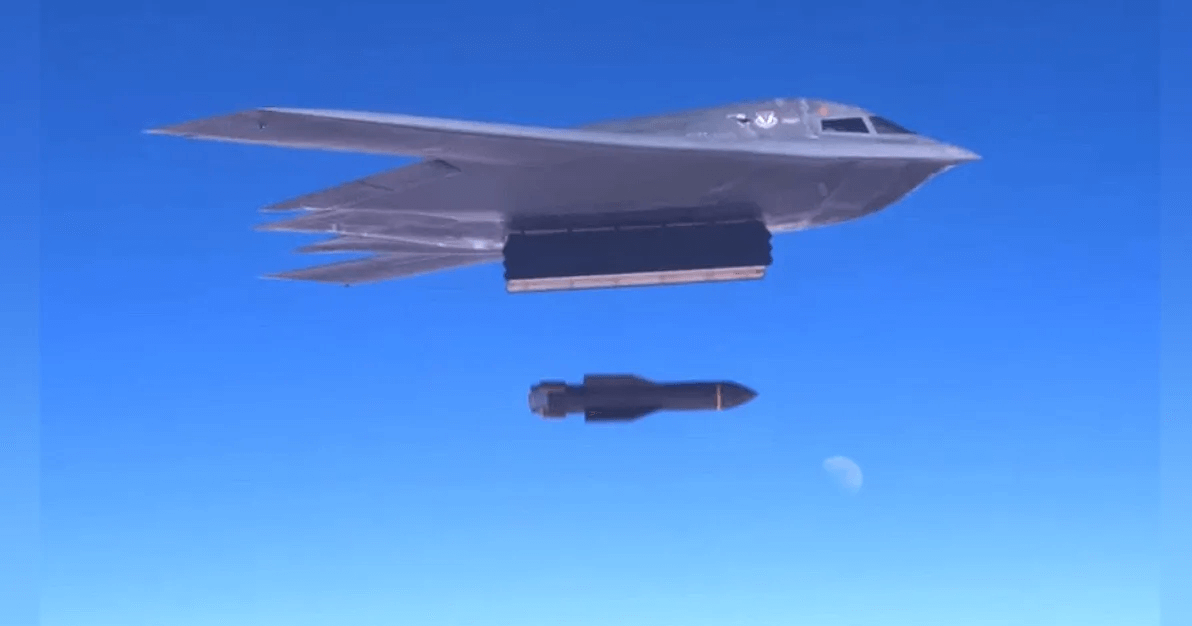
The US Air Force (USAF) deployed seven B-2 bombers and dropped 14 GBU-57 Massive Ordnance Penetrator (MOP) bunker buster bombs on two Iranian nuclear sites, as part of Operation Midnight Hammer in June 2025.
This marked the first time the bomb was used since it went live in service in 2010.
Even though the MOP has been used only once so far, the US military has already been working on its successor, the Next Generation Penetrator (NGP).
While most information about the NGP remains classified, we know it is envisioned as a more advanced version of the GBU-57 MOP. Experts surmise it can be equipped with an attached rocket booster for stand-off strike capabilities and deliver precision strikes within a Circular Error Probable (CEP) of 2.2 meters, even in GPS-aided, degraded, and denied environments, as previously explained by the EurAsian Times.
NGP has been officially named the GBU-76/B, as disclosed in a contracting notice published on June 1, 2026. “The Air Force Life Cycle Management Center, Armament Directorate, Attack Division (AFLCMC/EBD) is conducting market research for an industry analysis of capabilities,” the contracting notice stated. “AFLCMC/EBD is seeking to award a Multiple Award Indefinite Delivery Indefinite Quantity (IDIQ) contract to support all aspects of research & development, production, testing, and delivery of the Next Generation Penetrator (NGP), GBU-76/B weapon system,” it added.
This is the first time the NGP has been named in an official notice.
The notice states that “All interested vendors shall submit a response demonstrating their capability to support the design, production, testing, and bed down of components and specific activities related to the development, performance, and sustainment of the GBU-76/B weapon system.”
The USAF is requesting that interested vendors provide a response outlining how they would support the design, production, testing, and beddown of components and activities. This could involve a variety of responsibilities, including engineering, modelling, simulation and analysis, production, hardware acquisition, software, and aircraft integration, etc.
However, the notice emphasizes that information is only being collected for “planning purposes” at this point, suggesting that the program is in a very nascent stage.
Although it is unclear when the NGP was officially designated the GBU-76, the latest notice represents the most recent update to the program, following the USAF’s September 2025 award to Applied Research Associates and its partner, Boeing, to build a prototype.
The notice states that vendors must clearly demonstrate in their responses that they can build large penetrator warhead systems weighing approximately 20,000 to 30,000 pounds. Additionally, they must show that they have carried out such tasks for the government for at least five years, and that they have the facilities, personnel, equipment, and other resources necessary to complete the task.
The deadline for responses has been set to June 16.
The notice further said that foreign-owned or controlled companies will not be eligible for the Next-Generation Penetrator program. Meanwhile, small firms can submit a response demonstrating how they could fulfill part of the requirement, even if they are unable to meet the full program requirement.
The development comes after the USAF expended a significant portion of the GBU-57 available in its inventory during Operation Midnight Hammer. Although the exact number of these bunker bombs in the US Air Force’s inventory is classified, several sources state that the service had at least 20 GBU-57s in service as of the end of 2015. These numbers may have swollen as production has continued, but there was little indication of additional procurement in the years leading up to June 2025.
The US military is also restocking its GBU-57 MOP. Some USAF documents published earlier this year revealed that the service is finalizing a $100 million deal with Boeing to supplement its arsenal of GBU-57 MOPs.
While there’s little we can decisively say about the futuristic GBU-57 successor, we know that it is meant to address the evolving threats from deeply buried, hardened underground facilities, such as command bunkers, nuclear sites, and missile silos operated by adversaries like Iran, China, Russia, and North Korea. In fact, it most likely builds on lessons from the MOP’s first combat use in Operation Midnight Hammer.
MOP Successor in The Works
The GBU-57 MOP was created in the early 2000s by Boeing and the Defense Threat Reduction Agency (DTRA) to destroy Hard and Deeply Buried Targets (HDBTs), such as command centers, subterranean laboratories, and chemical, biological, and nuclear facilities, in countries such as Iran.
A USAF data sheet described the Massive Ordnance Penetrator bomb as “a weapon system designed to accomplish a difficult, complicated mission of reaching and destroying our adversaries’ weapons of mass destruction located in well-protected facilities.”
The MOP—considered the most powerful non-nuclear weapon in the US arsenal—is more than 20 feet long, weighs 30,000 pounds (about 13,600 kilograms), and contains a 5,740-pound (almost 2,600-kilogram) payload. It has a maximum penetration depth of 200 feet in reinforced concrete and 60 feet in unreinforced concrete. Additionally, the kinetic hit from this monster bomb delivers 800-900 megajoules of kinetic energy.
For high-accuracy targeting, the GBU-57 MOP uses a dual-mode guidance system that combines an Inertial Navigation System (INS) with GPS (Global Positioning System). However, more sophisticated iterations employ an adaptive fuze system that can identify structural voids as it penetrates.
The GBU-57 uses the BLU-127 family of warheads. Depending on the type, the warhead contains between 2,082 and 2,600 kilograms (4,590 and 5,732 pounds) of high explosive out of its total mass of 13,600 kilograms (30,000 pounds). Only about 20% of the bomb’s overall weight is made up of the warhead.
Interestingly, the United States started working on the next-generation bunker buster bombs almost as soon as the GBU-57 MOP began entering service in the early 2010s.
The public details about the GBU-76 remain limited due to the program’s early stage and classification. However, the USAF published requirements for the NGP in a contracting notice in February 2024, providing some insights into the scope of the futuristic weapon.
The notice said that the NGP design should integrate lessons learned from the development of previous penetrator warhead programs.
“The prototype penetrator warhead design effort should allow integration of technologies acquired and lessons learned under previous penetrator warhead developments to meet performance requirements for the HDBT target set,” it noted.
The notice said that the NGP application should function with a terminal accuracy of CE90 w/in 2.2m in “GPS-aided, degraded, and/or denied environments.”
This is an extremely high degree of precision needed, particularly for employment in GPS-degraded or denied locations.
The 2024 notice called for a warhead weighing 22,000 pounds or less, that would be “capable of blast/ frag (mentation)/ and penetration effects.”
However, the latest notice mentions Large Penetrator Warhead Systems weighing approximately 20,000 to 30,000 pounds.
The 2024 notice emphasized that the NGP should allow for the “possible integration of embedded fuze technology.”
Notably, bunker-buster bombs are intended for use against targets that are subterranean or for which precise location and configuration are difficult to determine. Therefore, sophisticated fuzes that sense the “voids” in underground mission spaces and/or “count” floors to calculate depth help maximize the damage from weapons like MOP or NGP.
It is believed that the NGP can incorporate rocket boosters to enable standoff strikes, unlike the GBU-57 MOP. In previous conversations about MOP replacements, the Air Force has raised the idea of a powered design that offers greater reach.
The new-age GBU-76/B bunker-buster bomb will be compatible with the B-21 Raider, the US’s next-generation stealth bomber planned to replace the B-2 Spirit.
Currently, only the B-2 is certified to use MOPs in an operational capacity, and each bomber can carry only 2 MOPs at a time. For potential future integration aboard the B-21 Raider, the USAF might consider making the GBU-76/B more compact than MOP, so that the Raider could at least carry two of these bombs at once.
The program is currently in a very early stage, so the requirements may evolve. However, it could be argued that the latest US war with Iran has provided a fresh impetus to the NGP, particularly as Washington has realized that it is not an easy task to take out Iran’s fortified military assets.
- Contact the author at sakshi.tiwari13 (at) outlook.com
- Follow EurAsian Times on Google News