Though it is highly unlikely that the United Kingdom will regain its 19th-century superpower status, when “the Sun never set in the British Empire”, there is now a strong school of thought shared among the strategic elites of 10 Nordic and Baltic countries of Europe that London must lead in defending Europe against any Russian misadventure, leveraging its nuclear capabilities, a permanent UN Security Council seat, intelligence networks, and leading global hub in Artificial Intelligence.
And it is being argued as “Plan B” to replace NATO, given rising doubts over the Trump-led United States’ support to NATO in general and its foundational collective defense clause, Article 5, in particular, which says that an armed attack against one member is considered an attack against all and all allies will take necessary action, including the use of armed force, to assist the attacked member.

Though for quite some time European policymakers have quietly debated over a plan if NATO becomes unreliable, especially if the U.S. reduces its commitment, the debate has become louder with the Russian invasion of Ukraine.
“Plan B” was mooted with some clarity when, in 2025, Matti Pesu and Tomas Wallenius of the Finnish Institute of International Affairs (FIIA) co-authored a paper arguing for it. But their idea has received a firm push from the leading and highly influential British weekly, The Economist, in its latest issue.
Pesu and Wallenius sum up “Plan B” as ‘Nordic Plus’. The two Finnish scholars argue that to counter the Russian threats, Finland “will likely turn to Sweden, Norway, the United Kingdom, and, potentially, France. Logistically, the Scandinavian countries play a crucial role in supplying Finland in the event of war, and Finland has been advocating for major improvements in Nordic connectivity and infrastructure. Moreover, these countries can potentially provide considerable military capabilities”.
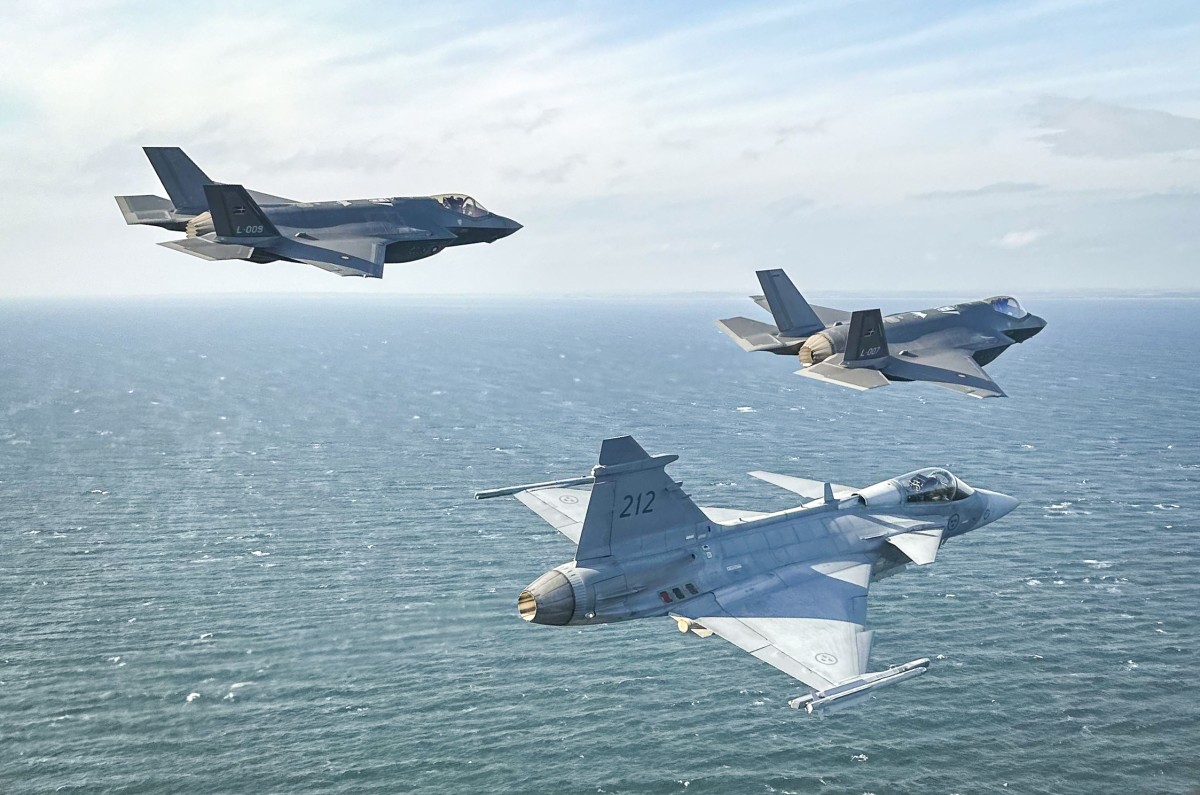
Explaining that, together, these countries have an air force of 200 modern fighter jets and expecting more financial resources for the military from the “affluent nations of Norway and Sweden”, Pesu and Wallenius then view the United Kingdom as “a serious security provider with a genuine interest in Northern European security”.
For them, London could “potentially offer a wide spectrum of military support on land, at sea and in the air, also providing special capabilities such as intelligence, reconnaissance and surveillance”.
Finally, they bring France, an additional European heavyweight, into the picture. “France could also contribute to Finland’s deterrence, particularly through its nuclear weapons. It is not inconceivable that Finnish skies could soon host training missions by nuclear-capable French fighter jets if Paris is truly prepared to introduce a European dimension to its nuclear deterrence”, they argue.
On the other hand, for the Economist, Plan B requires more than acquiring weapons; “it means creating a structure under which Europeans would fight”.
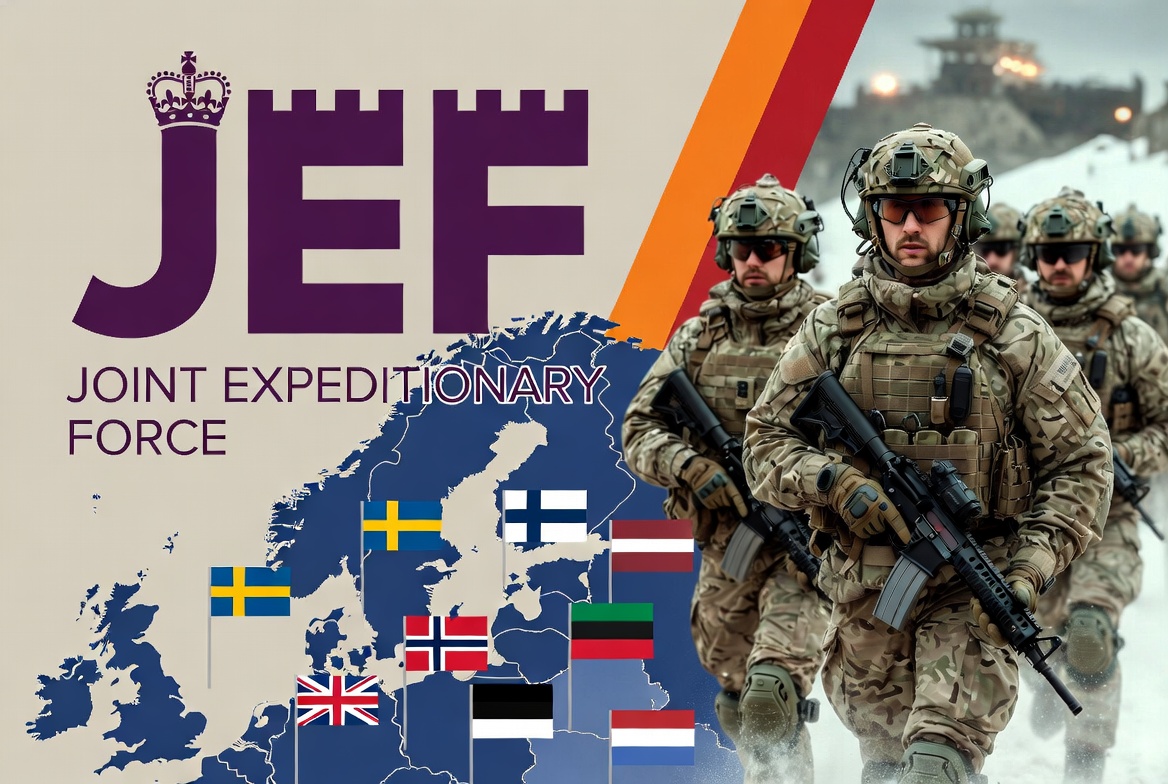
And in this context, it argues that since the core of the countries that will fight happens to be in Northern Europe – a coalition of Baltic and Nordic countries – the command structure should be the British-led coalition known as the Joint Expeditionary Force (JEF), with a headquarters near London.
It may be noted that the British-led Joint Expeditionary Force (JEF) is a rapid-reaction military coalition of the United Kingdom, Denmark, Estonia, Finland, Iceland, Latvia, Lithuania, the Netherlands, Sweden, and Norway. It was established in 2014 as a complement to the larger body, which could provide high-readiness forces on short notice for circumstances that did not meet NATO’s Article 5 threshold.
Interestingly, Sweden and Finland joined the coalition in 2017, years before they applied for NATO membership.
NATO’s Article 5 operates on a consensus or unanimity basis among its 32 members, meaning that any one member can block any NATO response to an attack on its members. But the JEF can react to situations on a non-consensus basis. It is said to have been activated several times on this basis for exercises and naval patrols. The idea here is to respond instantly to crises in the High North, the North Atlantic, and the Baltic Sea.
The core characteristics of the JEF are that it does not maintain a permanent standing army. Instead, participant nations draw from pre-identified, high-readiness units only when an activation or joint exercise is required. And operations are voluntary, with participating countries deciding whether to contribute and what specific capabilities to deploy based on the exact crisis at hand.
The JEF says that it is complementary to NATO and that its unique design allows it to deploy swiftly to safeguard critical infrastructure (such as undersea cables and pipelines in the Baltic) without needing the consensus of the entire NATO alliance.

The UK maintains the JEF’s operational headquarters and command at the Standing Joint Force Headquarters (SJFHQ) in Northwood, London. The headquarters is said to have already its own secure communications networks that, although limited, do not rely on NATO. And it has capabilities in intelligence, planning, and logistics, backed by a degree of the UK’s nuclear deterrence.
Considering all this, the Economist argues that “ the JEF seems the best solution if European members are unable to take over the existing NATO framework. But Europe will find some form of defense framework to replace the Americans. A deterrent based on someone who may not show up is no deterrent at all”.
However, any Plan B based on the JEF or the British leadership is not devoid of some inbuilt constraints.
First, JEF’s strategic impact is restricted by its lack of a permanent standing force. Its reliance on voluntary national participation may not meet the needs of the hour. An operation led by the UK cannot launch if the bulk of its participant nations (especially the Nordics and the Netherlands) do not politically support the deployment or the operational objective.
Secondly, as the JEF is strictly optimized for Northern Europe, the Baltic Sea, and the Arctic, skeptics say that it is not designed or equipped to project power or manage crises globally or in southern European theaters.
Thirdly, the JEF is said to be lacking the heavy armor, logistical depth, and troop “mass” required for sustained, high-intensity, state-on-state conventional warfare. After all, disparities in modernization across the ten member states could hinder unified operational performance. Above all, it lacks major powers such as France, Germany, and Poland.
Fourthly, there are serious questions about the British capacity to provide leadership, given its own shrinking defense budgets, which have left the country with fewer ships, submarines, and army units.
The EurAsian Times recently explained that, to defend itself if attacked, the island nation needs more than 3 percent of its GDP for defense, which is unlikely given the present economic conditions.
It is worth noting that last November, in a highly critical assessment, the Defense Committee of the British Parliament said that the UK was “nowhere near” where it needed to be to defend itself and its allies, especially at a time when security threats to Europe were “significant”.
The committee had said, “The UK’s defense industrial base is not yet configured for sustained collective defense. It faces challenges in capacity, skills, innovation, procurement, and financing….. The Government must ensure that defense finance is accessible, predictable, and resilient—including for SMEs and start-ups”.
Fifthly, there is the importance of the US-factor. Even Matti Pesu and Tomas Wallenius acknowledge that “the continent, lacking corporate agency in defense matters, will face significant challenges in coordinating its security in the absence of American leadership, if history is any guide. In the 1920s, America decided to disengage from Europe’s problems. Britain and France stepped into the breach and sought to ensure European security. Unfortunately, Britain and France were economically and militarily too weak to effectively deter the ambitions of revisionist states”.
These economic limitations in the UK and France seem equally relevant today.
In fact, notwithstanding their popularizing Plan B concept, Pesu and Wallenius are afraid of the failure of the idea, and in that situation, and this is really noteworthy, they talk of Plan C. “If maintaining allied support for Finnish security becomes increasingly difficult, it is possible that Finland will explore the possibility of a Plan C based on rapprochement with Russia”.
Incidentally, Finland joined NATO on April 4, 2023. But within two years, Finnish strategic elites talked of Plan B, unsure of NATO’s ability to save their country from Russia. And, they are not averse to appeasing Russia under Plan C.
Does that mean Plan B will remain a nonstarter? Only time will tell.
- Author and veteran journalist Prakash Nanda is Chairman of the Editorial Board of the EurAsian Times and has been commenting on politics, foreign policy, and strategic affairs for nearly three decades. He is a former National Fellow of the Indian Council for Historical Research and a recipient of the Seoul Peace Prize Scholarship.
- CONTACT: prakash.nanda (at) hotmail.com