US President Donald Trump’s upcoming visit to Ankara for the NATO summit could provide a diplomatic opening for Turkey to secure dozens of advanced fighter jet engines, potentially easing a long-standing bottleneck in its air force modernization plans.
However, analysts say the trip is unlikely to resolve the deeper rift over Turkey’s exclusion from the F-35 program, which has significantly strained bilateral relations since 2019.
The July 7-8 summit, hosted by President Recep Tayyip Erdogan, will bring together leaders from the military alliance’s 32 member states.
Last month, Trump promised to make Erdogan “very happy” when asked about Turkey’s efforts to secure F-110 jet engines and its readmission to the F-35 fighter jet program.
Analysts said it would likely mean freeing up fighter jet engines Turkey wants to use in its flagship KAAN stealth fighter project.
“It’s likely to be the green light for the F110 GE engines for the KAAN fighter plane, about 40 of them. There had been obstacles to that supply, and very possibly those are now being removed,” Sinan Ulgen, director of the Istanbul-based Edam think tank, told AFP.
“Turkey has produced a couple of prototypes which are flying with the F110 engine, but it has been waiting for the supply of additional engines to increase the number of KAAN platforms,” he said.
KAAN is a twin-engine stealth fighter being developed by Turkish Aerospace Industries (TAI) to replace the Turkish Air Force’s fleet of F-16s as Ankara seeks to join the exclusive club of nations producing fifth-generation combat aircraft, notably the US, China and Russia.
Although Turkey will eventually fit the fighter with its own domestically produced engine — the F110S lacking stealth capability — that project is still in the preliminary design phase, Defense Minister Yasar Guler said in September.
Turkey received a first batch of 10 F110s in September, and talks with the US government to acquire 80 more were “ongoing”, he said.
But that’s been held up by a lack of political clearance linked to Turkey’s 2017 acquisition of a Russian S-400 missile defense system, Foreign Minister Hakan Fidan said in September.
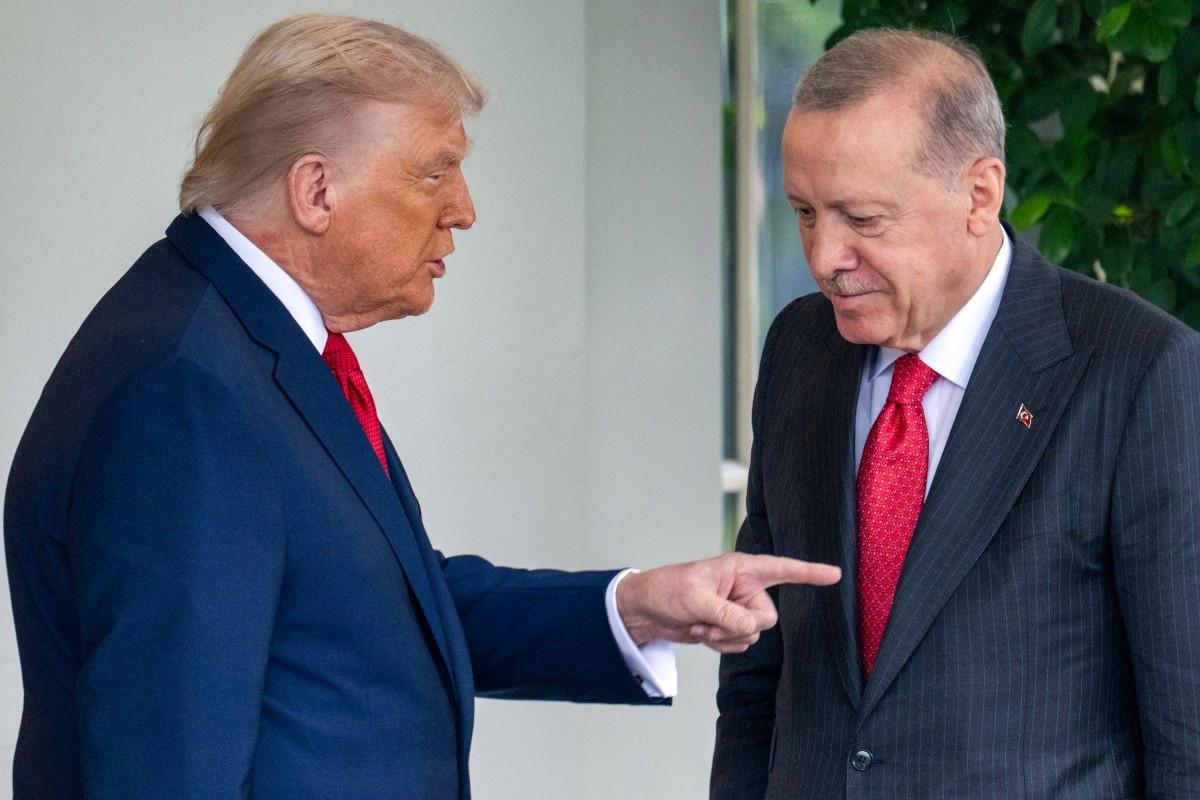
Infuriated, Washington expelled Turkey from its F-35 fighter jet program in 2019 and imposed CAATSA sanctions a year later, hampering Turkish defense projects and souring ties.
“The CAATSA issue must be resolved. The US needs to take steps both regarding the F-35 and the engines for KAAN. KAAN’s engines are currently awaiting approval in the US Congress,” Fidan said, his remarks raising eyebrows back home as Turkey had said the KAAN would be entirely domestically produced.
Ankara’s exclusion from the F-35 program has forced it to refocus on self-sufficiency.
“Some argue we should not buy F-35s and invest that money into our own fifth-generation fighter jet program. And that’s exactly what’s happening with President Trump’s decision to export jet engines,” Ozgur Unluhisarcikli, head of the German Marshall Fund in Ankara, said.
“Without those engines, Turkey cannot produce the KAAN jet.”
F-35 Deadlock
With a KAAN delivery date many years away, only Indonesia has placed an order, signing a $10bn contract to buy 48 fighters. The NATO summit could generate further interest, Ulgen said.
“Looking at the failure of the German-French FCAS initiative, there may be some interest. Spain could potentially become a partner and there may be interest from the Gulf as well… But there are more obstacles to be overcome for it to become a credible offer on the international stage,” he said.
Experts expected little progress on the lingering F-35 dispute: for Congress to lift the CAATSA sanctions, Ankara would have to get rid of the S-400 — but selling it to a third country would require Moscow’s approval, and returning it to the Russians was not on the cards.
“The US administration might wish to… put this issue behind it and sell Turkey some F-35, but that will go to Congress and changing the congressional decision won’t be easy,” said Professor Mustafa Aydin, an international relations expert at Istanbul’s Kadir Has University.
But Matthew Bryza, a retired US envoy and former senior White House and State Department official, said Trump could move to resolve the matter as the F-35 was an executive decision which he could easily reverse.
“President Trump can certainly declare that the S-400/F-35 dispute is finished. It’s the CAATSA sanctions that require congressional action. Whether he can persuade Congress to do that, depends on how much political capital he’s willing to expend,” he told AFP of a move that could be “politically costly in the lead up to the midterm elections” due to Turkey’s opponents in the Greek and Armenian diaspora.
By Agence France-Presse