Taiwan conducted a combat readiness exercise with M1A2 Abrams Main Battle Tanks (MBTs) acquired from the United States, even as US President Donald Trump sent a clear message to Taiwan that he would not support Taiwanese independence, sending shockwaves through Taipei.
The Republic of China (official name for Taiwan) Army conducted combat readiness drills in Hsinchu, using M1A2T tanks and armored vehicles in anti-airborne and anti-infiltration exercises amid ongoing military pressure from China. The troops simulated the defense of a nearby military airport in the event of a Chinese invasion.
China considers Taiwan a renegade Chinese province and has vowed to unite it with the Chinese mainland, with force if necessary. In contrast, Taiwan (a self-ruled democratic island state) swears by its independence and has been building military capability to thwart an invasion, if and when it occurs.
The exercise began with the 584th Armored Brigade, which hosts the Abrams, receiving orders to immediately mobilize to Hsinchu Air Base, which was supposedly seized by invading forces. The command was reportedly delivered by the Team Awareness Kit (TAK), a mobile application designed by the US military that enables users to exchange secure messages, text, photos, files, and video streams.
As soon as the 584th Armored Brigade received orders to mobilize and move to Hsinchu County as part of the anti-invasion drills, the Brigade Commander issued an operational directive and a mission briefing. He then led the convoy out of the base.
Taiwan’s newly delivered Abrams tanks rolled through Hsinchu County in pre-dawn combat readiness drills, testing urban maneuvering and coordination capabilities. pic.twitter.com/sTPegETI13
— TaiwanPlus News (@taiwanplusnews) May 20, 2026
The convoy crossed several bridges and traveled about 22 kilometers to the air base in the Nanliao district of Hsinchu County, which is home to a crucial RoC Air Force base and is considered a hub of the country’s semiconductor industry, making it vulnerable to a potential Chinese assault in the event of an invasion.
The head of the 584th Armored Brigade’s 3rd Combined Arms Battalion, Lt. Col. Huang Chen-yung, told reporters that the tanks had little effect on the civilian bridges they traversed in the Hsinchu area despite weighing 70 tons.
🇹🇼 M1A2T Abrams tanks (Taiwan's upgraded variant) conducting a night bridge-crossing operation to highlight rapid heavy armor deployment. pic.twitter.com/AYOF8QCdSb
— Taiwan Military (@TaiwanMilitary) May 20, 2026
Interestingly, these exercises were conducted after Lee Shying-jow, a former commander of the Republic of China (ROC) Army and head of the National Security Bureau, sparked controversy by claiming that 40% of Taiwan’s bridges could not support the weight of the M1A2Ts. He has since maintained suspicions that the tanks would not be able to traverse Taiwanese bridges safely without causing structural damage.
Each M1A2T exerts an average ground pressure of 1.1 kilograms per square centimeter when traveling on roadways, as its weight is uniformly distributed over seven load-bearing wheels, Huang told reporters. This is less than the approximately 9 kilograms exerted by large trucks frequently spotted in Taiwan.
🚨 Breaking: Taiwan's Army mobilized six M1A2T Abrams tanks across Hsinchu bridges early May 20, challenging former security chief's claim the 70-ton tanks would damage infrastructure.
★ https://t.co/nu16nKyVWM ★ pic.twitter.com/FHSSMC8mZG— TVBS World Taiwan (@tvbsworldtaiwan) May 20, 2026
Huang said that the exercise was planned with the expectation that the enemy would likely target the cutting-edge Abrams. Therefore, the convoy crossed bridges one tank at a time, in batches, to avoid an enemy hit that would disable the lead tank and obstruct those behind it. Moreover, Army personnel set up bridgehead outposts before tanks crossed the bridge to ensure safe passage.
Taiwan purchased 108 tanks from the US in a deal approved by Washington in 2019. The last shipment of M1A2T Abrams tanks was delivered on April 27, 2026, as EurAsian Times reported at the time. The training on May 20 was the second time the American-made tanks had practiced outside of their base since the Army’s 584th Armored Brigade commissioned its initial batch of 38 Abrams tanks in late October 2025.
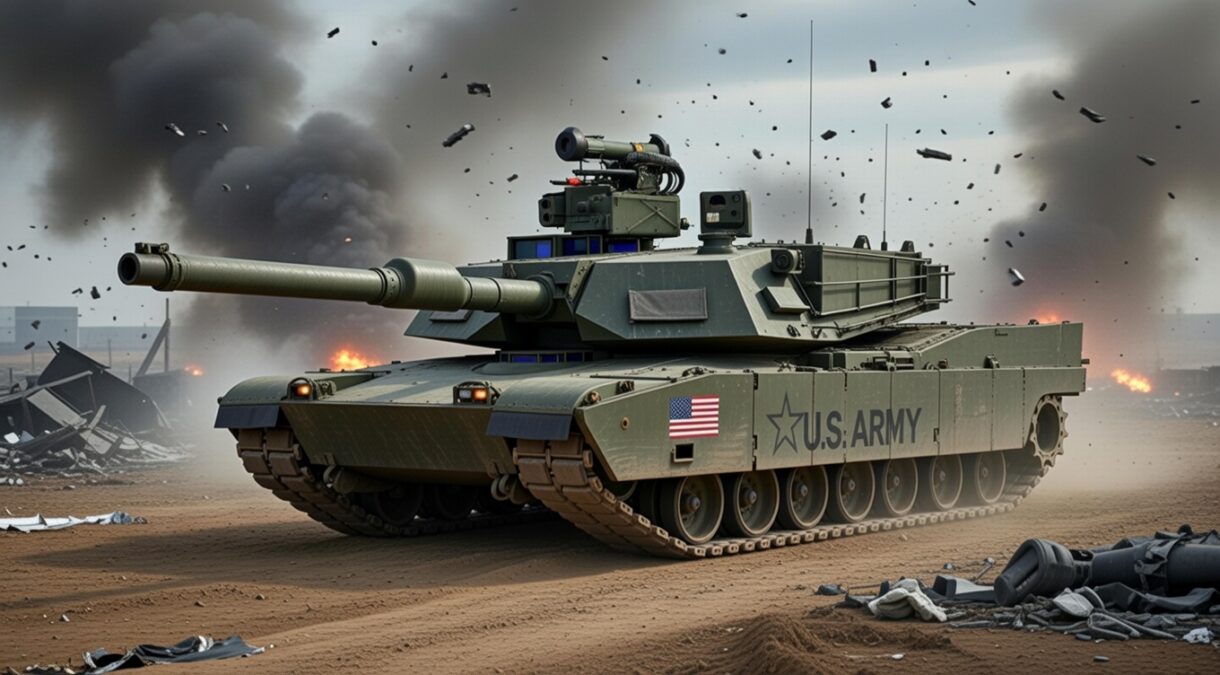
The M1A2T is a modified variant of the M1A2 Abrams, specifically designed for Taiwan, and represents a major technological advancement over the army’s current tank fleet. It provides Taiwan’s armed forces with a significant increase in accuracy, speed, and firepower with its 120mm main gun and sophisticated aiming systems.
The Abrams is twice as fast as Taiwan’s current tanks, which will shorten the time required to reinforce troops during operations.

To improve battlefield cooperation and survivability, the tanks are equipped with cutting-edge composite armor and a specially designed Taiwanese battle management system (BMS). This will improve their ability to counter modern anti-armor threats posed by the Chinese People’s Liberation Army (PLA), as previously explained by EurAsian Times.
The tanks could be used to ambush advancing PLA forces from high ground or along highways to prevent or delay the establishment of a beachhead, a critical stage in an invasion. The tanks would also support Taiwan’s multi-layered defense strategy that uses assault helicopters, artillery, HIMARS rocket launchers, and anti-ship missiles as a first line of defense against a PLA invasion. In fact, the tanks would also likely serve as a last line of defense, confronting any remaining PLA forces that reach Taiwan’s coast.
Interestingly, these latest drills come after the US President advised Taiwan against pursuing independence, after his high-stakes meeting with Chinese President Xi Jinping.
Trump Flips The Script On Taiwan
“I’m not looking to have somebody go independent. And, you know, we’re supposed to travel 9,500 miles to fight a war. I’m not looking for that. I want them to cool down. I want China to cool down,” he said at an interview with Fox News.
Although Washington maintains ambiguity on whether the US will come to Taiwan’s support against China, military pundits and policymakers have long believed that the US will likely go to war with China in the Indo-Pacific if Taiwan was invaded.
Trump’s latest statement, however, suggests he may be upending the long-standing support for Taiwan.
Despite establishing diplomatic relations with China in 1979, the US retained the right to sell arms to Taiwan under the Taiwan Relations Act of 1979. The act orders Washington “will make available to Taiwan such defense articles and defense services in such quantity as may be necessary to enable Taiwan to maintain a sufficient self-defense capability.”
The Trump administration approved its largest-ever arms package for Taiwan in December 2025, valued at a whopping $11 billion. Additionally, a second package worth some $14 billion has yet to be formally approved.
Needless to say, China has vociferously opposed the US arms sales, accusing the US of turning Taiwan into a “powder keg” nation.
In his latest remarks about Taiwan, Trump indicated the next arms package to Taiwan was being put on hold to use as a bargaining chip with China.
“I haven’t approved it yet. We’re going to see what happens,” Trump said, referring to the expected arms package. “I may do it, I may not do it. I’m holding that in abeyance, and it depends on China. It’s a very good negotiating chip for us, frankly. It’s a lot of weapons.”
Meanwhile, Taiwan’s Defense Minister Wellington Koo on May 19 said he was “cautiously optimistic” about the arms sales. “It is clear that the side repeatedly provoking, creating incidents, and undermining the peaceful and stable status quo in the Taiwan Strait is China, not our country,” Koo told the Parliament. ”Therefore, under these circumstances, we believe that maintaining this arms-sales channel is in line with U.S. interests,” he said.
- Contact the author at sakshi.tiwari13 (at) outlook.com
- Follow EurAsian Times on Google News