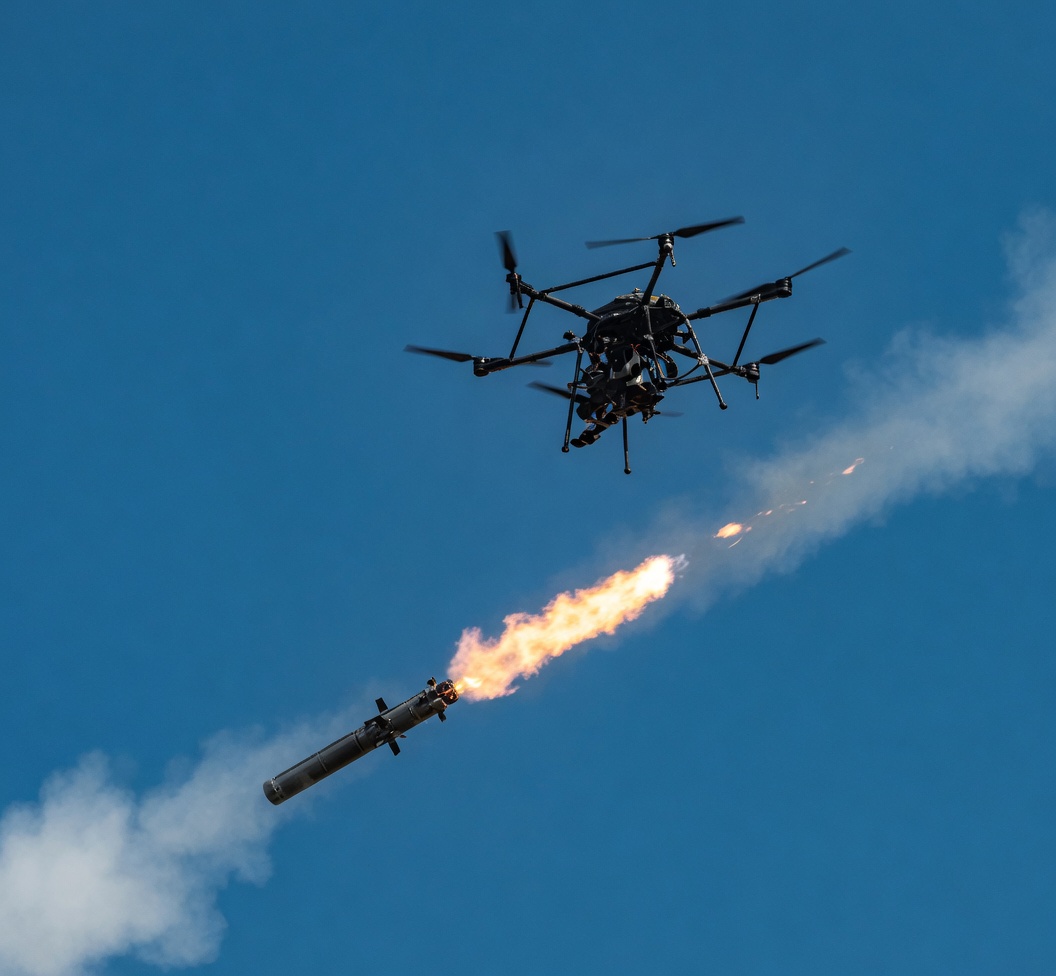
The Indian MoD on May 19 announced the completion of development trials of the Unmanned Aerial Vehicle Launched Precision Guided Missile-V3 (ULPGM-V3) in air-to-ground and air-to-air modes.
ULPGM is designed for UAV integration to destroy soft and hard targets, on the ground and in the air.
Conceptually, ULPGM is a loitering munition designed to engage adversary drones and helicopters attempting to attack Indian Army (IA) assets. As such, it is an area-defense counter-drone weapon system, unlike interceptor drones designed to protect platoon-level soldier deployments. Interceptor drones are relatively cheaper and can be widely deployed along the battlefront.
The PIB release announcing the completion of the flight trials states:
“Defence Research & Development Organisation (DRDO) has successfully completed the final deliverable-configuration development trials of Unmanned Aerial Vehicle Launched Precision Guided Missile (ULPGM)-V3 in air-to-ground and air-to-air modes at the DRDO test range near Kurnool, Andhra Pradesh. The trials were carried out using an integrated Ground Control System (GCS) to command and control the ULPGM weapon system. The GCS features state-of-the-art technologies to automate readiness and launch operations.”
ULPGM Capability
The PIB release does not reveal critical weapon-system specifications such as:
1. Range 2. Type of seeker 3. Warhead weight and type 4. Accuracy
However, past news reports have claimed that the missile features a 2-kg warhead and has a 1-meter circular error probability (CEP).
The ULPGM missile has been developed by the Research Center Imarat, Hyderabad, as the nodal lab, along with other DRDO laboratories, namely the Defense Research & Development Laboratory (DRDL), Hyderabad; the Terminal Ballistics Research Laboratory (TBRL), Chandigarh; and the High Energy Materials Research Laboratory (HEMRL), Pune.
The missile has been produced entirely within the Indian defense ecosystem, leveraging a mature domestic supply chain. As such, it is ready for “immediate serial mass production.”
Launch Platform
The launch platform used for the trials — a multicopter developed by Newspace Research and Technologies, Bengaluru — is unlikely to emerge as the final platform.
Multicopters use commercially available Commercial Off-The-Shelf (COTS) microcontrollers, propellers, batteries, and gyros. They are easy and relatively inexpensive to configure, but lack the speed, stealth, payload capacity, and range of drones with conventional winged airframes.
As such, it is possible that the IA will eventually deploy the ULPGM on a medium-sized drone with a conventional stealth-shaped airframe. Whether such a drone is already under development is not known.
Analysis
A long-endurance, area-defense loitering drone with both air-to-air and air-to-ground capability is not known to have been deployed thus far in the Ukraine war, despite the conflict having emerged as the seminal crucible for drone warfare.
The fact that the concept of an area-defense drone has not been battle-tested should be a reason for pause, not a claim of a conceptual breakthrough.
Let me elaborate. As the war in Ukraine has evolved, troop deployments along the line of contact have become increasingly thin. Reconnaissance drones now make the battlefield completely transparent. Troop concentrations and weapons deployments are immediately detected and attacked using fiber-optic cable-guided FPV drones. Each drone is like a precisely aimed artillery shell and costs as much, possibly less.
In the absence of troop concentrations and heavy weapons deployment along the front line, an area-defense-based counter-drone weapon system is irrelevant in emerging warfare.
Unwieldy, Vulnerable Architecture
The ULPGM relies heavily on the GCS for successful interception. This makes the weapon system unwieldy and vulnerable.
An interceptor drone with 2–3 hours of loitering capability would need to be medium-sized. A medium-sized multicopter drone would be easily detectable in flight and would be immediately engaged by ground-launched air-defense missile systems. A launch platform with a conventional airframe would be even more detectable, as it would require a launch catapult.
An adversary, using drone-based and ground-based electronic eavesdropping, could easily locate and attack a GCS. Indeed, counter-drone warfare is increasingly gravitating towards attacking and destroying drone control centers rather than the attacking drones themselves.
For a successful ULPGM engagement, the adversary target, the ULPGM launch platform, and the GCS would all have to be in close proximity — roughly within 10–15 km. As such, adversary attack drones could easily skirt the GCS deployment to strike deep into the interior.
Let us not forget an important lesson from the war in Ukraine: drone strikes are all about finding gaps in the adversary’s air-defense system.
There is another possibility. The adversary could also easily saturate the ULPGM deployment. It is important to understand that the low cost of drones means a peer adversary will always have a large number at its disposal.

Electronic Warfare
Under the ULPGM architecture, the GCS would control the launch platform, detect the target, and launch the missile. The architecture is heavily reliant on communication channels. How likely is it that these communication channels would not be jammed or interfered with through electronic warfare?
Also, the combined cost of the ULPGM, its launch platform, and the GCS would far exceed the target cost.
Manpower Intensive
The architecture would require deploying several trained personnel to launch and operate the ULPGM platform and detection sensors (RF, optical, and IR). The deployed personnel would have to be positioned in close proximity to the line of contact. GCS personnel and their equipment would be easily targeted by the adversary.
Conclusion
Drone warfare is gravitating towards the use of relatively inexpensive drones deployed in large numbers across the entire battlefield, for both attack and defense.
Counter-drone capability based on low-cost interceptor drones makes sense. Counter-drone capability based on high-cost, high-technology, manpower-intensive drones makes less sense.
The DRDO concept is a total departure from battlefield realities.
Drone warfare is trending toward AI-based autonomous operations, for both attack and interceptor drones. DRDO would better serve the nation by focusing on developing autonomous drone technology based on indigenously manufactured chipsets and sensors, rather than attempting to field unproven and technologically lagging capabilities based on COTS electronic components on drones manufactured by private-sector players like Adani Defence Systems & Technologies Limited, Hyderabad, whose credentials in defense technology are dubious.
It appears that the ULPGM architecture is designed to protect VAs and VPs in the interior, not on the battlefront. The system could well be intended to protect against attacks on political rallies, a role in which it would indeed be effective.
However, the thought leaves one depressed.
- Vijainder K Thakur is a retired IAF Jaguar pilot, author, software architect, entrepreneur, and military analyst.
- This is an Opinion Article. Views Personal of the Author
- Follow the author @vkthakur