While Taiwan has secured its last batch of M1A2 Abrams tanks, North Korea has displayed American M1A1 Abrams tanks, purportedly captured in Ukraine as war trophies at a newly inaugurated museum.
North Korea formally inaugurated the Memorial Museum of Foreign Military Operations on April 26, 2026, as reported by state-owned KCNA. The event, commemorating North Korean soldiers killed in the Ukraine conflict, was attended by North Korea’s Supreme Leader Kim Jong Un and Russian Defense Minister Andrei Belousov.
Notably, North Korea began deploying troops to fight alongside the Russian military in October 2024, as reported by the EurAsian Times at the time. Several waves of North Korean soldiers have since been sent to the frontline, with some estimates pegging the total number exceeding 20,000, though it cannot be independently confirmed.
The spirits of the soldiers will remain as a “symbol of the North Korean people’s heroism” and support “a victorious march by the Korean and Russian people,” the Supreme Leader said in a speech at the event. He also lauded the soldiers for thwarting what he called the Western “hegemonic plot and military adventurism” in the war.
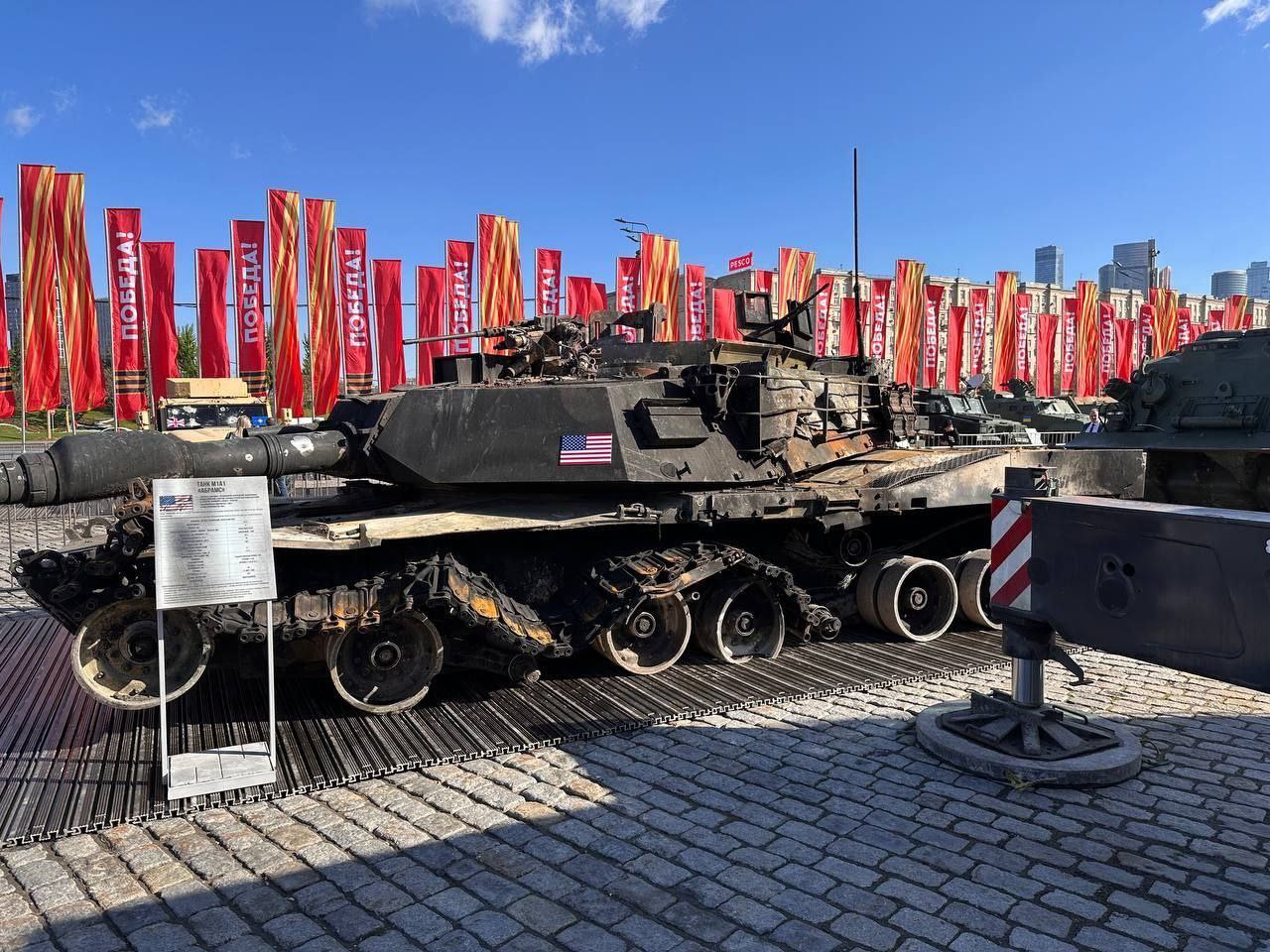
Perhaps the most notable thing about the inauguration was the display of Western-origin weapons allegedly captured from Ukrainian forces in the war at the museum, including the American Abrams, the German Leopard 2A4 tanks and Marder infantry fighting vehicles, and French AMX-10RC reconnaissance vehicles and VAB armored personnel carriers, etc.
Cameras ERUPT as Kim Jong Un inspects wrecked NATO armor IN Pyongyang alongside Russian Defense Minister pic.twitter.com/y2LFNVTDkv
— RT (@RT_com) April 26, 2026
It is currently not clear how the North Korean troops managed to seize and bring home the tanks that are reportedly on display.
Another North Korean museum, the Victorious Fatherland Liberation War Museum, exhibits tanks such as the M26 Pershing, M4 Sherman, and M24 Chaffee, all of which are exhibits from the Korean War. The centerpiece of this museum is the USS Pueblo, a US Navy intelligence ship captured by North Korea in 1968.

Fielded by Ukraine since February 2024, several Abrams tanks were seized by the Russian forces. In fact, Russia displayed these war machines in its own exhibitions to boost public morale and inspire confidence in the protracted war ordered by President Vladimir Putin.
North Korea’s display of Abrams tanks ties into broader military cooperation with Russia. The two countries signed a military treaty in 2024, which obligates both countries to provide military assistance “without delay” in the event of an attack on the other.
North Korea has since sent troops to aid Russia, alongside alleged shipments of missiles. In return, Moscow has been accused of bolstering North Korea’s fleet of intercontinental ballistic missiles, hypersonic weapons, military satellites, and other conventional weapons.
More recently, Russia and North Korea agreed to “long-term” military cooperation, as noted by the Russian defense ministry.
“We agreed with the DPRK Defense Ministry to place our military cooperation on a stable, long-term footing,” Moscow’s Defense Minister Andrey Belousov said, using the initials of North Korea’s official name. “We are ready to sign a plan this year for Russian–Korean military cooperation for the period of 2027–2031,” he added.
At the same time, though, the display of Western weapons—including the Abrams tanks—could potentially be aimed at reigniting its own pride against the United States, considered an enemy by Pyongyang. However, the timing would certainly be interesting as reports indicate that US President Donald Trump could meet with Kim Jong Un during his Asia trip.
Although the Abrams displayed by North Korea is an older M1A1 variant that is no longer considered suitable for modern combat, an upgraded variant of the tank—M1A2—is one of the most potent ground combat machines in the world, which neighboring Taiwan has received
Taiwan Comples Abrams Delivery
The Republic of China Army’s Armored Training Command in Hukou Township, Hsinchu County, received the last shipment of M1A2T Abrams tanks that Taiwan bought from the United States early on April 27, 2026, the Taiwanese media reported.
The reports noted that about 28 tanks, all wrapped in black waterproof tarps, were seen departing the dock on big civilian flatbed trailers.
The acquisition of M1A2 Abrams is part of a military modernization drive aimed at building capability amid fears of a Chinese invasion. The Taiwanese Army today has some 1,000 tanks, including the aging CM-11 Brave Tiger and M60A3 variants that have been in service for more than two decades.
The M1A2T is a customized version of the M1A2 Abrams tailored specifically for Taiwan, and it’s a technology leap from the army’s current tank fleet.
Equipped with a 120mm main gun and advanced aiming systems, the Abrams offers Taiwan’s armed forces a major upgrade in firepower, precision, and speed.
The Abrams is twice as fast as Taiwan’s current tanks, which will cut down the response time for reinforcing troops during operations. The tanks feature advanced composite armor and a custom-built Taiwanese battle management system (BMS) to enhance combat co-operation and survivability. This will enhance their ability to counter the modern anti-armor threats of the Chinese People’s Liberation Army (PLA) forces.
The tanks include other enhancements such as a turret-mounted Auxiliary Cooling and Power System (ACPS), Taiwan-integrated battle management systems, and the Inter-Vehicular Information System (IVIS) for networking.
At this point, it is unclear whether Taiwan’s M1A2T tanks will eventually be outfitted with the Trophy active protection system, which could mitigate certain threats. The Abrams will enhance Taiwan’s capability to engage targets successfully while remaining concealed, thanks to thermal management technology that reduces heat signatures and improves aiming.

The military of the island state has set aside NT$40.52 billion (US$1.28 billion) over eight years (2019–2027) to purchase 108 M1A2T tanks from the United States as part of these plans. The first batch of 38 US-origin M1A2 tanks from a 108-unit order reached the Port of Taipei in New Taipei’s Bali District in December 2024. The next order, comprising approximately 42 tanks, was delivered in July 2025.
The Army’s Sixth Corps will deploy the tanks to fortify northern Taiwan’s fortifications. However, the 28 tanks delivered recently will first undergo readiness training and evaluation.
Citing Chinese military experts, China’s state-owned Global Times earlier reported that the M1A2 tanks are too big and heavy for efficient use on Taiwan’s terrain, adding that they would be vulnerable to attacks from drones and attack helicopters. The M1A2, weighing more than 60 tons, is not suitable for Taiwan’s heavily water-covered island topography, which limits mobility and deployment, military analyst Wei Dongxu was quoted as saying.
Although its weight may hinder its ability to maneuver over the rough Taiwanese mountains that cover about two-thirds of the island and densely populated urban areas, the Abrams is generally accepted as the most sophisticated armor capability in the Taiwanese arsenal to date. In fact, the purchase has been strongly defended by Taiwan-based experts.
For instance, Paul Huang, a Research Fellow at the Taiwan Public Opinion Foundation (TPOF, said, “Despite many bad pundit takes, they are unsuitable/too big for Taiwan, M1 tanks are actually among the more sensible & survivable platforms for TW – if operated correctly.”
The M1A2T tanks are especially helpful for anti-landing operations along the 14 beaches that the PLA could use to launch an invasion, according to Taiwan’s defense analysts.
By strategically placing these tanks near vital landing areas, such as Linkou and Hukou in northern Taiwan, the Taiwanese Army could utilize their lethality and durability to counter Chinese amphibious attacks.
The tanks could be used to ambush advancing PLA forces from high ground or along highways to prevent or delay the establishment of a beachhead, a critical stage in an invasion. The tanks would also support Taiwan’s multi-layered defense strategy that uses assault helicopters, artillery, HIMARS rocket launchers, and anti-ship missiles as a first line of defense against a PLA invasion.
The tanks would also likely serve as a last line of defense, confronting any remaining PLA forces that reach Taiwan’s coast. The completion of delivery, therefore, signifies a major step in Taiwan’s defense preparedness in the face of a looming threat from China.
- Contact the author at sakshi.tiwari13 (at) outlook.com
- Follow EurAsian Times on Google News