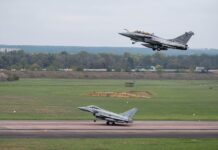
India’s indigenous Light Combat Aircraft (LCA) Tejas Mk1A took its maiden flight from HAL’s Nashik facility today (October 17).
These aircraft will replace Soviet-origin MiG-21 fighter jets, retired by the Indian Air Force (IAF) last month. The IAF is expected to receive its first Tejas Mk1A aircraft by the end of October.
Meanwhile, India is bolstering its air-combat capability with the addition of a longer-range, indigenous Astra Mk2 air-to-air missile, which will be outfitted on Tejas and Su-30 MKI jets, after successful trials.
Citing informed sources, ANI News reported that the Defence Research and Development Organisation (DRDO) is poised to extend the range of the Astra Mark-2 (Mk2) air-to-air missile to over 200 kilometres. The IAF could acquire about 700 Astra Mk2 missiles, according to a detailed proposal earmarked for discussion by the Indian Ministry of Defense (MoD) in the “near future,” the report noted.
#WATCH | Nashik, Maharashtra | LCA Tejas Mk 1A gets a water cannon salute after its maiden test flight today. https://t.co/HtZiheoppl pic.twitter.com/R5r4BJZ1ym
— ANI (@ANI) October 17, 2025
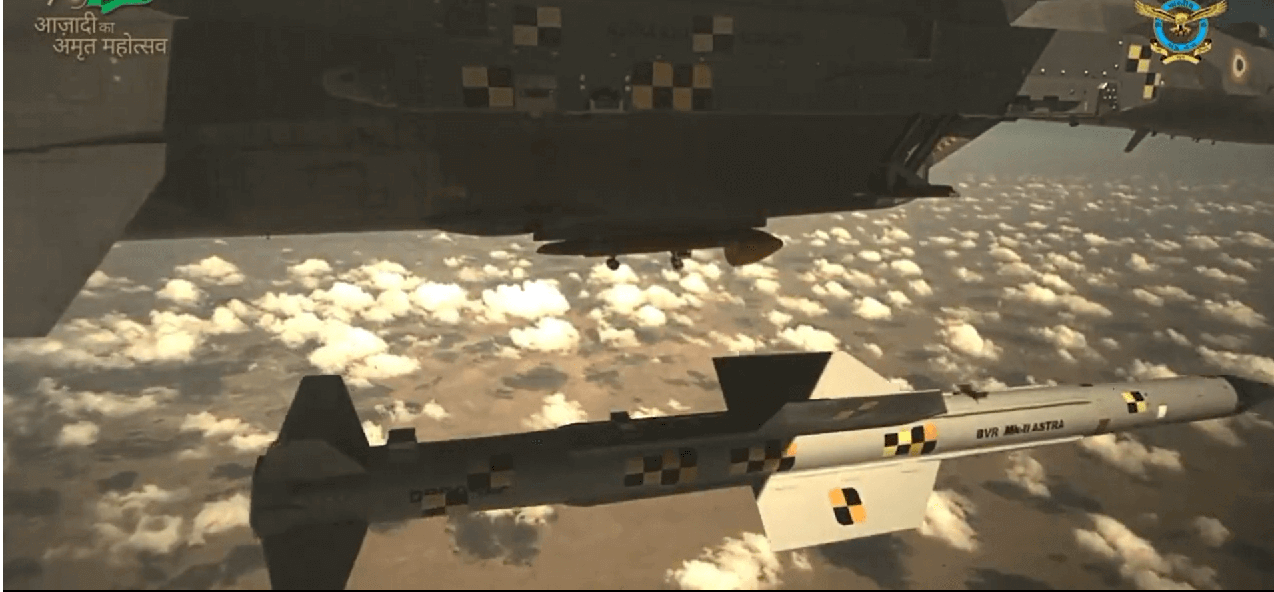
The Astra Mk-2 builds on the existing Astra M-1 missile, which has a range surpassing 100 kilometres. Although the DRDO was earlier mulling an expansion of Astra Mk-2’s range to 160 kilometres, the decision has been modified to extend the range over 200 kilometres for better Beyond Visual-Range (BVR) combat.
The Astra missile was officially inducted in 2019 and is now fully operational, integrated with frontline platforms like the Su-30MKI and Light Combat Aircraft (LCA) Tejas Mk-1. The IAF has placed multiple production orders, including an additional 200 units approved in August 2025, to bolster its BVR combat capability.
The Indian Air Force currently uses potent long-range air-to-air missiles such as the R-77 (80-100 kilometers range), Astra Mk-1 (over 100 kilometers range), and Meteor (excess of 200 kilometers range), among others.
The induction of Astra Mk-2 would complement the existing arsenal and bolster the IAF’s chances of having the first-strike advantage.
Long-range air-to-air missiles (LRAAMs) enable fighter aircraft to engage and neutralize enemy aircraft and other high-value aerial assets from very far ranges. These missiles primarily rely on radar guidance, specifically active radar homing (ARH), where the missile carries its own radar system for final target detection and tracking. Thus, enabling a “fire-and-forget” capability, freeing the launching aircraft to engage other targets.
“The rise of LRAAMs is profoundly impacting air combat. Very long-range standoff engagements are becoming the norm. Pilots will increasingly rely on networked sensor information rather than visual cues for targeting. Robust and secure communication links are critical for data sharing and mid-course guidance updates. LRAAMs are optimized for neutralizing assets like AWACS and tankers, crippling an adversary’s ability to coordinate operations,” as noted by Indian Air Force veteran and commentator, Air Marshal Anil Chopra (retd) in a previous EurAsian Times article.
The significance of these long-range air-to-air missiles cannot be overstated, especially as adversaries expand the range of their air defense systems, making it harder to launch attacks even from miles away from hostile airspace.
Both Pakistan and China possess long-range missiles. For instance, Pakistan’s PL-15E has a range of up to 145 kilometres, and China’s PL-15 has a range of over 200 kilometres.
In fact, Pakistan launched the PL-15E against India in the brief 4-day combat, and claimed to have downed multiple Rafale fighter jets, a claim India flatly rejected.
While the Astra Mk-2 is supposedly compatible with different combat aircraft, its integration with the locally produced LCA Tejas may be the most noteworthy. The combination of LCA Tejas and Astra Mk-2 represents the most potent example of indigenisation in Indian defense in recent times, and boosts Tejas’ firepower against rivals.
LCA Tejas + Astra Mk-2 To Boost IAF’s Capability
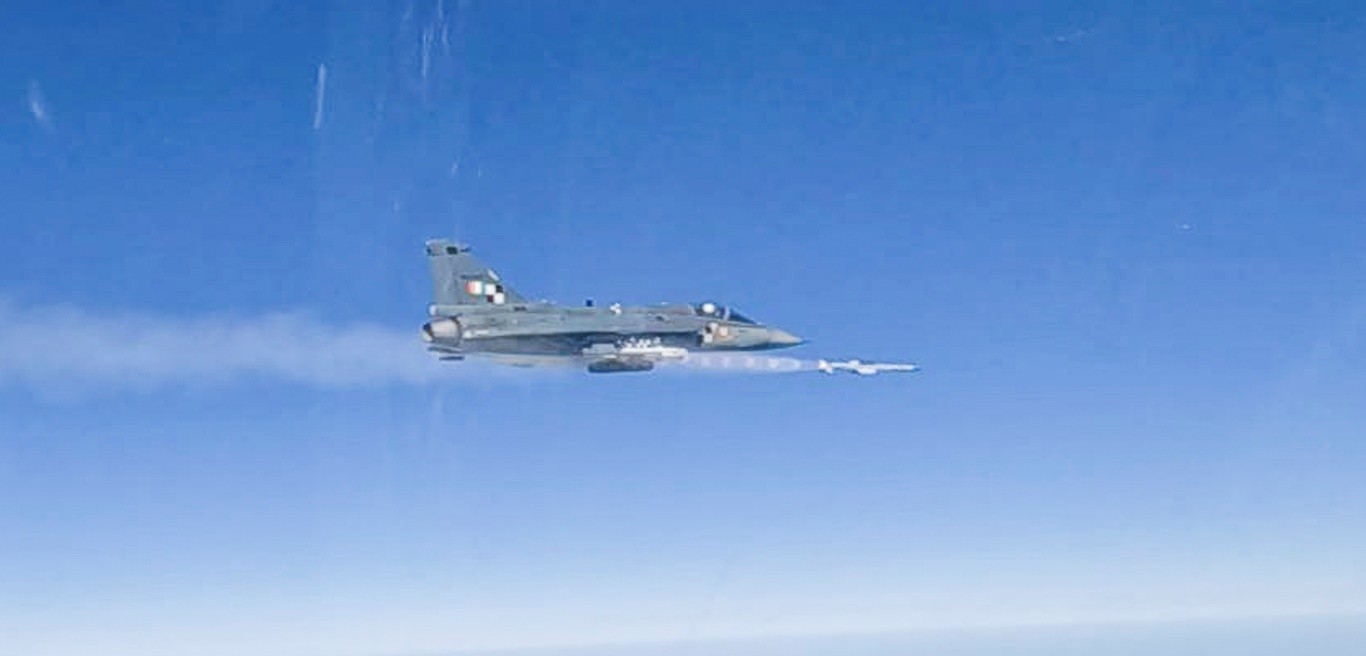
The integration of the Astra Mk-2 onto the LCA Tejas, a single-engine, lightweight multirole fighter, could progress rapidly. The Astra-Mk1 missile has been integrated with LCA Tejas Mk-1, and could soon be fitted onto the more advanced Tejas Mk-1A.
Earlier, the Aeronautical Development Agency (ADA) conducted a test launch of the Astra missile from one of the LCA Tejas Mk-1A prototypes in March 2025.
Astra Mk-2’s 200-kilometre range would allow Tejas fighter pilots to neutralize threats from outside enemy visual range, reducing exposure to short-range missiles or guns, and giving it the “first-look, first-kill” advantage. The Astra Mk-2 has enhanced accuracy and kinematics, allowing LCA Tejas to dominate BVR (beyond visual range) combat.
Tejas Mk1A’s AESA radar would likely pair perfectly with Astra’s active seeker, supporting salvo launches and network-centric warfare, boosting mission success rates.
It would be a big boost to India’s self-reliance ambitions because 100% Indian design would mean that New Delhi would no longer need foreign approvals for upgrades, maintenance, or custom integrations.
Currently, the IAF relies on costly foreign long-range missiles, which come with supply chain risks and integration hurdles. In contrast, the Astra family of missiles is 100% indigenously produced. They are platform agnostic and can be integrated with the diverse fleet of the IAF and upgraded as required.
Notably, the delivery of the Tejas MK-1A aircraft has been grossly delayed amid a rapidly depleted squadron strength in the Indian Air Force (IAF).
The delay was caused by the late delivery of GE-404 engines from General Electric Aerospace. However, the deliveries are now being accelerated, and the Hindustan Aeronautics Limited (HAL) has stated that it expects to complete Tejas Mark 1-A deliveries in four years. The IAF will get about 180 Tejas Mk-1A aircraft.
In August 2023, the Tejas LSP-7 successfully tested the Astra missile off the coast of Goa, proving that it could engage targets farther than 100 kilometers away. The Astra Mk-2 would take this capability much further, boosting the firepower and offensive capabilities of India’s first indigenous light fighter jet.
Astra is a powerful tool in aerial combat because of its sophisticated characteristics. The missile’s 20-kilometer operational ceiling guarantees that it could successfully attack adversaries in a variety of combat situations.
The Astra missile, which can reach Mach 4.5, offers the quick reaction and interception essential in modern air combat. Its 100–120–second flight time allows it to eliminate threats quickly, a capability fully verified by DRDO’s rigorous testing on several platforms, including Tejas.
The sophistication of Astra extends to its guidance system. Using a combination of inertial guidance, mid-course updates, and terminal active radar homing (effective at 13 kilometers), the missile ensures high precision in target engagement.
This advanced guidance, coupled with its resistance to electronic countermeasures (ECM), significantly enhances the Indian Air Force’s combat effectiveness.
With Pakistan fielding a smaller but steadily modernizing air force, Astra Mk-2’s long-range engagement capability would maximize the IAF’s effectiveness, allowing fewer aircraft to control larger airspaces, which is a critical capability along the Line of Control (LoC) and India’s volatile western borders.
- Contact the author at sakshi.tiwari13 (at) outlook.com
- Follow EurAsian Times on Google News