The US Navy is moving ahead with integrating the Patriot surface-to-air missile system into the Aegis combat system to enhance air defense at sea.
Lockheed Martin disclosed at the Sea Air Space 2026 Symposium on April 21, 2026, that it had been awarded a formal contract by the US Navy to integrate PAC-3 MSE (Missile Segment Enhancement) missiles onto the Aegis combat system. The deal is reportedly worth $93 million in the first phase and over $200 million over the course of the contract.
The Aegis Weapon System is the Surface Combat System of the United States Navy that provides integrated air and missile defense capabilities. And, the US Navy’s Arleigh Burke–class destroyers make up the bulk of the Navy’s Aegis‑equipped surface fleet.
“We’ve been working on this for nearly a decade at Lockheed Martin,” Jason Reynolds, Vice President and General Manager at Lockheed Martin Missiles and Fire Control, IAMD, was quoted as saying by media reports. “Investing our own [internal research and development funds] to bring this capability into reality. And what we’re gonna do is show you that these battle-tested capabilities are going to be working better together.”
In addition, the US Navy is requesting over $1.73 billion to purchase about 405 Patriot interceptors as part of its planned 2027 Fiscal Year budget. As noted in its budget request, the Navy views PAC-3 MSE integration with Aegis as an extra way to intercept “a wide range of threats, including tactical ballistic missiles, air-breathing threats, cruise missiles, and unmanned aerial systems.”
The contract is a culmination of years of effort to fuse the Patriot missiles with Aegis.
Lockheed Martin conducted a communications test between a modified PAC-3 MSE datalink and the SPY-1 Radar, a crucial part of the Aegis Weapon System, in June 2023 to verify PAC-3 MSE’s compatibility with the system. It changed the dual-band datalink of PAC-3 MSEs to a tri-band datalink to enable communication at Aegis’s S-band frequency.
Later, in 2024, the manufacturer test-fired a PAC-3 MSE interceptor from an MK-70 containerized launch platform using the virtualized Aegis Weapon System, a road-mobile version of the surface fleet’s Mk 41 VLS of the Aegis Combat System, as reported by the EurAsian Times at the time.
According to reports, there will be no modifications to the Mk 41 VLS as part of the PAC-3MSE integration with the Aegis. In fact, the interceptors are being modified into launch canisters so that they may fit directly into the current Mk 41 cells. Additionally, the missile’s command-guidance radio frequencies would need to be modified for integration.
Lockheed had earlier stated that each canister will contain a single PAC-3 MSE missile. And, the first ship with navalized PAC-3 MSEs is expected to deploy in 2028, marking initial operational capability (IOC).
Notably, the US Navy had earlier highlighted that the addition of PAC-3 MSE to Navy ships will fill a gap and complement the existing Vertical Launch System (VLS) inventory of surface-to-air interceptors. Further, it will provide a crucial asset in combatting modern security threats, particularly in the Indo-Pacific region.
The Aegis Combat System currently employs SM-3 missiles for midcourse and exo-atmospheric intercepts, SM-6 and SM-2 for upper-tier engagements, and ESSM for point defense. The addition of PAC-3MSE would introduce a proven hit-to-kill capability into the mix, optimized for the terminal phase.
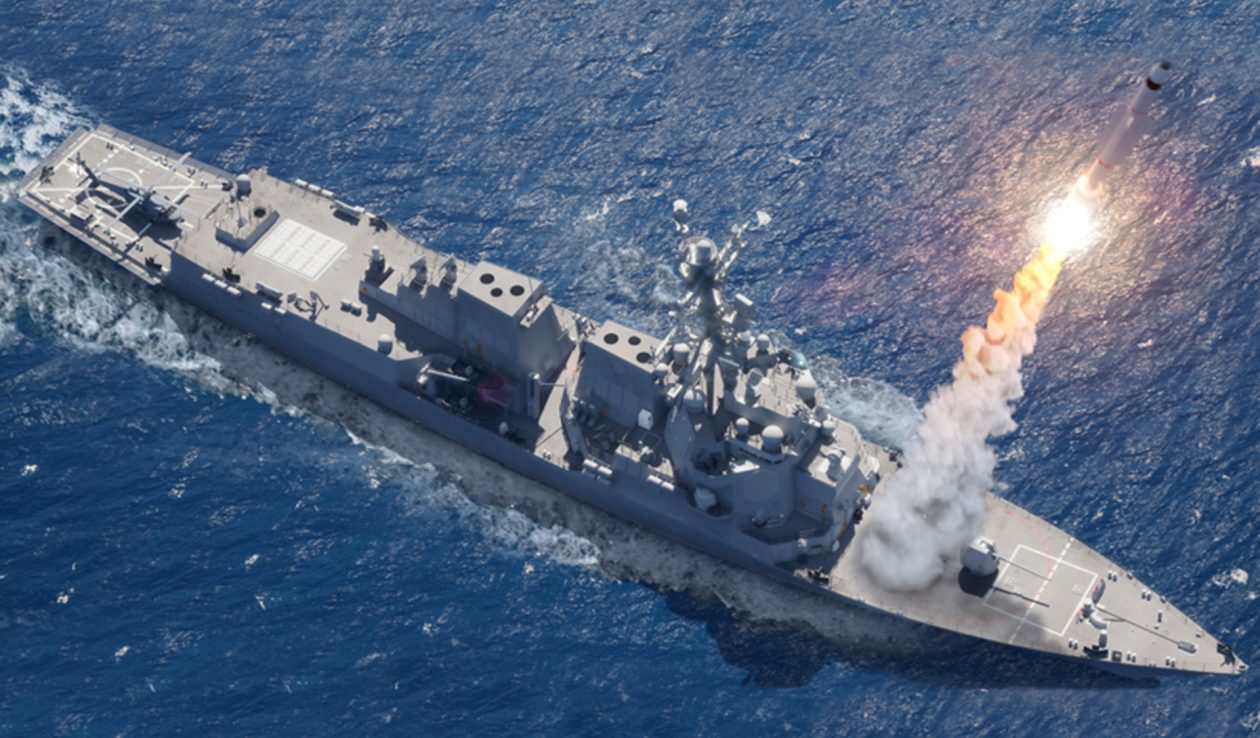
It would allow close-in intercepts of maneuvering ballistic missiles, cruise missiles, hypersonics, drones, and aircraft that manage to penetrate the existing outer layers.
Earlier, Lockheed Martin emphasized that the PAC-3 MSE overlaps with several missions currently fulfilled by the SM-6. Therefore, supplementing the Navy’s inventory with PAC-3 MSE would free up the more expensive SM-6 inventory for offensive missions that the PAC-3 cannot perform, enhancing operational flexibility.
It is pertinent to note that Patriot systems, particularly advanced interceptors such as the PAC-3 MSE, face manufacturing constraints.
However, demand from the US and its allies has forced an expansion in production of these lethal interceptors—Lockheed has signed a seven-year framework agreement to increase annual PAC-3 interceptor production from 600 to 2,000, and Boeing has reached a framework agreement with the Pentagon to quadruple the PAC-3’s seeker capacity.
A Proven Interceptor
The most advanced variant of Patriot interceptors, the PAC-3 MSE is a high-velocity, hit-to-kill interceptor designed to destroy incoming threats through direct kinetic impact, delivering exponentially more energy on target than traditional blast-fragmentation warheads. The missile ensures precise, lethal engagements against a wide array of threats, including tactical ballistic missiles, cruise missiles, advanced maneuvering threats, hypersonic weapons, and warplanes.
With its dual-pulse solid rocket motor, the PAC-3 MSE outperforms the original PAC-3 in terms of thrust and range. The design permits two stages of propulsion, enhancing the interceptor’s speed and maneuverability in the terminal stage.
The PAC-3MSE facilitates extended range, higher altitude, and greater coverage. Meanwhile, enlarged and folding control fins, combined with an Attitude Control Section featuring attitude-control motors, deliver superior agility and rapid divert response for terminal-phase intercepts. According to the manufacturer, the missile can intercept ballistic missiles at a range of 35–40 kilometers and targets such as aircraft and cruise missiles at over 60 kilometers.
Notably, the missile has a Ka-band active radar seeker for terminal guidance, which enables precise targeting. Additionally, with connectivity to systems such as THAAD, the Army’s IBCS combat command system, F-35 sensors, and new radars like LTAMDS, the PAC-3 MSE easily integrates into larger Integrated Air and Missile Defense (IAMD) designs, enabling 360-degree engagement capabilities.
Some other upgraded components of the PAC-3MSE over the baseline interceptors include new actuators, thermal batteries, electronics with additional hardening, an updated lethality enhancer, and enhanced software for improved maneuverability and lethality across the engagement envelope. These improvements significantly boost the missile’s performance, allowing it to counter sophisticated aerial threats.
Notably, the awarding of a formal contract for navalised PAC-MSE comes amid a major surge in demand for these missiles, which have proven decisive in recent conflicts, including in Ukraine and the Middle East.
For example, the Patriots have been at the forefront of protecting the US Army’s military assets. In June 2025, the US Army recorded the largest single-event launch of Patriot interceptors in US military history when Iran launched ballistic missiles on the Al Udeid base in Qatar as retaliation for the US air strikes on its nuclear facilities under “Operation Midnight Hammer.”
In the first three days after the US launched “Operation Epic Fury,” American forces and their Gulf allies expended about 800 Patriot interceptors to down Iranian drones and missiles. The number is expected to have increased manifold in the nearly six-week regional conflict.
In Ukraine, the Patriots made history by downing Russian Kinzhal hypersonic missiles that were earlier positioned as invincible by Russian President Vladimir Putin. Reports suggest that it also took down multiple Su-34s and was responsible for shooting down a Russian A-50. It is unclear which Patriot systems have been donated to Ukraine, but Kyiv likely has at least some of the newer PAC-3 interceptors.
Against that background, it makes sense that the US is now keen to deploy these interceptors at sea, where it faces an enhanced threat, as seen during the latest US-Iran war, which forced US warships and carriers to brave sustained enemy fire.
- Contact the author at sakshi.tiwari13 (at) outlook.com
- Follow EurAsian Times on Google News