Iran’s Shahed-class drones have gained great attention in recent wars due to their low cost and their ability to saturate cutting-edge air defense systems. Their deployment by Russia against Ukraine and by Iran and their proxies has highlighted the effectiveness of massed, low-cost unmanned strike systems.
The Shahed-class drones first made a notable impact when Yemen-based Houthis militia backed by Iran fired them into Saudi Arabia in 2019.
However, these drones gained massive global attention starting in mid-September 2022 when Russia started to deploy the Shahed-136 and Shahed-131 variants to target key infrastructure in Ukraine, often using them for saturation attacks and overwhelming its air defenses.
These drones are produced by Russia as “Geran-2”.
Notably, the Shahed one-way attack drones are widely known as the “poor man’s cruise missile” thanks to their low production cost of roughly $20,000–$50,000 per unit, their simple and rugged design, and their effectiveness when used in large swarms.
Moreover, their use creates a painful asymmetry on the battlefield because defending against these cheap, expendable drones often requires firing multimillion-dollar interceptors, imposing a heavy financial burden on the defender.
The early impact of Shahed-class drones demonstrated the value of attritable, mass-produced kamikaze drones in modern warfare and prompted a global rethink of strategy and a visible doctrinal shift, evident in the increasing prioritization of cheap kamikaze drones by advanced militaries worldwide.
Iran deployed its rather massive army of Shahed-class drones on three occasions in the past two years: the April 2024 attacks on Israel (Operation True Promise), the June 2025 “12-Day War” with Israel, and the wider regional war in West Asia this year.
The Shahed-class drones are built with simple, dual-use commercial components, including basic piston or jet engines, fiberglass airframes, and minimal electronics. This straightforward design allows them to deliver effects comparable to those of far more expensive cruise missiles at a fraction of the cost, while enabling rapid, large-scale production with relative ease.
Beyond the Shahed-136 and Shahed-131, which have been extensively used by Russia and Iran (and Iranian proxies), the Islamic Revolutionary Guards Corps (IRGC) operates a host of other variants, most of which have been combat-tested with a great degree of success.
The Missile Threat Project, an initiative of the Washington-based think tank CSIS (Center for Strategic and International Studies), has compiled data on Iran’s Shahed drones as well as its lethal ballistic and cruise missiles.
The Vast Inventory Of Iran’s Shahed Drones
“Iran fields one of the largest and most diverse arsenals of unmanned aerial systems (UAS). Iran’s family of Shaheds is capable of performing a variety of functions, including one-way attack missions, reconnaissance, and munition delivery. Iran has employed the Shahed-131, -136, and -238 in some of its Operation True Promise strikes. Iran actively supplies Shahed UAS to Russia and Axis of Resistance proxies, including the Houthis, Hezbollah, and Iraqi militia groups,” states the Missile Threat Project.
The data prominently mentions the Shahed-class one-way attack drones.
Shahed-131 has a range of 900 kilometers, Shahed-136 has a range of 2,500 kilometers, Shahed-238 has a range of 600 to 1,000 kilometers, Shahed-101 has a 500-kilometer range, and Shahed-107’s range is listed as “unconfirmed.” All these drones have been used by Russia in its war against Ukraine, as well as in IRGC operations.
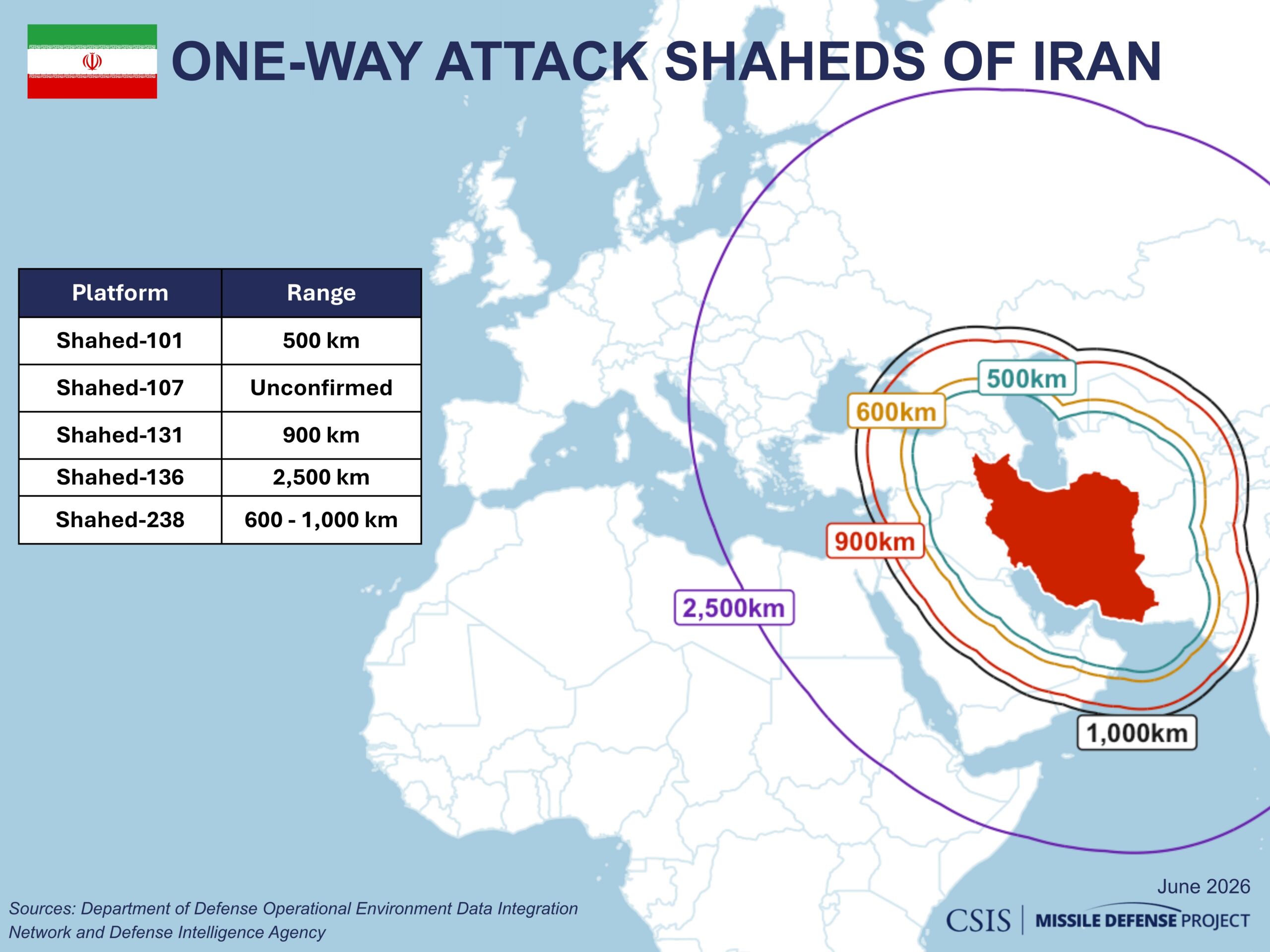
The Shahed-131 and Shahed-136 are the most distinctive and popular of the lot, as they were the first to be deployed by Russian forces.
The Shahed-238, on the other hand, is a jet-powered high-speed variant of the one-way attack drone. It is reportedly powered by a small turbojet engine (often the Czech-built PBS Velká Bíteš TJ150), allowing a cruise speed of 500–600 kilometers/hour, compared to the 185 kilometers/hour of older models.
They have been deployed by both Iran and Russia, the latter rebranding them as “Geran-3.”
Meanwhile, the Shahed-107 and Shahed-101 are smaller, cheaper, and better suited for roles such as frontline strikes or medium-range logistics, rather than long-range strikes conducted by the Shahed-136, according to open-source reporting.
The data also mentions the Shahed-141 as another one-way attack drone developed by Iran, albeit without a confirmed range. It is part of a family of flying-wing drones developed by Iran that were heavily inspired by the American RQ-170 Sentinel stealth drone, which Iran captured in 2011. Therefore, it features a flying-wing tailless design. According to some reports, this drone was spotted in Ukraine in April this year.
The data also mentions a host of Shahed-class unmanned combat aerial vehicles (UCAVs) developed by Tehran over the years: the Shahed-161, Shahed-139, Shahed-191, Shahed-171, and Shahed-181, noting that their ranges are unconfirmed. Meanwhile, Shahed-129, also listed down as a UCAV, has a range of about 1,700 kilometers.
Unlike Shahed one-way attack drones, which are disposable, single-use “kamikaze” missiles that crash onto targets to detonate, the UCAVs are reusable aircraft built to carry, deliver, and fire a variety of precision weapons before returning to base after their mission.
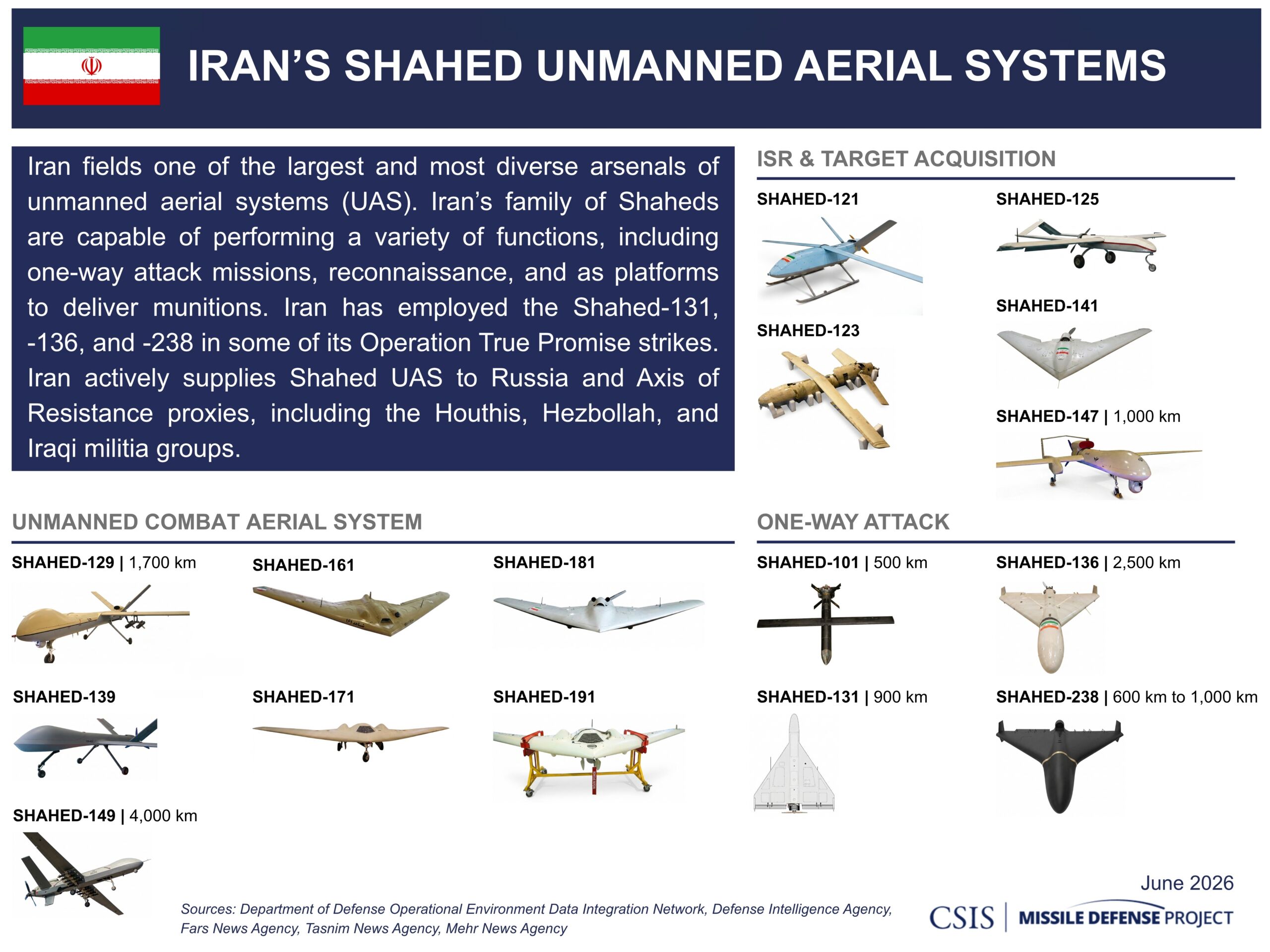
Although the dataset does not provide specific information about these Shahed UCAVs, open-source reporting helps fill some gaps.
The Shahed-161 is a compact Iranian jet-powered tactical UAV (UCAV) featuring a flying-wing design and a small turbofan engine. The drone has a 150-kilometer operational range, a 7,600-meter service ceiling, and the ability to carry two 50-kilogram bombs, per reports.
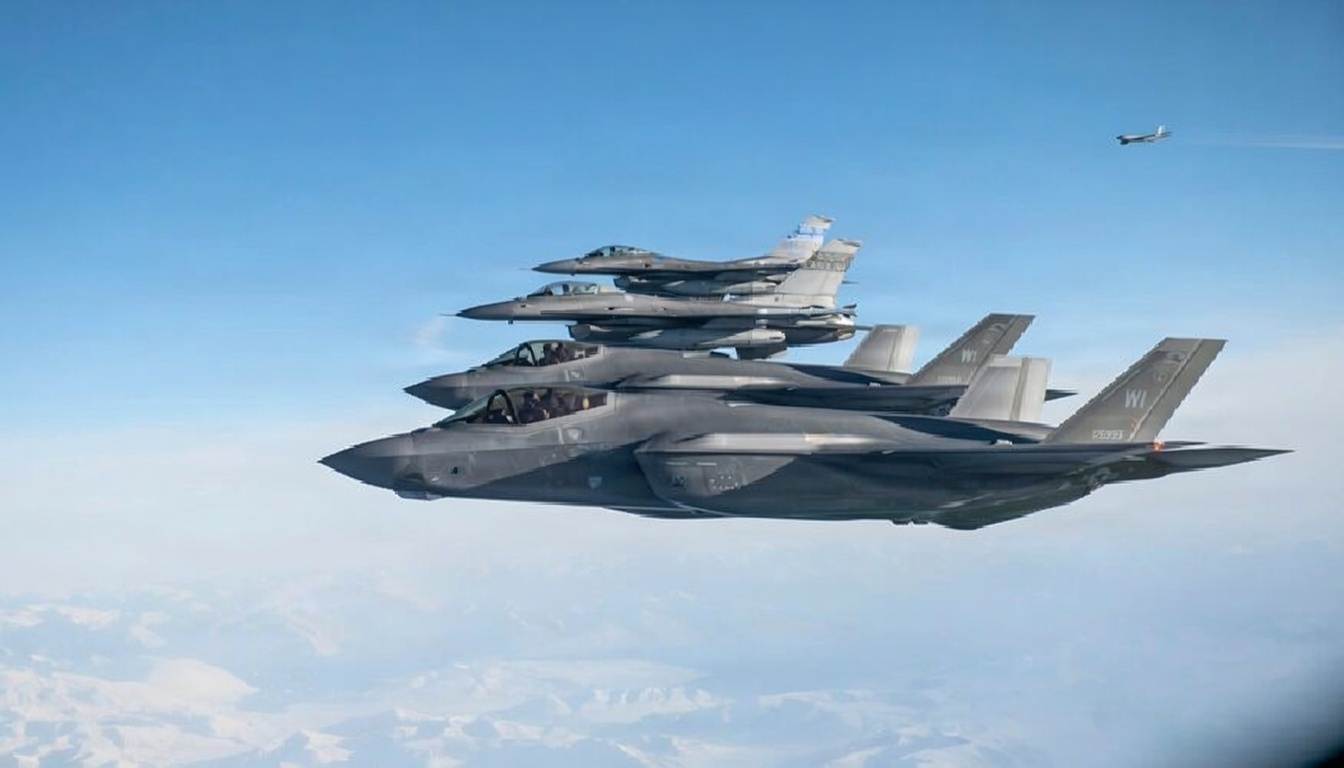
The Shahed-139, on the other hand, is an Iranian medium-altitude long-endurance (MALE) combat drone. It is larger, has an estimated range of about 2,000 kilometers, and resembles the US MQ-1 Predator drone, as per reports. In fact, a US Navy F-35C stealth fighter shot down an Iranian Shahed-139 drone aggressively approaching the USS Abraham Lincoln aircraft carrier in February 2026.
The Shahed-191, also known as “Saegheh”, is an Iranian jet-powered flying-wing UCAV with stealth features. “Equipped with a high-speed turbojet, the drone benefits from enhanced radar evasion, prompting engineers to place the munitions it carries inside an internal weapons bay within the fuselage,” states Fox News.
Shahed-181 is believed to be a Saegheh variant—it is a smaller piston-engine flying-wing drone with a propeller-driven design and an external or semi-recessed weapon carriage.
Shahed-171 “Simorgh” is a jet-powered drone reverse-engineered from the US RQ-170 Sentinel stealth drone captured by Iran. It is designed for reconnaissance, surveillance, and strike missions and has stealth features. One of these drones was also reportedly destroyed by US forces during strikes on Iran in early 2026.

The Missile Threat Project also has a repository of Shahed-class ISR (Intelligence, Surveillance, and Reconnaissance) drones: Shahed-147, Shahed-197, Shahed-149, Shahed-121, Shahed-123, Shahed-125, and Shahed-178. The think tank only lists down the range of three drones: Shahed 147 with a 1,000-kilometer range, Shahed-197 with more than 1,000 kilometers, and the long-range Shahed-149 with a range of 4,000 kilometers.
The range of all other ISR drones is currently “unconfirmed”.
The Shahed-147 is a high-altitude long-endurance (HALE) surveillance UAV developed by Iran and publicly unveiled in November 2023. It has a twin-boom configuration and a wide-body design, and is propelled by a turboprop engine. It is equipped with a Synthetic Aperture Radar (SAR) for all-weather, high-resolution imaging, as well as likely electro-optical/infrared (EO/IR) turrets. This allows persistent wide-area surveillance, targeting support, and border/coastal monitoring.
According to reports in the Ukrainian media, the drone has been deployed by the Russian military in the ongoing war.
The Shahed 197 is an ISR drone that was reverse-engineered from an American RQ-170 that fell inside Iran in 2011. It is powered by a microturbojet engine, has a 20-hour endurance, and a combat range of 2,000 kilometers, according to The Jerusalem Post. These drones have been intercepted by Israeli F-35I Adir stealth fighters.
The Shahed-149 Gaza is a HALE drone often compared to the US MQ-9 Reaper. It has a 35-hour endurance and the ability to loiter over the target for extended periods. Moreover, it can carry a payload of up to 500 kilograms and 8–13 guided munitions.

Shahed-121 and Shahed-123 are early, smaller members of Iran’s Shahed family of UAVs. They served as developmental or tactical reconnaissance platforms and precursors to the more capable Shahed-129. In January 2016, a Shahed-121 flew over the USS Harry S. Truman carrier in international waters in the Gulf — the first such overflight of a US carrier since 2014. It was unarmed, and the event was filmed by US and French forces.
Shahed-125 is an early-model tactical reconnaissance UAV (ISR) with some reports of limited armament. It is described as an Iranian copy of the US RQ-7 Shadow tactical drone. The Shahed-178, on the other hand, is a rather obscure drone of the class designed for ISR and strike roles.
Shaheds Have Taken On The World
Iran fired thousands of Shahed drones along with a diverse set of ballistic missiles on US military assets in the region and military bases in allied countries in the wider Gulf region, as well as on Israel. These were aimed at overwhelming air defenses and making the war unsustainable for Washington, which had vowed to decapitate Tehran.
In one instance, for example, a Shahed-136 was reportedly behind the destruction of a US Air Force (USAF) E-3 Sentry Airborne Warning and Control System (AWACS) aircraft in a strike at Prince Sultan Air Base in Saudi Arabia on March 27, 2026, dealing a massive blow to the US military.
Iran claimed widespread success against US and allied radar systems, bases, and infrastructure, many of them achieved by the Shahed drones. Though several of these claims are refuted by the US and its allies, even partial successes achieved in strikes may have inflicted psychological and economic costs and forced the use of interceptors.
The operational success of Shaheds has, in fact, brought about a global revolution with more and more countries now seeking the same capability. For example, Russia has built Geran-2, whereas the United States has reverse-engineered the Shahed-136 to develop LUCAS (Low-cost Unmanned Combat Attack System), a system that was ironically deployed against Tehran in the latest US-Iran war.
As China generally refuses to be left behind, it has also developed its own version of the Shahed-136, which analysts believe is a Shahed clone. In 2023, videos of a Chinese version of Iran’s famous Shahed-136 kamikaze drone, the Sunflower-200, being tested at firing ranges in China surfaced on social media, as reported by the EurAsian Times at the time. Meanwhile, Taiwan is reportedly developing a Thunder Tiger drone, Papa Delta, that bears an uncanny resemblance to the Shahed.
Similarly, many Turkish arms companies, including Skydagger and Turkish Aerospace Industries, are developing drones similar to the Shahed, and Egypt has unveiled the Jabbar-150, inspired by the Shahed-136 design.
In summary, it is safe to say that the dawn of the Shahed-class drones has changed the rules of warfare, making drones central to any conflict worldwide.
- Contact the author at sakshi.tiwari13 (at) outlook.com
- Follow EurAsian Times on Google News