In an era where debates over modern warfare are dominated by the rapid rise of First-Person View (FPV) drones and many analysts are quick to declare traditional tube artillery obsolete, the Indian Army plans to induct more than 300 K9 Vajra-T self-propelled tracked howitzers.
The deal is estimated at around Rs 23,000 crore (US$2.4 billion), and the proposal is expected to be placed before the Defense Procurement Board (DPB) sometime this week.
Notably, if the proposal is approved, it would significantly expand the Indian Army’s artillery inventory, taking the total number of K9 Vajra (Thunder) guns to more than 500.
The initial 100 units were ordered in 2017 at a cost of Rs 4,500 crore (US$474 million), and delivery was completed in 2021, ahead of schedule.
Impressed by the performance of these artillery guns across all weather and terrain conditions, India signed a repeat order for 100 more 155 mm/52 caliber K9 VAJRA-T Self-Propelled Tracked Artillery Guns in 2025.
The K9 Vajra (or Vajra-T) is the Indian licensed and customized variant of the South Korean K9 Thunder self-propelled howitzer (SPH), designed and developed by Hanwha Aerospace.
In India, these artillery guns are produced under license by Larsen & Toubro (L&T), with at least 50-60% Indian components.
L&T had won the contract for the first batch of 100 K9 Vajra-T platforms through global competitive bidding, following a successful field evaluation. It delivered the Vajra Platforms ahead of schedule, with the 100th K9 Vajra-T platform delivered in 2021.
The second batch contract was also awarded to L&T and included upgrades for high-altitude deployment, ensuring India’s readiness to counter challenges in high-altitude regions such as Ladakh.
These artillery guns were initially deployed in Rajasthan at the India-Pakistan border. However, following the India-China stand-off in the Ladakh sector in 2020, these guns were also repurposed for operations there.
The K9 Vajra-T has proven its exceptional capabilities across India’s challenging terrains with its advanced 155mm/52-caliber gun system. The artillery system delivers precision fire at long range while maintaining a high rate of fire in burst mode and sustained operations.
These guns can fire up to 6 rounds per minute in burst mode and sustain 2-3 rounds per minute over prolonged periods. These artillery guns have a range of over 40 km and can launch projectiles at around 65 km/hr.
South Korea’s K9 Howitzer
The K9 has firmly established itself as one of the most sought-after military equipment in the international arms market.
The K9 Thunder is a 155mm/52 caliber self-propelled howitzer designed and produced by South Korea’s Hanwha Aerospace. It can carry up to 48 projectiles and launch six rounds per minute.
Since its debut in 1999, the K9 has evolved into a cornerstone of South Korea’s defense exports, making up more than half of global self-propelled howitzer orders. As of last year, over 1,900 K9 units have been delivered or are slated for export to various countries.
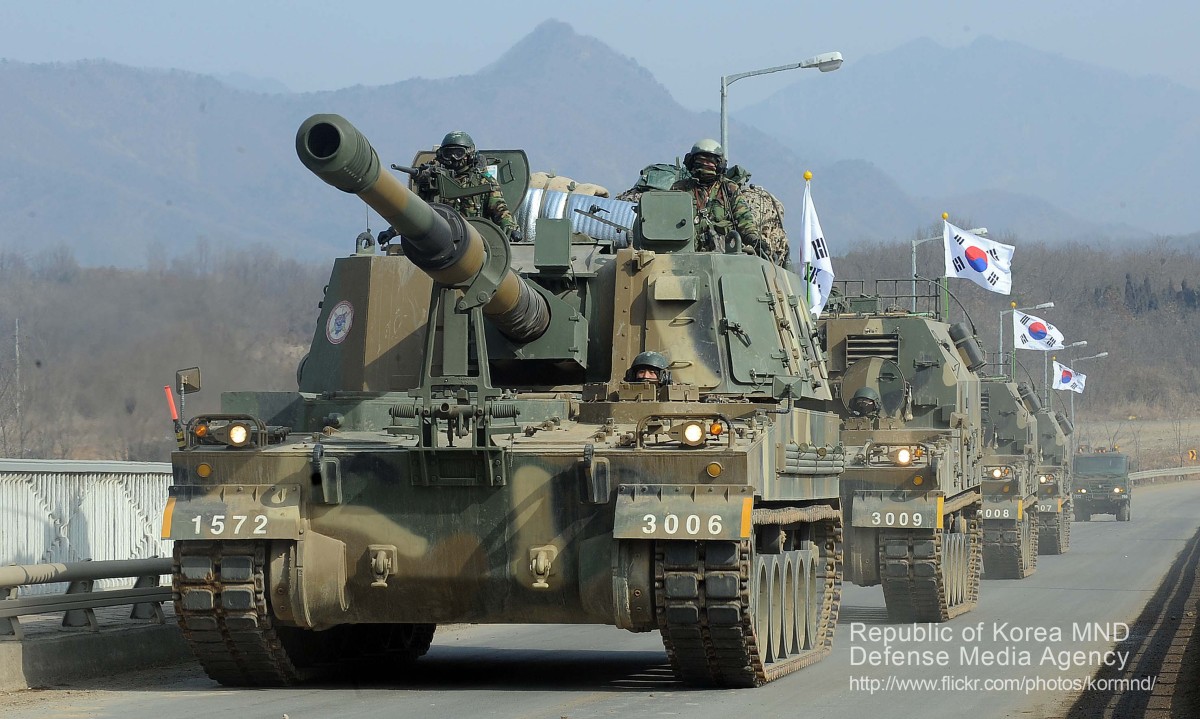
South Korea itself operates a large fleet of K9 howitzers, which are deployed along the heavily fortified demilitarized zone (DMZ) separating it from North Korea.
The K9’s ability to operate in the challenging mountainous terrain of the DMZ is a key feature, as it is equipped with an advanced hydropneumatic suspension that helps it navigate rough landscapes with ease.
The K9’s five-man crew operates in a fully enclosed environment, protected from nuclear, biological, and chemical threats, with 19mm steel armor providing defense against heavy machine-gun rounds and shrapnel.
Additionally, a .50-caliber machine gun mounted on the turret provides close defense and limited air defense capabilities.
The K9 Thunder is widely adopted worldwide, with deliveries either completed or in progress to countries including Australia, Egypt, Estonia, Finland, India, Norway, Poland, Romania, and Turkey.
Indian Army’s Artillery Modernization Drive
The K9 Vajra-T artillery guns are an important part of the Indian Army’s artillery modernization drive. Under this drive, the Indian Army is integrating several 155 mm gun systems, including K-9 Vajra, Dhanush, and Sharang.
In addition, the Indian Army is in the process of inducting other 155 mm gun systems, such as the Advanced Towed Artillery Gun System (ATAGS), Mounted Gun System (MGS), and Towed Gun System (TGS).
The Advanced Towed Artillery Gun System (ATAGS), a 155mm/52-caliber howitzer, is an Indigenous Indian artillery system developed by DRDO, with Tata Advanced Systems and Bharat Forge as key development partners.
The Army has also ordered 114 Dhanush artillery guns, India’s first indigenously built artillery gun. These guns were manufactured by Advanced Weapons and Equipment India Limited (AWEIL), which was previously part of the Ordnance Factory Board (OFB).
The first gun was inducted in April 2019, and the Army is expecting to receive all the guns by the year’s end.
Additionally, India is investing in the Pinaka Multi-Rocket Launch Systems (MRLS). In February this year, India signed contracts worth Rs 10,147 crore for various ammunition for the Army’s Pinaka MRLS.
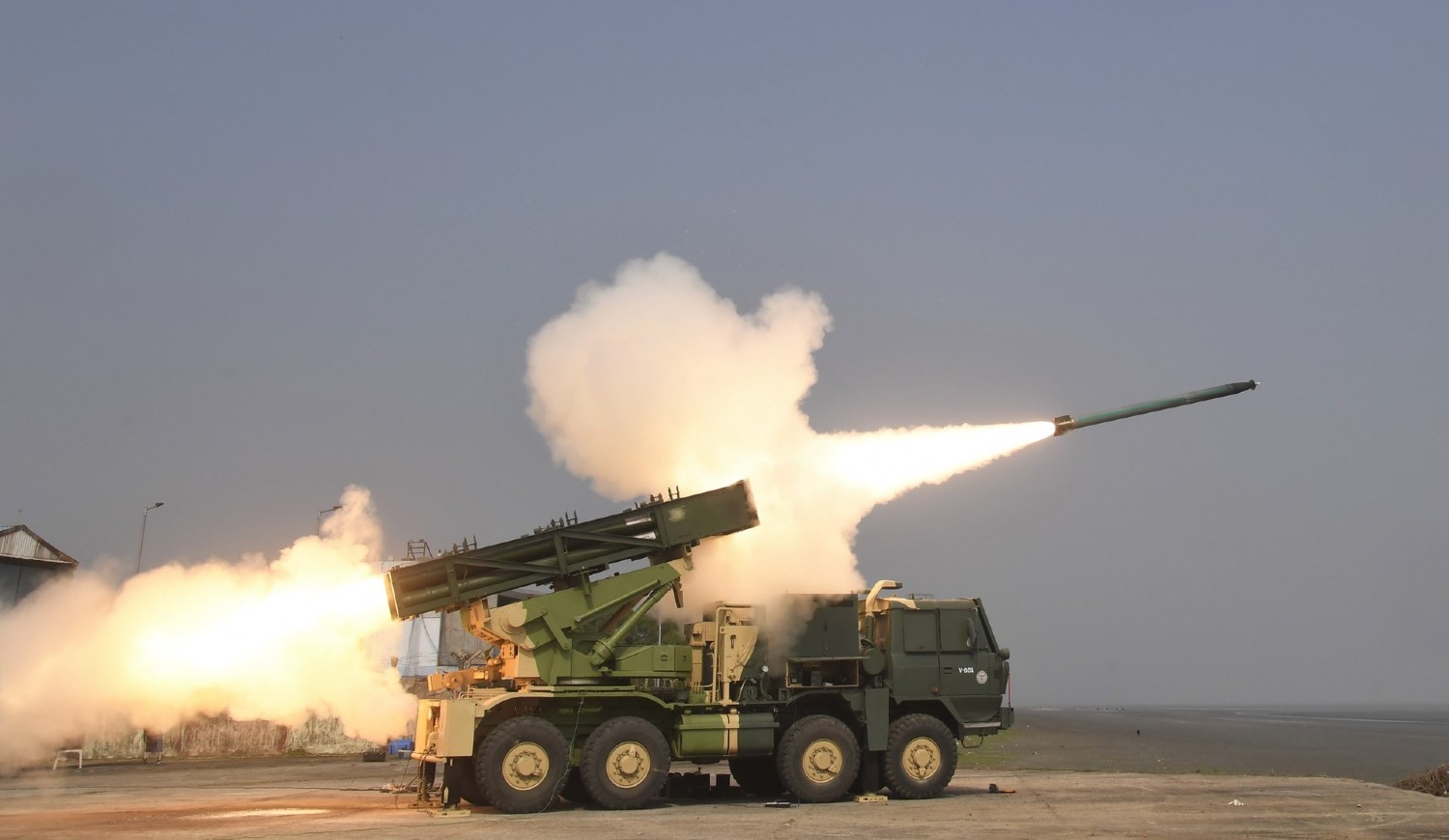
Pinaka Multiple Rocket Launch System (MRLS) has a range of 40 km for the Mark-I and 60-75 km for the Mark-II and Enhanced versions. The Guided Pinaka can strike targets beyond 75 km. Pinaka ER (Extended Range) has a range of 90 km. Work is underway to enhance the range to 120 km and further to 300 km.
However, one might wonder why India is still betting so heavily on big artillery guns in an era of FPV drones.
India Bets Big on Artillery
The war in Ukraine and the dramatic rise of FPV drones have led many to believe that large artillery guns have become obsolete. However, artillery remains a cornerstone of firepower even in the war in Ukraine.
In fact, many defense analysts have been warning against drawing the wrong lessons from the war in Ukraine, namely that big artillery guns have become obsolete.
Drones serve as a valuable complement, especially for precision strikes and filling shell shortages, but they do not replace artillery’s unique strengths in volume, range, suppression, all-weather reliability, and psychological impact.
For instance, a single FPV drone could carry a small warhead, comparable to battalion-level mortars at best.
They excel at scanning wide areas and delivering precision strikes on point targets such as vehicles, soldiers, or even armored vehicles; however, these drones cannot deliver the broad-area suppression or destructive power of a 155mm howitzer battery. Artillery provides massed fires to neutralize positions, interdict advances, or break defenses.
In fact, it was precisely because of these qualities of artillery guns that Joseph Stalin famously declared artillery to be the “God of War”.
Large artillery guns also offer an advantage in terms of range. The FPV drones operate over a few kilometers.
An area of around 15-20 km around the frontline is where the FPV drones are most active. However, large artillery guns can be fired at greater distances.
The K-9 Thunder, for instance, has a range of over 40 km.
Moreover, artillery has some distinct advantages. It can fire day and night, in any weather, and modern electronic warfare cannot jam it.
Drones, in fact, are highly susceptible to electronic warfare (jamming, spoofing), weather (wind, rain), and countermeasures. Artillery is far more resilient in contested environments.
In fact, even in the Ukraine War, Kyiv consumes nearly 200,000 shells per month routinely, and up to 600,000 in intense operations.
Despite these massive numbers, Kyiv is still at a disadvantage as Moscow fires up to 10,00,000 shells per month during intense operations.
In a November 2024 interview with RBC-Ukraine, Sergey Musienko, Deputy Commander of the Missile Troops and Artillery of the Armed Forces of Ukraine, explained the crucial role of artillery.
“At present, artillery remains the main means of destruction on the battlefield. These include missile systems, multiple launch rocket systems, artillery guns, and mortars, which inflict destruction both in front of the front line of defense and at a fairly large range.”
“At present, missile forces and artillery remain the priority means, which, I think, will remain the main component of fire damage to the enemy for a long time to come.”
Musienko also said that the role of artillery is actually becoming more crucial.
“The trend of developing missile forces and artillery is gaining momentum. New types of missiles are emerging, new launchers and warheads are being modernized and created. The same applies to artillery – barrel, rocket and even mortars – modern technologies will never completely replace it. And drones will never replace artillery in fire damage, we see this today on the battlefield.”
The importance of artillery can hardly be overstated, especially in a war fought between two large armies that can fight each other to a grinding stalemate.
Russia’s continued dependence on artillery guns is also evident in the fact that, despite the rise of FPV and fiber-optic drones, it imported 45-year-old North Korean Koksan guns to supplement its own artillery.
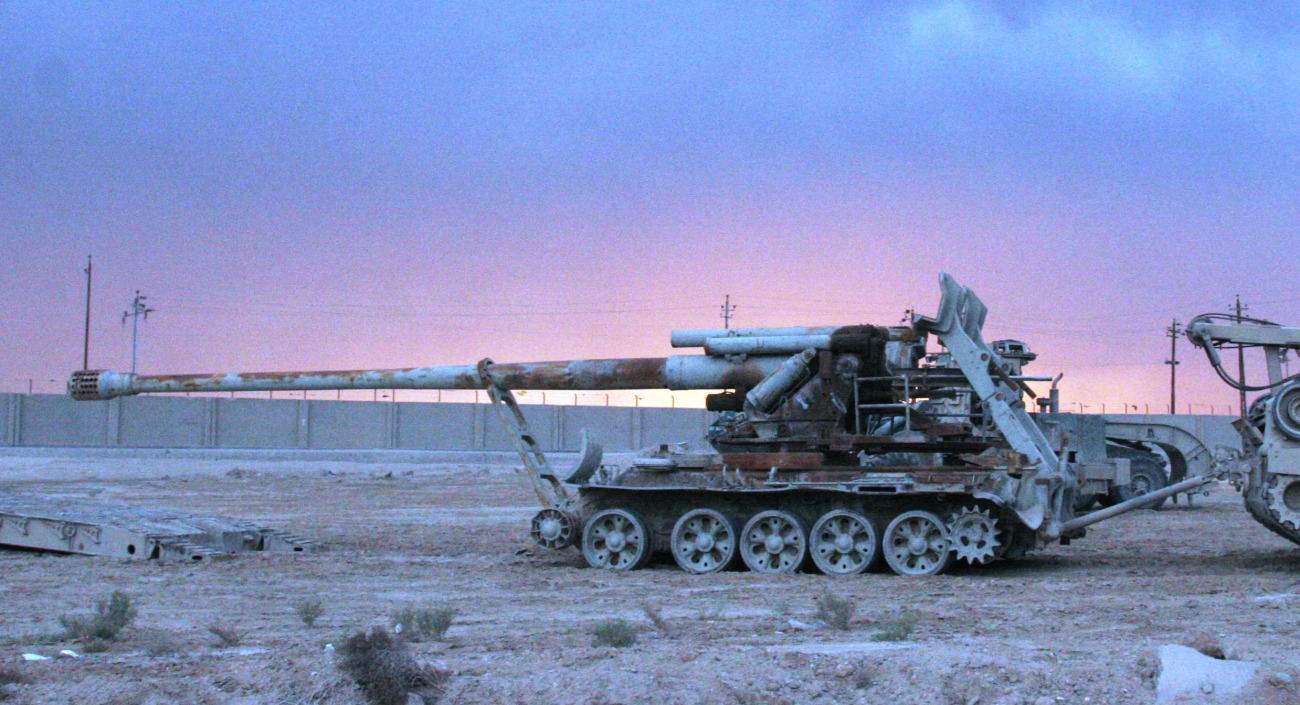
According to the UK-based Open Source Center (OSC), from August 2023 to March 2025, North Korea also shipped at least 15,809 containers to Russia, which would translate into an estimated 4.2 to 5.8 million rounds of artillery ammunition.
Similarly, European countries are sending over one million artillery shells to Ukraine annually, in addition to the millions of artillery shells sent to Ukraine by the US.
These figures clearly suggest that the drones are supplementing, not replacing, the artillery guns.
A 2025 Small Wars Journal analysis summarized the consensus: “Drones are no substitute for artillery in high-intensity warfare. UAVs complement—rather than replace—traditional firepower.”
India, therefore, is making the right decision by not ignoring the critical role of artillery in modern warfare, despite the rise of drones.
- Sumit Ahlawat has over a decade of experience in news media. He has worked with Press Trust of India, Times Now, Zee News, Economic Times, and Microsoft News. He holds a Master’s Degree in International Media and Modern History from the University of Sheffield, UK.
- He can be reached at ahlawat.sumit85 (at) gmail.com