On April 25, VRDE and Bharat Forge initiated field trials of Advanced Armored Platforms (AAP) — Tracked and Wheeled (Tr & Wh) advanced Infantry Combat Vehicles (ICVs) / Armored Personnel Carriers (APCs).
Officially, the two platforms are collectively referred to as Vikram VT21.
The start of field trials marks a milestone in demonstrating the efficacy of the Development-cum-Production Partner (DCPP) model, which blends DRDO’s expertise with industry partners’ manufacturing capabilities to accelerate platform design and development.
The AAP-Wh transitioned from concept to combat-ready status in under 3 years through ongoing collaboration and joint problem-solving. The indigenous content of the AAP variants is claimed to be 65 percent, including the engine. This is planned to be increased to 90 percent.
AAP variants are being developed by DRDO’s Vehicle Research & Development Establishment (VRDE) in partnership with TASL and Bharat Forge Limited.
AAP Tr and AAP Wh are advanced variants of the TASL-developed Wheeled Armored Platform (WhAP) ICV/APC.
WhAP
The WhAP is a multi-utility armored platform with a modular design, configurable for a variety of combat and combat-support roles, including that of an ICV.
ICVs differ from APCs in that they are more heavily armed and capable of engaging in direct combat alongside infantry.
Modularity can significantly enhance an armored vehicle’s ability to support infantry in combat operations. Being modular, AAP—like WhAP—can be configured as either an APC or an ICV.
WhAP Development History
The WhAP features an integrated power pack, automatic transmission, and amphibious capability (flotation and propulsion). It has been rigorously tested in India and operationally deployed in counter-insurgency operations. India has inducted limited numbers into its forces, and the platform has also seen export success (e.g., deliveries to the Royal Moroccan Army and interest from Greece).
WhAP was originally developed as the Tata Kestrel, which was initially classified as an IPMV (Infantry Protected Mobility Vehicle).
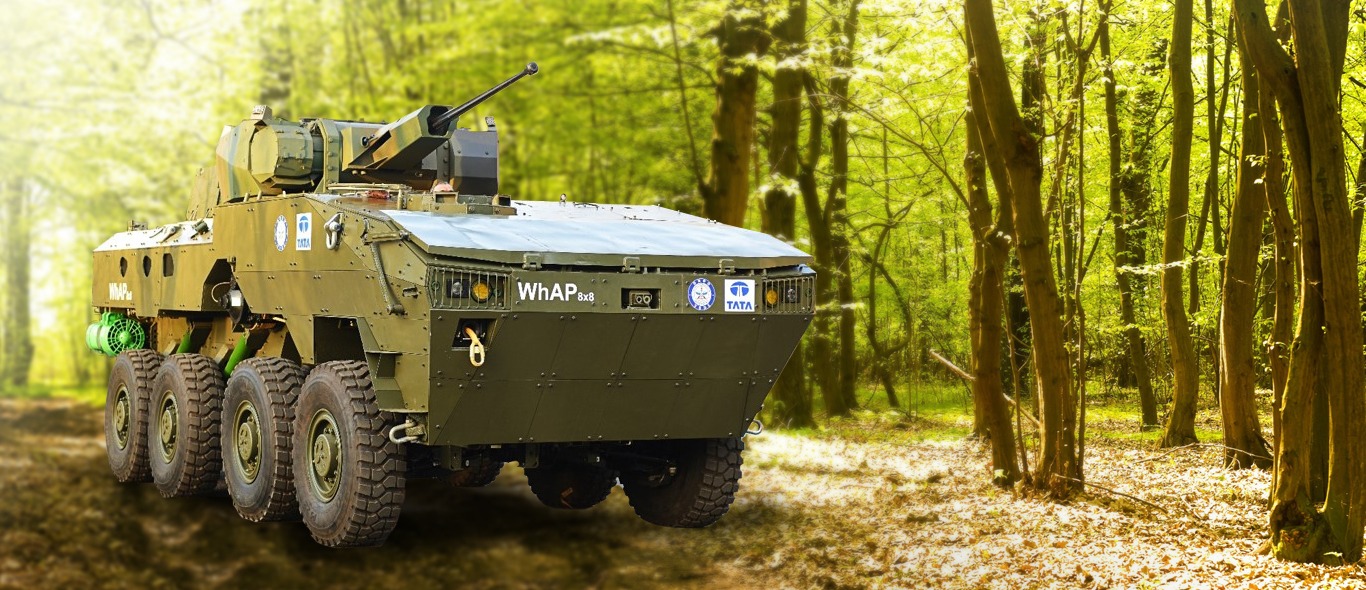
The Kestrel was conceptualized to replace the older Soviet-era BMP-1 and BMP-2 armored personnel carriers used by the Indian Army.
The Kestrel was developed in close collaboration with DRDO and the Indian Army. Tata Motors first showcased it at Defexpo 2014, featuring the Kongsberg PROTECTOR MCT-30R turret.
The platform underwent extensive trials across various terrains—including deserts, high-altitude regions, and plains—to ensure it met the Indian Army’s stringent requirements. During these trials, the vehicle’s mobility, durability, and protective features were thoroughly evaluated. Its ability to withstand blasts and firepower was also a major focus.
The trials also focused significantly on the vehicle’s modularity and adaptability to different weapon systems. Versions of the WhAP were equipped with 30 mm cannons, missile launchers, and other armament systems.
Tata Motors unveiled a new variant of the Kestrel, called WhAP, at Aero India 2017.
On completion of trials, Tata Motors announced that the WhAP was ready for mass production. This vehicle was India’s first indigenously developed 8×8 wheeled armored vehicle and marked a major step forward in the country’s defense manufacturing capabilities.
In October 2019, the Indian Ministry of Defence cleared the WhAP for production and export to friendly nations. The Indian Army planned to acquire 200 WhAPs.
The first batch of WhAPs was inducted into the Army on April 12, 2022, at the Bombay Engineer Group (BEG) and Center, Pune, by the then Chief of the Army Staff, General Manoj Mukund Naravane.
The WhAP was inducted into the Central Reserve Police Force’s 110 Battalion in Pulwama, Kashmir, in August 2023.
In August 2024, it was reported that the Indian Army was planning to order another batch of 105 WhAPs from Tata Advanced Systems Limited.
Modularity
The WhAP is highly modular. It can be configured as an amphibious fighting vehicle capable of crossing rivers and lakes, or operating in coastal areas—an important capability given India’s geographical diversity.
WhAP modularity also facilitates upgrades to higher levels of protection in line with mission requirements. It offers protection against small-arms fire and mine resistance, potentially up to STANAG Level 3 or higher.
The WhAP can be fitted with a 30 mm automatic cannon, anti-tank guided missiles (ATGMs), and machine guns (7.62 mm or 12.7 mm), making it versatile in terms of firepower.
Power Packs
The Tata WhAP currently features a Cummins ISXe 600 turbocharged diesel engine, which is proposed to be replaced in the future by a CVRDE–Ashok Leyland-developed indigenous 600 hp variant.
AAP platforms take the versatility of the WhAP to a higher level, with a more powerful, indigenous-focused diesel engine delivering 720–750 hp.
AAP Advantages
The 25-ton AAP variants will have provisions for integrating an Active Protection System (APS), loitering munitions, and a mini-UAV. These capabilities are required to meet the Army’s FICV specifications outlined in a 2021 RfI. The vehicles are designed to meet mobility and dimensional specifications defined by VRDE and will have a crew of three.
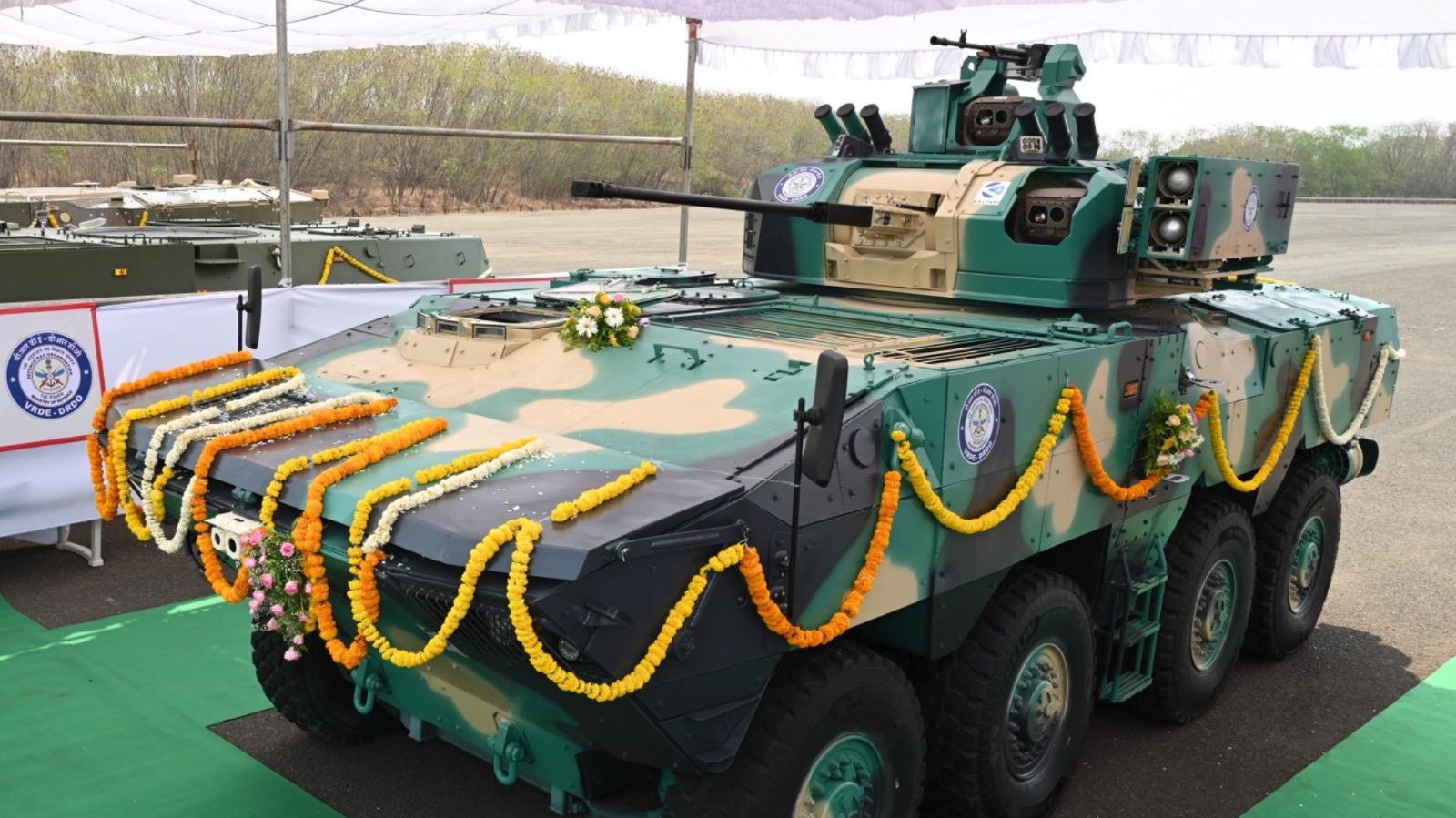
The AAP platforms share the DNA of the WhAP in terms of chassis and technology. However, they represent distinct platforms.
AAP reportedly features improved design, protection, and mobility. Most importantly, it is available in both wheeled and tracked variants, with high component commonality between the two, and is sharply focused on meeting the Indian Army’s Future Infantry Combat Vehicle (FICV) requirements.
The WhAP can be equipped with a crewless turret of either Indian or foreign origin. The AAP family, however, is being developed around an indigenously developed crewless turret module.
The crewless turret will feature a 30 mm gun, a 7.62 mm coaxial machine gun, and ATGM launchers. It will also incorporate advanced sights and a fire-control system. Four ATGMs are proposed to be housed in two twin launchers. The preferred ATGM is the Nag Mk2, which is currently under development.
India’s quest to acquire the capability to manufacture armored platforms has been painstaking and thorough. The synergy on display between the private and public sectors could prove to be a game-changer.
The public-private handshake — visible in everything from the WhAP’s export success to the Vikram VT21’s rapid rollout and ongoing field trials — could position India as a credible player in global armored vehicle design and production.
- Vijainder K Thakur is a retired IAF Jaguar pilot, author, software architect, entrepreneur, and military analyst.
- This is an Opinion Article. Views Personal of the Author
- Follow the author @vkthakur