The US has approved the sale of Tomahawk cruise missiles to Germany, Chancellor Friedrich Merz announced on Thursday.
“On the sidelines of the NATO meeting in Ankara, we agreed with the American government that American Tomahawk missiles will be purchased by us and stationed in Germany,” Merz told MPs in a statement to parliament.
The move will “close an important strategic gap in our defenses”, he said.
“At the same time, we will work on developing our own European systems and stationing them in Europe.”
Earlier, Berlin had persuaded Washington to approve the sale of the Tomahawk and Typhon MRC.
Germany had first notified the US of its intent to acquire the US Army’s Typhon missile launcher system in July 2025, with the 2nd Multi-Domain Task Force, based in Wiesbaden, Germany, singled out to receive them, as EurAsian Times reported at the time.
The demand has purportedly been renewed amid rising tensions between the US and Germany, aggravated by Berlin’s criticism of the US-Iran conflict.
Merz caused a stir by saying that Washington had been “humiliated” by its inability to reach an agreement with Tehran and accusing Trump of having “no strategy” or an exit plan.
Trump told Merz to focus on Germany’s own issues and accused him of wanting Iran to have nuclear weapons. However, tensions took a sharp turn when Trump announced plans to withdraw about 5,000 US troops from Germany.
Additionally, it raised speculation that the US could suspend plans to deploy Tomahawk cruise missiles on German soil, as promised by former President Joe Biden in 2024.
Merz subsequently confirmed that the US did not plan to deploy any Tomahawk cruise missiles in Germany in the near future, while emphasizing that this was unrelated to the tensions between the two leaders.
“The Americans don’t have enough for themselves right now. Objectively speaking, there is virtually no possibility of the US supplying weapons systems of this kind,” Merz said in an interview. However, he later emphasized that there had been no “definitive cancellation” by the US regarding Tomahawk.
Nonetheless, Germany moved to ease tensions with the US President.
“I’m not giving up on working with Donald Trump either,” the German Chancellor said. He admitted that he may have to accept that Trump held a different opinion, “But that doesn’t change the fact that I remain convinced that the Americans are our most important partners in the North Atlantic Alliance,” he added.
European countries, including Germany, have had very limited land-based long-range conventional strike options since the end of the Cold War and the INF Treaty, while Russia has developed long-range missiles, such as the Iskander-M, with a range of about 500 kilometers, and Kalibr cruise missiles, which can reach up to 2,500 kilometers.
The Typhon and Tomahawk purchase is explicitly characterized as a temporary “bridging” or interim solution. Germany and European partners are developing indigenous long-range systems, such as the European Long-Range Strike Approach, as EurAsian Times explained earlier.
However, these are not expected before 2032.
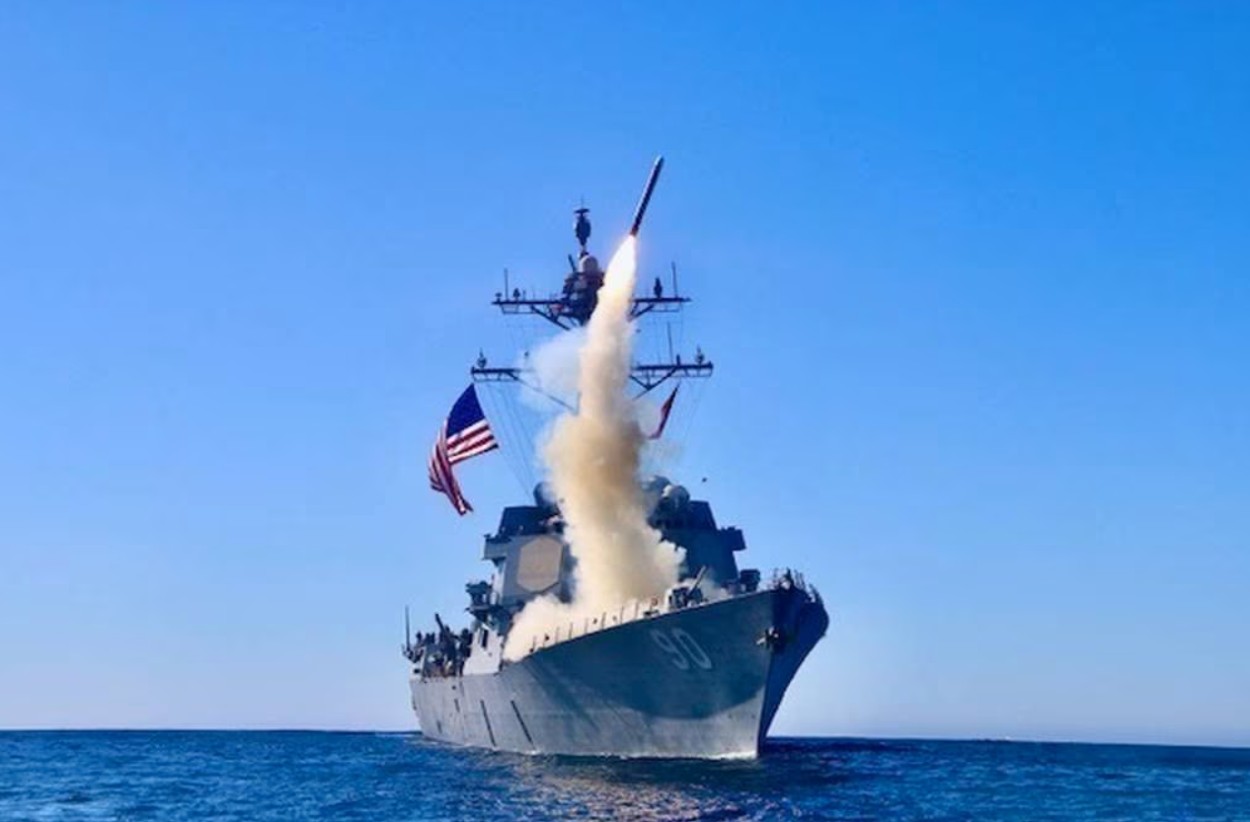
The Tomahawk is a long-range, subsonic cruise missile developed by the United States for precision strikes against land and sea targets. Manufactured by Raytheon (RTX), it has served as a key naval weapon since entering service in the early 1980s. Launched from ships, submarines, and now ground-based systems, it allows forces to engage heavily defended targets from standoff distances of over 1,000 miles while keeping launch platforms out of harm’s way.
With AFP Inputs