

US President Donald Trump asked a combat pilot which fighter jet is the world’s best. The answer wasn’t the F-22 Raptor or the F-35 Lightning II — it was the F-16 Fighting Falcon.
The F-22 Raptor is widely considered the world’s best air-superiority fighter, and the F-35 the best multi-role stealth fighter. However, despite these advantages, many USAF pilots still swear by the fourth-generation F-16’s capabilities.
And on Thanksgiving Day, a senior USAF pilot who took part in recent combat operations in Iran told the American President that he would not switch to the fifth-generation F-22 or F-35, even if the President paid him to do so.
“So could I ask, before I give my little speech to you – a little quick one – could I ask, so the F-16, you love it, right?” Trump asked US Air Force pilot Lt. Col. Brant Smith.
“World’s greatest fighter jet, sir,” Smith replied.
Trump then asked Lt. Col. Smith to compare the F-16 with other fighter jets, such as the F-22 or the F-35.
“The F-16 all day,” Smith replied. “You couldn’t pay me to switch airplanes.”
“I love flying this airplane. And I think there are very few pilots in this room that would argue with me. Both of those airplanes (F-22 and F-35) are great, and they have their place in the world and in the war. But this is a lot of fun. We get to do it all, and it does it all very well,” Smith said.
He also informed the President about the combat operations his unit flew with the F-16.
“We’re an F-16 unit. We’ve been here since about ten days before Epic Fury kicked off. And we’re flying combat operations out in the straits every day,” he said.
Trump also underlined the F-16’s key role in combat operations against Iran.
“Every day the stellar F-16 squadron is conducting missions across the Middle East to defend our interests and our assets – like few people could ever even think about. This year, you’ve flown more than 2,000 sorties over more than 12,000 hours across eight different operations, including Operation Epic Fury,” Trump said.
In Operation Epic Fury, the F-16’s central role has largely been overshadowed by the B-2 Spirit bombers and the F-35s. But does theF-16 hold any advantage over the F-22 or F-35?
F-16 vs. F-22 & F-35
The F-16 has long been seen as the pure, responsive, multirole “sports car” of fighter jets.
In several practical aspects, such as cost-effectiveness, mission-capable rates, and operational sustainability, the F-16 could be rated higher than both the F-22 and the F-35. In fact, few fighter jets in global aviation history match the F-16 Fighting Falcon’s aura, operational longevity, adaptability, and widespread adoption.
Developed in the 1970s by General Dynamics (now Lockheed Martin) as a lightweight fighter, it has constantly evolved over the last five decades into one of the most flexible multirole platforms ever: capable of air-to-air combat, close air support, precision strike, suppression of enemy air defenses (SEAD), reconnaissance, and more.
According to Lockheed Martin, 29 countries currently operate the F-16, which together fly more than 2,800 F-16s. The fleet has completed over 14 million sorties and more than 21 million flight hours.
The fighter’s adaptability to modern battlefield requirements is evident in Lockheed Martin’s backlog of over 110 orders for the latest F-16 Block 70/72 fighters from seven countries.
One of the F-16’s key advantages is its versatility.
The F-22 Raptor is optimized almost purely for air superiority roles. It has little to no ground-attack capability and is not a primary strike or multirole fighter.
The F-35 is a highly capable multirole fighter with stealth characteristics and excellent sensor fusion and networking. It is optimized for networked, beyond-visual-range (BVR) fights; however, its internal weapons bay severely limits how many munitions it can carry.
By contrast, the F-16 can carry and fire more than 180 types of weapons on its external pylons.
Smith’s emphasis on “we get to do it all” illustrates how F-16 units are used in various real-world operations.
Furthermore, the latest Block 70/72 configuration F-16s have seriously closed the avionics gap with the F-35 through the integration of the AN/APG-83 AESA radar, Link-16 tactical data links, helmet-mounted displays, a high-resolution Center Pedestal Display, an all-digital electronic warfare suite, Infrared Search and Track (IRST) sensors, and the Sniper Advanced Targeting Pod.
These systems deliver fifth-generation situational awareness on a proven fourth-generation airframe.
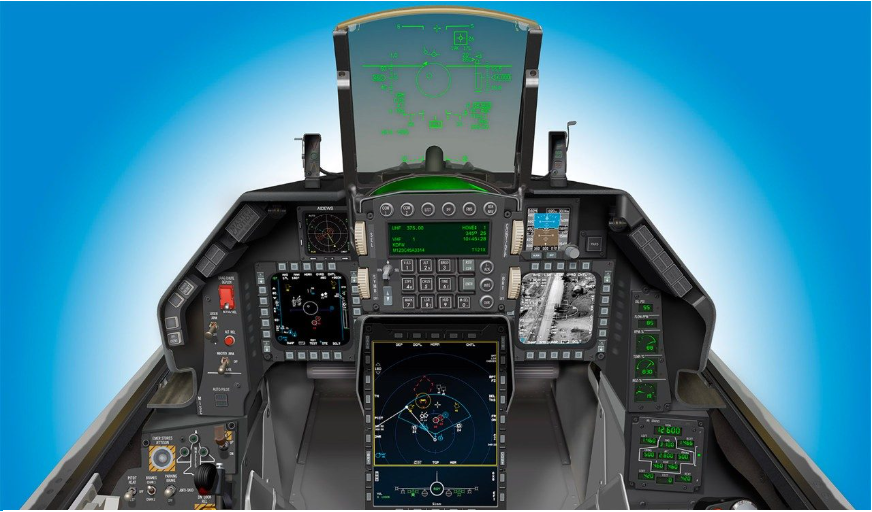
According to Lockheed Martin, “Northrop Grumman’s advanced APG-83 AESA radar provides the Block 70/72 with 5th-generation fighter radar capabilities by leveraging hardware and software commonality with F-22 and F-35 AESA radars.”
Another key F-16 advantage is its cost-effectiveness in terms of airframe, maintenance, and cost per flight hour.
The F-16’s cost per flight hour is around US$32,000, compared to US$47,000 for the F-35 and up to US$80,000 for the F-22 Raptor.
The F-16 is much cheaper to operate, enabling higher sortie rates and larger fleets.
Because of their complex onboard systems, sensors, and stealth coatings, the F-35 and the F-22 are much harder to maintain, which impacts their mission-capable rates.
According to the Government Accountability Office (GAO), mission-capable rates measure the share of time an aircraft can fly and perform at least one tasked mission.
A 2024 GAO report found that during 2018–2023, the F-22 never met its objective MC rate goal. By contrast, the F-16C met its goal three times, and the F-16D met it once during that period.
Similarly, in its June 2026 report, the GAO found that across the F-35 fleet, the mission-capable rate fell from 67% in FY2021 to 44% in FY2025, while the full mission-capable (FMC) rate dropped from 38% to 25%.
In prolonged conflicts, cost-effectiveness, availability, sustainability, and MC rates are crucial factors.
The high-tempo sortie rates Lt. Col. Smith’s unit achieved during Operation Epic Fury illustrate this point.
According to Trump, Smith’s F-16 unit, the 510th Expeditionary Fighter Squadron, flew over 2,000 sorties and more than 12,000 flying hours during the operation.
The F-16 is also highly maneuverable. Its high thrust-to-weight ratio, fly-by-wire controls, bubble canopy for visibility, reclined seat, and side-stick all make it a highly maneuverable fighter jet. Due to its better thrust-to-weight ratio, the F-16 is also faster than the F-35 and has a better climb rate.

In within-visual-range dogfights, the F-16’s high maneuverability plays a vital part for the USAF. Multiple F-16 pilots rate it among the best dogfighters, capable of beating most opponents in basic fighter maneuvers.
Lt. Col. Smith also said that flying the F-16 “is a lot of fun.” Other pilots echo this sentiment.
For instance, test pilot Billie Flynn, who has also flown fifth-generation jets, has called the F-16 the most fun fighter and “the sexiest, most aggressive fighter ever made.”
However, Lt. Col. Smith’s preference for the F-16 is also contextual.
His unit was flying combat operations against Iran, which is not a peer adversary and has an archaic air force consisting mostly of third-generation fighters, with a few older fourth-generation types.
Against a peer adversary such as China or Russia, most fighter pilots would prefer flying an F-35.
The F-16, however, would remain relevant even in the era of stealth fighter jets. The USAF has largely abandoned its long-standing ambition to transition to an all-stealth fighter force, opting instead for a mixed “stealth/non-stealth” fleet structure through at least 2035.
Under the updated fighter force structure, by 2035 the USAF aims for a 60% stealth fleet and a 40% fleet of upgraded fourth-generation fighters, split equally between the F-15s and the F-16s.
- Sumit Ahlawat has over a decade of experience in news media. He has worked with Press Trust of India, Times Now, Zee News, Economic Times, and Microsoft News. He holds a Master’s Degree in International Media and Modern History from the University of Sheffield, UK.
- He can be reached at ahlawat.sumit85 (at) gmail.com