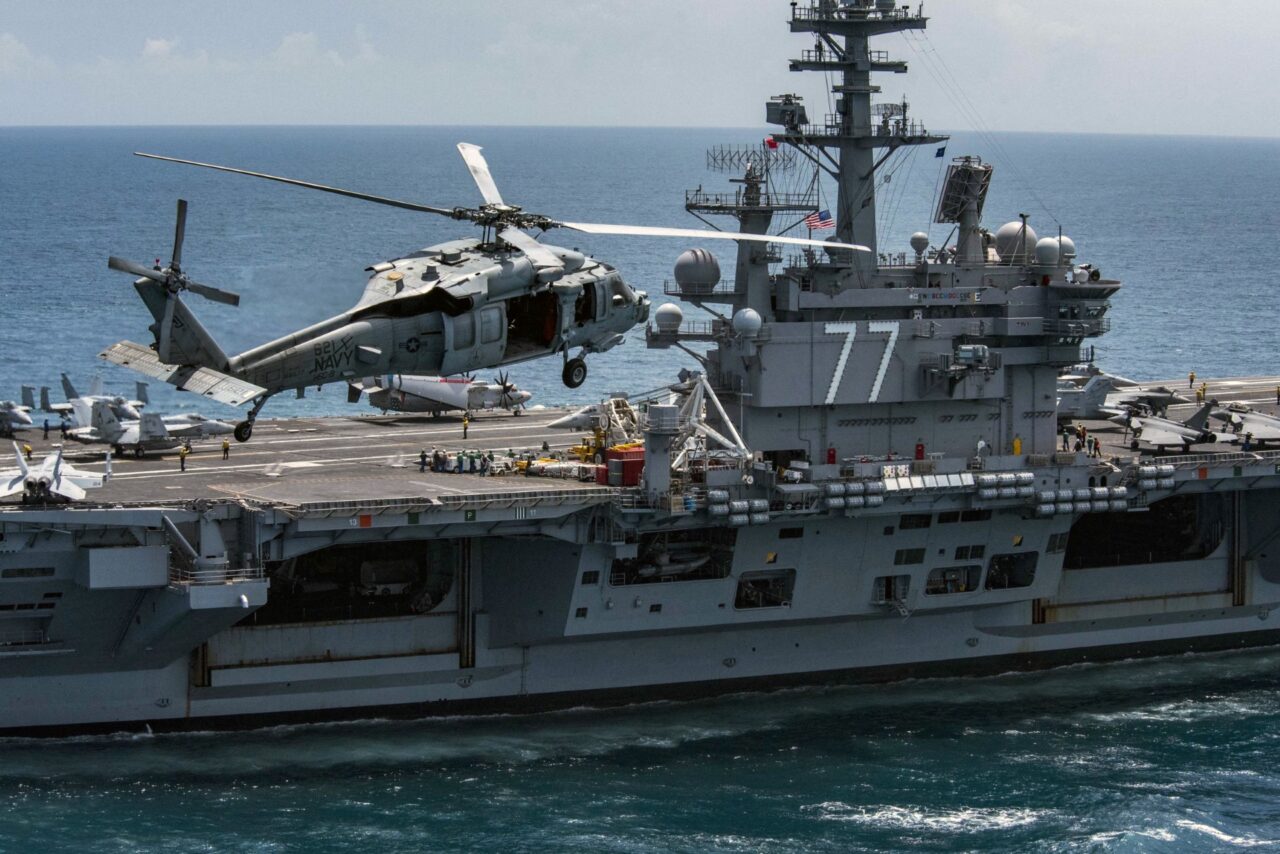
A U.S. Navy MH-60S Sea Hawk helicopter assigned to the USS George H.W. Bush aircraft carrier ditched in the Arabian Sea early on July 1, leaving one crew member missing, U.S. Naval Forces Central Command and the U.S. 5th Fleet said.
The incident occurred at approximately 3:30 a.m. EST. According to the Navy, there is no indication that the emergency was caused by hostile action.
Three of the helicopter’s four crew members were successfully recovered and are currently in stable condition aboard the George H.W. Bush. U.S. Navy assets in the region are continuing an active search for the missing aircrew member.
The Navy has not released further details about the circumstances leading to the emergency landing. The rescued crew members were medically assessed and are reported to be in stable condition. Search-and-rescue efforts are ongoing, with additional naval assets deployed in the area to locate the missing sailor.
The USS George H.W. Bush, a Nimitz-class aircraft carrier, is currently deployed to the U.S. 5th Fleet area of operations in the Middle East. The carrier and its strike group have been operating in the Arabian Sea and surrounding waters in support of regional maritime security missions.
What is Helicopter Ditching?
Ditching is an intentional, controlled emergency landing on water when a helicopter can no longer maintain flight. It is very different from an uncontrolled crash, as pilots follow pre-defined procedures to maximize everyone’s safety.
Unlike fixed-wing aircraft, helicopters can often perform an autorotation — using the upward airflow through the rotor blades to slow descent — giving crews a better chance of a survivable landing on water.
Even highly reliable helicopters like the MH-60S can suffer sudden issues with engines, transmissions, rotors, or hydraulics. In twin-engine aircraft, the loss of one engine is usually manageable, but combined failures or critical system malfunctions can force a ditching.
Running out of fuel, fuel contamination, or fuel system failures are recurring causes of ditchings worldwide. Over water, there are no nearby alternate landing sites, and many pilots are forced to land on the water.
Flying over the ocean at night or in poor visibility can present considerable challenges to aviators. Without a visible horizon, pilots can lose their sense of up and down. This is one of the leading causes of helicopter accidents over water, especially during shipboard operations.
Environmental factors also contribute to ditching: Severe turbulence, strong winds, heavy rain, or sudden changes in sea state can affect helicopter stability. Saltwater spray can also affect sensors and visibility.
A large bird strike, particularly to the rotor system or engines, can cause fatal damage requiring an immediate ditching.
Human Factors and Operational Pressure: High workload during ship landings and takeoffs, fatigue, or errors in judgment can contribute to these incidents. Although ruled out in the recent incident, damage to critical systems from hostile fire has historically led to ditchings in war zones.
Helicopter ditching is a scenario that naval aviators train for extensively. When it happens, survival depends on a pilot’s skill, aircraft design, crew training, and the speed at which rescue assets can respond. The ongoing investigation into the July 1 incident involving the USS George H.W. Bush will hopefully reveal exactly what went wrong.
While every ditching is different, survivor accounts from past incidents reveal just how quickly and disorienting the situation can become. In one U.S. Navy helicopter ditching, the aircraft experienced a transmission failure and was forced to autorotate into the water.
According to the accident report: “The helicopter experienced a material failure in the transmission… The pilots continued the autorotation and impacted the water in a 10-15 degree nose-up, wings-level attitude. The helicopter sank immediately. The co-pilot was pinned in his seat by debris from a collapsed instrument panel. His body position was approximately horizontal, and his face was turned down and underwater. He was stunned and disoriented, but used the HEEDS bottle.
He removed the instrument panel from his legs, released his harness, exited the aircraft and swam approximately 15 feet to the surface. The second crewman in the cabin section was thrown from his seat to the cabin floor. He was on his knees in chest-deep water as the aircraft sank. As the water rushed in, he recalls being dazed and disoriented, but alert.
He took a breath of air and reached for his HEEDS bottle… The HEEDS bottle had an instant calming effect. He oriented himself in the aircraft, disconnected his gunner’s belt, exited the aircraft, inflated his life preserver and floated approximately ten feet to the surface.”
This account highlights how rapidly a helicopter can fill with water and how critical training and emergency equipment become in those critical seconds.
Seahawks
MH-60 Seahawk is vital for US military operations in the region.
MH-60 Seahawk is a highly versatile, twin-engine, medium-lift helicopter used extensively by the US Navy for a variety of missions. It is basically a navalized version of the UH-60 Black Hawk, adapted for the challenging environment of shipboard missions.
The current fleet is standardized into two primary variants: the MH-60R “Romeo” and the MH-60S “Sierra.”
MH-60S is a multipurpose utility helicopter intended for both humanitarian and combat support operations. It is considered an ideal platform for mine countermeasures, vertical replenishment, search-and-rescue, and special operations support, thanks to its large cargo doors and high degree of configurability.
While it has the same airframe architecture as the MH-60R, its adaptability and transport capabilities are prioritized over the specialized sub-hunting sensor package.
Both choppers, R and S variants, operate across a range of platforms in littoral warfare, including surface ships, destroyers, and aircraft carriers. They can deliver vital supplies at sea or carry out life-saving rescues, thanks to their cargo hooks and rescue hoists. And, they can effectively hunt down enemy small boats.
These helicopters can detect and track small hostile ships at considerable distances using a combination of high-resolution radar and electro-optical/infrared sensors, enabling operators to maintain situational awareness even in crowded waterways.
This means that commanders can detect threats early and develop a precise, proportionate reaction thanks to this sensor integration.
- By ET Online Desk
- Follow EurAsian Times on Google News