The US Navy recently lost two of its EA-18G Growler electronic attack aircraft, which are no longer in production.
Two US Navy EA-18G Growler jets from the VAQ-129 “Vikings” Growler Demonstration Team, based at Naval Air Station Whidbey Island, Washington, collided mid-air during the Gunfighter Skies Air Show at Mountain Home Air Force Base in Idaho on May 17.
The jets were reportedly performing a close-formation demonstration when they collided around 12:10 p.m. local time, roughly 2 miles (or over 3 kilometers) northwest of the base, as noted by the 366th Fighter Wing in a post on Facebook.
One of the Growlers is seen closing in on the other from the rear before colliding, striking the lead aircraft’s back with its nose from above, in videos posted to social media after the chilling accident. After the collision, the two jets are seen stacked on top of one another as they moved vertically.
Nonetheless, the four pilots of the two affected planes managed to eject and safely parachute down to the ground even as their aircraft crashed and burst into flames. The air show was canceled after the accident, and the base was locked down.
The US Navy’s Super Hornet and Growler fleet has suffered significant attrition in recent years.
An EA-18G from VAQ-130 “Zappers” crashed on a routine training flight into a remote, steep, wooded mountainside east of Mount Rainier in October 2024, killing both pilots. Meanwhile, another Growler from VAQ-135 crashed in February 2025 during an approach to NAS North Island amid adverse weather and potential human error, although thankfully, both pilots ejected and survived.
In addition, the US Navy lost three Super Hornets (on which the Growler is based) between December 2024 and August 2025, as previously reported in detail by the EurAsian Times.
Every loss of the EA-18G Growler is a cause of concern for the US Navy because there is no direct, dedicated alternative to the EA-18G Growler in the US military’s inventory that matches its specific combination of carrier-based operations, advanced jamming capabilities, and SEAD/EA mission profile. Each Growler costs about $67 million.
More importantly, though, the Growler production lines ended in 2019, and Boeing has explicitly stated that it would not be restarted.

Currently, there is no direct replacement for the Growler on the immediate horizon.
The US Navy’s F/A-XX sixth-generation carrier-based fighter is a long-term program intended to replace the F/A-18E/F Super Hornet and assume significant portions of the EA-18G Growler’s electronic attack role. However, it does not help that the program has yet to get a jump start, as the Pentagon has so far prioritized the US Air Force’s F-47 Next-Generation Air Dominance (NGAD) project.
Even if the Pentagon moves ahead with the downselect between Northrop Grumman and Boeing for the F/A-XX in August 2026, the aircraft would not become operational until at least the mid-2030s, or perhaps later.
According to reports, the Navy plans to operate the existing 150–160 Growlers until at least 2046, driven by Next Generation Jammer (NGJ) upgrades, structural service-life extensions, and Growler Capability Modification (GCM) or Block II upgrades.
The ongoing attrition does not augur well for their operational readiness and overall combat capability, particularly as they also support the US Air Force (USAF) operations and are often the first to enter the battlefield and ensure the safety of the strike group.
These peacetime strains on the remaining airframes reduce overall availability, as several are currently undergoing upgrades.
No Alternatives For Growlers
The Growler is a carrier-based electronic warfare (EW) aircraft, a tailored version of the combat-proven two-seat Boeing F/A-18F Super Hornet. It provides tactical jamming and electronic protection to US military forces and allies worldwide, as recently seen in the US-Iran war.
Combining speed and maneuverability with advanced Electronic Warfare, the EA-18G Growler is considered among the most advanced airborne electronic attack (AEA) platforms in the world. It provides critical electronic intelligence, surveillance, and reconnaissance (ISR) data to other joint-force aircraft, playing the most instrumental role in a modern networked combat environment.
The aircraft is equipped with the APG-79 Active Electronically Scanned Array (AESA) radar system for improved radar image resolution and tracking range, and the INCANS Interference Cancellation System for uninterrupted radio communications in a heavily jammed environment.
Additionally, the Growler has a Joint Helmet-Mounted Cueing System for unparalleled aircrew situational awareness and head-up control of aircraft targeting systems and sensors, and its ALQ-227 Communications Countermeasures Set helps locate, record, playback, and digitally jam enemy communications across a wide frequency range.
The aircraft is also equipped with AN/ALQ-218 wideband receivers on the wingtips and ALQ-99 high- and low-band tactical jamming pods, which together create a full-spectrum electronic warfare suite capable of detecting and jamming all known surface-to-air threats.
The Growler retains Super Hornet performance and can carry kinetic weapons, such as AGM-88 HARM or AARGM anti-radiation missiles, to destroy radars it has jammed or detected. Additionally, the aircraft carries two AIM-120 Advanced Medium-Range Air-to-Air Missiles (AMRAAM) for eliminating an adversarial aircraft.
It provides advanced survivability and electronic protection for ground, air, and maritime combat forces with high reliability and lower operating costs. And at the same time, it blinds surface-to-air missile (SAM) sites, early-warning radars, and fire-control systems, limiting enemy coordination, command-and-control, and targeting.
In real time, three Growlers connected to a network can produce targeting tracks for adversarial radio-frequency emitters. The Growler might use its EW pods to precisely pinpoint signal sources, enabling faster data transfers, as explained by the EurAsian Times. When one of the three planes picks up a signal from a source, such as a cell phone, the other two can listen for it as well. All three measure the time it takes for transmissions to travel from the source to each aircraft, enabling triangulation to “a very, very small area.”
Unlike other aircraft of a US strike package, the Growler does not primarily drop bombs but creates conditions for other aircraft to operate safely. For example, a stealth aircraft may not be able to hold off on its own in a contested environment with hostile air defenses.
This is where the Growler comes in.
The EA-18G Grolwer degrades the enemy’s ability to detect and engage, thereby multiplying the effectiveness of friendly forces. It supports first-strike or deep-strike missions by suppressing defenses and performing stand-off and escort jamming.
Simply put, it serves as the “first line of defense in hostile environments,” enabling strike packages that include stealth aircraft such as the F-35 and strategic long-range bombers to operate by blinding enemy sensors.
The Growlers played a very crucial role in Operation Absolute Resolve in Venezuela in January 2026, which led to the extraction of the former Venezuelan President Nicolas Maduro and his wife.
Operating from the deck of the USS Gerald R. Ford carrier strike group, the Growlers provided crucial suppression of enemy air defenses (SEAD) by jamming Venezuelan radar systems, disrupting military communications, and degrading integrated air-defense networks. This non-kinetic electronic attack created safe corridors for US special operations choppers to conduct a daring raid into Caracas without any meaningful resistance.
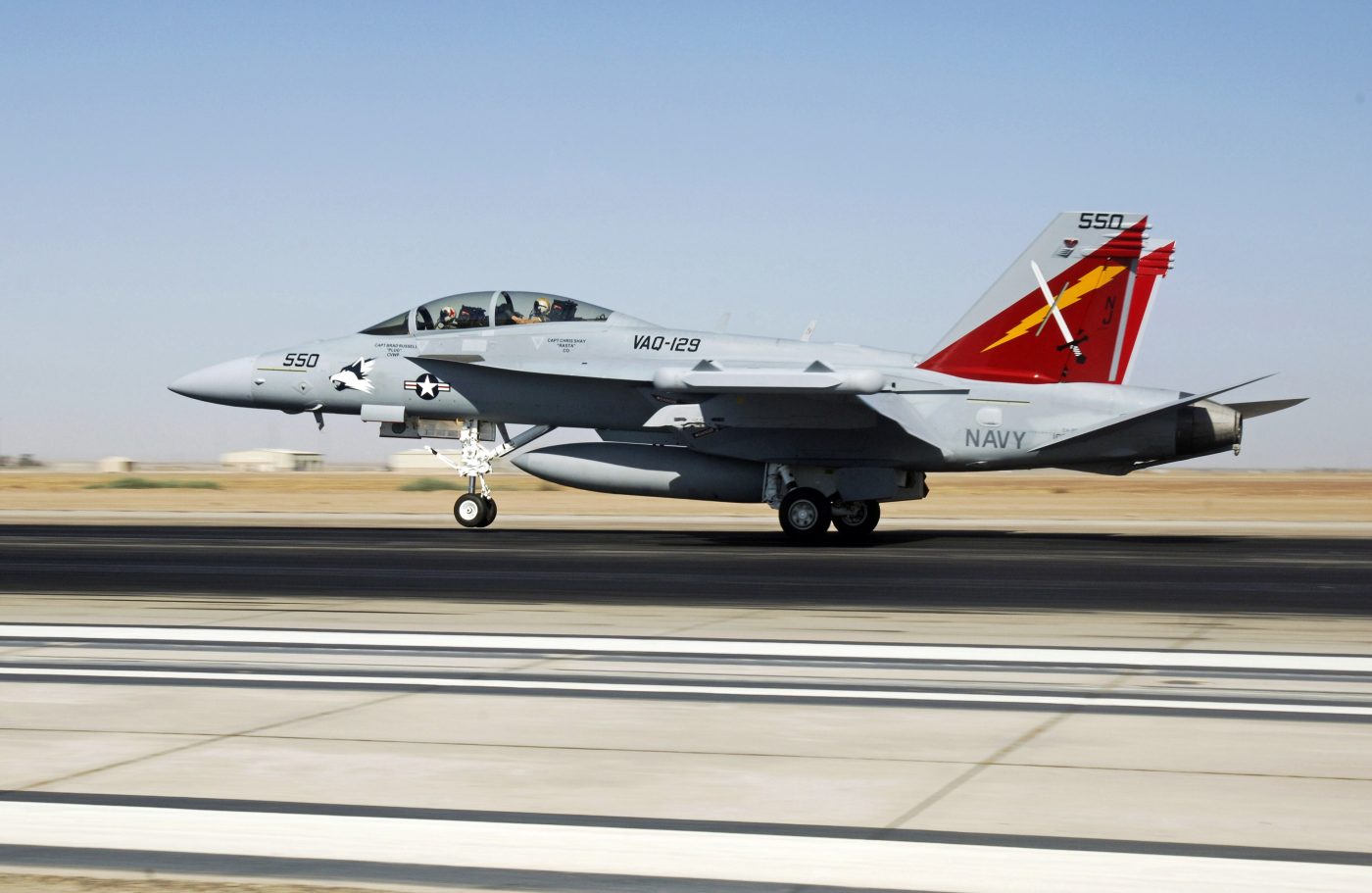
More recently, the aircraft played an indispensable role in Operation Epic Fury against Iran, becoming a “day-one” enabler for air operations. The Growler essentially paved the way for the US aircraft to conduct strikes across Iran, blinding and decapitating Iran’s dense, layered integrated air defense system (IADS) composed of Russian-origin radars, surface-to-air missiles, and ground-based networks.
Notably, the aircraft is expected to be very crucial in a conflict involving China, which is virtually never off the table.
It must be noted that advanced A2/AD (anti-access/area denial) systems, such as those erected by China along its coastline, rely heavily on radars and networks. The Growler, on its part, is essential for disrupting these “kill webs” and ensuring the success of the strikes.
Losing Growlers reduces the US military’s ability to penetrate defended airspace and protect other assets.
The US Navy operates roughly 153–160 Growlers. This is a relatively small number for a fleet that must support multiple carrier strike groups, expeditionary squadrons, training, and maintenance rotations.
Every loss of this aircraft eats into a scarce, high-value capability that no other platform fully replicates today.
- Contact the author at sakshi.tiwari13 (at) outlook.com
- Follow EurAsian Times on Google News