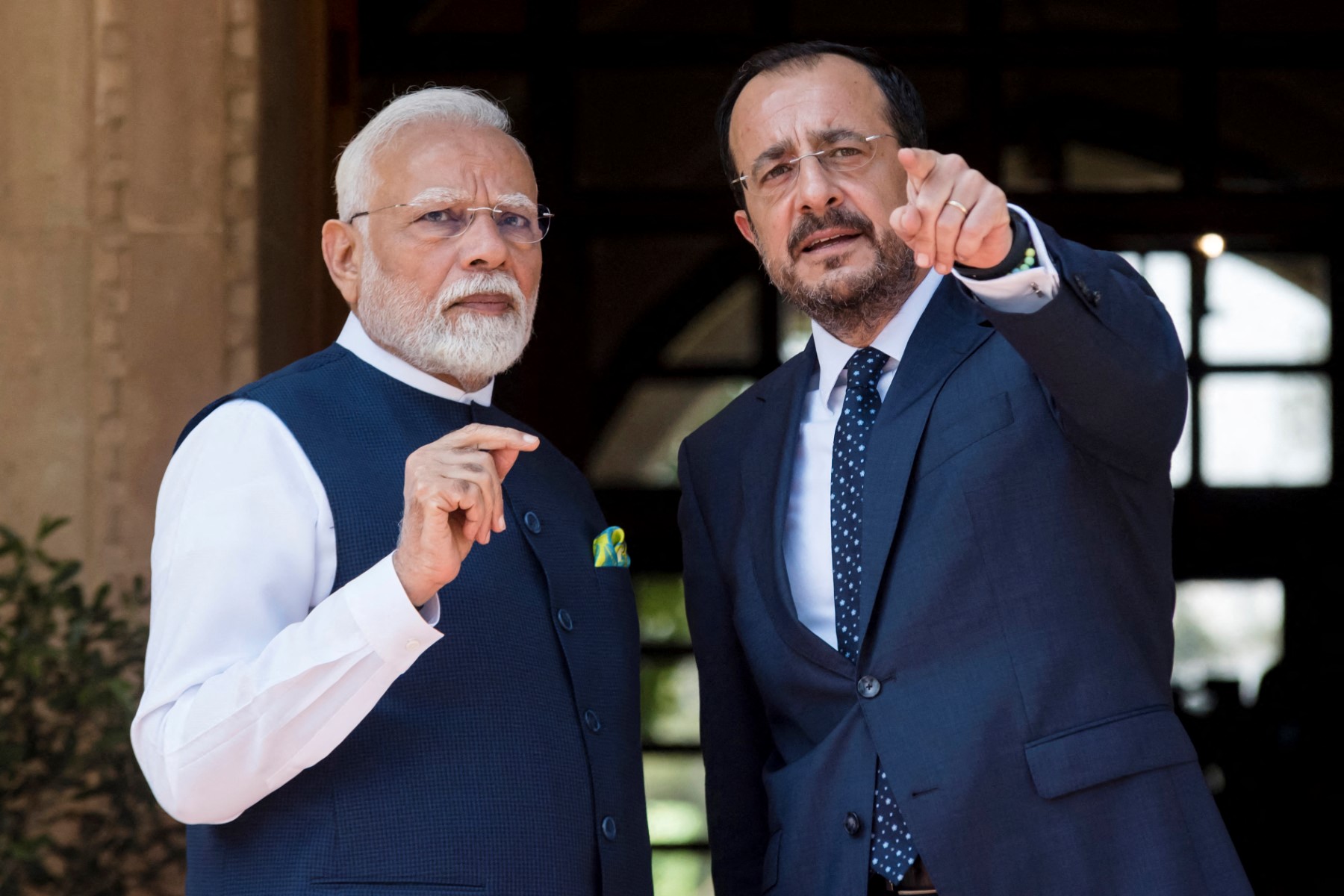
Cyprus President Nikos Christodoulides arrived in the Indian capital, New Delhi, carrying the Cypriot flag and a larger strategic objective. The message was clear: this small island nation on Europe’s southeastern frontier is being recast as the crucial bridge between the Indo-Pacific, the Eastern Mediterranean, and Europe’s core.
The dates now read like coordinates.
Modi in Cyprus in June 2025. Netanyahu, Mitsotakis, and Christodoulides in Jerusalem in December 2025. Mohamed bin Zayed in Delhi in January 2026. EU leaders in India that same month. Modi in Jerusalem in February 2026. Mitsotakis had opened the Greek line to Delhi in February 2024.
These were not visits. They were assemblies. One after another, India, the Gulf, Israel, Cyprus, Greece, and Europe stopped merely convening around a map — they began building one.
During Modi’s visit to Israel, New Delhi and Jerusalem moved beyond technology and security. They elevated the partnership and bound it to IMEC, the India-Middle East-Europe corridor, and I2U2, which includes Israel, India, the UAE, and the USA.
Israel is no longer merely India’s security partner in the Middle East. It is India’s Mediterranean bridgehead into Europe. The two visits fused capital, ports, energy, data, infrastructure, and security into one operating code. The Emirates are not scenery on the corridor. They are the engine.
Greece and Cyprus anchor the European coast. At the trilateral summit in Jerusalem, Israel, Greece, and Cyprus connected the sea, energy, electricity, gas, critical infrastructure, and IMEC into one framework. Mitsotakis and Christodoulides did not come for photographs with Netanyahu. They came to say that the road from India to Europe does not end in Haifa. It passes through Nicosia, Athens, the Balkans, and Europe’s hinterland.
IMEC is the skeleton. It was born as a sea-and-rail corridor connecting India to the Gulf and the Gulf to Europe, carrying energy, data, and trade. Rome’s move with Delhi confirmed that the European end is formalizing. But a skeleton is not a body. Without a Mediterranean anchor, IMEC remains a diagram that reaches the water and cannot become sovereignty. Israel, Cyprus, and Greece turn the diagram into a system.
EastMed is the backbone of the whole thing — the gas pipeline linking Israel, Cyprus, and Greece. It’s not just steel and pipes. It’s a principle: Israeli and Cypriot gas flowing straight to Europe via Cyprus, Crete, and Greece, with no need to ask Ankara for permission.
The Vertical Corridor, the northbound Balkan energy route, gives depth. It carries the Greek entry point north through Bulgaria, Romania, Moldova, and Ukraine. Thus, the Mediterranean is not the corridor’s end, but its European beginning. IMEC moves to India. EastMed supplies sovereign energy. The northern route carries both into Europe’s depths. This is no longer connectivity. This is breathing.
A rival system is forming against it.
Saudi Arabia and Pakistan signed a defense pact; Pakistan has reportedly deployed thousands of troops, jets, drones, and air defense in Saudi Arabia; and Turkey is in talks over a security compact with Riyadh and Islamabad. Turkey is not yet a signatory, but it is already part of the equation.
Saudi Arabia brings capital and standing. Pakistan brings an army, a nuclear deterrent, and industrial depth. Turkey brings chokepoints, NATO access, the Caucasus, Syria, Libya, Cyprus, the defense industry, and disruption.
The alignment of India, the UAE, Israel, Cyprus, Greece, and Europe is a counterweight, not an anti-Saudi bloc. Saudi Arabia itself is a link in IMEC, and a reminder that corridors do not operate in diplomatic purity. They operate under pressure.
If the Middle Corridor entrenches Ankara as the gate through Kazakhstan, the Caspian, Azerbaijan, Zangezur, and Turkey, IMEC inverts the map. Anchored by EastMed and Europe’s northern depth, it neutralizes the veto before it is born.
Zangezur is a narrow strip of land that punches way above its weight. Under the U.S.-backed TRIPP route, it would link Azerbaijan directly to Nakhchivan through southern Armenia and onward into Turkey — turning a sleepy passage into a powerful Turkish-Eurasian lever.
This is the Constantinople Protocol in motion, whether anyone names it or not. For Israel, the rule is simple: no Turkish dependency may become a veto over freedom of action. For Europe, the lesson is colder. A gate can remain open in law and still fail in practice. The Bosphorus does not need to be closed; administrative measures are enough. Zangezur does not need to announce itself; determining passage is enough. Every exposure must be replaceable before it becomes coercion. Redundancy replaces protest.
Kazakhstan exposed the problem. Trump did not bring it into the Abraham Accords. There was nothing to normalize. Israel and Kazakhstan have had relations since 1992. The announcement produced embarrassment in Jerusalem, not strategy. Ministers were instructed to remain silent. No statement was issued. The silence was policy: Jerusalem refused someone else’s theatre.
The failure was not the absurdity. It was the map. Kazakhstan is not IMEC. It belongs to that other map: China, Central Asia, the Caspian Sea, Azerbaijan, Zangezur, Turkey, Europe. Washington wrapped a Turkish-Eurasian route in a Middle Eastern brand. It did not strengthen the Abraham Accords. It confused rival architectures.
IMEC reduces dependence on Turkey. The Middle Corridor entrenches it. Kazakhstan was not added to the Abraham Accords. It was added to American confusion.
Biden reached the same place by another route. In January 2022, his administration withdrew political support for EastMed. The explanation was environmental and economic. The reality was power: the pipeline clashed with Washington’s preference not to confront Turkey’s self-appointed role as a gatekeeper. Weeks later, Russia invaded Ukraine, and Europe discovered that energy dependency is not a budget item but a sovereign risk. The project designed to reduce that risk was frozen just before the risk exploded.
President Trump views corridors through deals, minerals, and spectacle. Joe Biden saw EastMed through the lens of climate, de-escalation, and managing Ankara. One blurs. The other freezes. Both leave Washington managing dependency instead of making it redundant.
Washington remains an indispensable ally. It cannot be the operating system. Sovereignty that rests on an American mood is not sovereignty. It is a fluctuation.
Pakistan is the warning. Washington knew the problem and still called it access: intelligence, logistics, mediation. The Turkish file carries the same structure: too useful to abandon, too dangerous to confront, too central to bypass. For Washington, Pakistan remains a channel. For Delhi, Jerusalem, Nicosia, and Athens, Pakistani-Turkish convergence is a structural risk. That is where the interests split.
Delhi closed the circuit. India can now reach Europe through a map no gatekeeper controls. The route no longer asks permission. Geography stops being blackmail.
- Shay Gal works with governments and international institutions on strategic risk, security architecture, and high-stakes decision-making.
- This is an Opinion Article