India appears to have taken another leap in its hypersonic cruise missile (HCM) program, setting a benchmark for indigenous defense innovation while heading towards entry into a select club of countries.
“DRDL Hyderabad has conducted the second successful extensive long-duration test of Actively Cooled Full Scale Scramjet Combustor, achieving a run time of over 1200 seconds at its state-of-the-art Scramjet Connect Pipe Test (SCPT) Facility on May 09, 2026,” India’s Defence Research and Development Organisation (DRDO) announced on X. “This is a major advancement towards the Hypersonic Missile Programme,” it added.
The scramjet, meant to propel hypersonic missiles, has been designed and developed by DRDO’s Hyderabad-based subsidiary, the Defence Research and Development Laboratory (DRDL). The test was conducted at the Scramjet Connect Pipe Test (SCPT) facility.
Notably, the latest demonstrated runtime exceeds the combustor’s previous top ignition time of more than 700 seconds, achieved in January 2026.
Before this, DRDL had successfully ground-tested a subscale actively cooled scramjet combustor for more than 1,000 seconds at the same facility in April 2025.
India’s Ministry of Defense (MoD) emphasized in its statement that these ground tests have validated the combustor design and the capabilities of the test facility. The latest test has positioned the scramjet combustor for full-scale, flight-worthy testing, which is crucial to advancing India’s hypersonic missile program.
The combustor reportedly uses indigenously developed liquid hydrocarbon endothermic fuel. Additionally, it is equipped with a high-temperature thermal barrier coating (TBC) designed to withstand temperatures exceeding steel’s melting point.

Hypersonic missiles travel at more than five times the speed of sound and are very hard to detect by existing air defense systems due to their high speed, low-altitude flight, maneuverability, and plasma sheath effects that can disrupt radar and communications.
Currently, only a few countries, Russia and China, are believed to have developed and deployed hypersonic missiles, although states like Iran and North Korea are alleged to have developed the capability despite sanctions. Meanwhile, the United States—boasting the world’s most powerful military—has yet to deploy an operational hypersonic weapon.
For India, which has traditionally relied on arms imports to bolster its combat power, the development of an indigenous hypersonic weapon would be a much-needed boost to its defense industry and combat capabilities readiness.
Moreover, it would also help deter Pakistan, which is currently being armed to the teeth by China and is probably set to receive potent hypersonic cruise missiles as part of that effort, if it hasn’t already received them.
During last year’s Indo-Pakistan conflict, Pakistan’s surface-to-air missile (SAM) systems, such as the HQ-9 and HQ-16, were found to be leaking India’s air-launched supersonic missiles. The addition of more advanced hypersonic missiles could, at least in theory, make these systems more vulnerable to an Indian onslaught in a conflict situation.
The Latest Test & India’s Hypersonic Program
A supersonic combustion ramjet (scramjet) engine is very different from a ramjet engine that powers missiles like Akash and BrahMos.
Hypersonic speed is achieved through an advanced air-breathing engine that employs supersonic combustion to sustain long-duration, high-speed flight. “In a ramjet, airflow in the combustion chamber is subsonic, whereas in a scramjet, it remains supersonic throughout the combustion process. A scramjet engine is an absolute prerequisite for sustained, level hypersonic flight within the atmosphere,” as explained by Indian Air Force veteran and a seasoned military commentator, Squadron Leader (retd) Vijainder K. Thakur.
At such incredibly high speeds, air friction and combustion can generate extreme heat in the combustor, perhaps exceeding 2,000–3,000°C.
This can melt or degrade engine materials in seconds without advanced cooling.
It is pertinent to note that an actively cooled scramjet combustor is the most critical component of a scramjet engine. Active cooling circulates a coolant or fuel through channels in the combustor walls to absorb intense heat from the hot gas via convection, keeping the wall material below its melting point.
The fuel is then injected through precise orifices, struts, or wall ports into the supersonic airflow. This injection is carefully designed for rapid mixing in just a few milliseconds, as the flow is moving extremely fast.
However, this process is very challenging, as Squadron Leader Thakur earlier explained in a detailed EurAsian Times report.
For one, maintaining stable combustion during engine start in supersonic airflow is one of the most difficult challenges in scramjet development. “Igniting a scramjet is often likened to lighting a matchstick in a hurricane,” notes Thakur.
The scramjet combustor generally employs an innovative flame stabilization technique to maintain a stable flame at air speeds exceeding 1.5 kilometers per second.
On their part, the DRDO scientists conducted numerous ground experiments and investigated several innovative and promising ignition and flame-holding approaches before developing the scramjet engine layout.
As far as the system’s specialized fuel is concerned, the Indian MoD stated that the key to the innovation is an indigenous endothermic scramjet fuel, originally developed in collaboration with industry partners and the DRDL. The fuel has two advantages: it significantly improves cooling and is relatively easier to ignite.
DRDO states that these endothermic fuels undergo chemical reactions when heated, absorbing large quantities of heat, thereby cooling the engine structure and conditioning the fuel, thereby improving combustion efficiency.
That said, other challenges include maintaining structural integrity and flight control at hypersonic speeds.
As Thakur explained, “At Mach 5 and above, atmospheric drag generates intense frictional heating. The missile airframe must withstand extreme temperatures without structural degradation. Additionally, frictional heating can cause the missile to become enveloped in a plasma sheath, disrupting radio communications and guidance signals.”
DRDO has achieved a major milestone in its hypersonic program by developing the Thermal Barrier Coating (TBC), designed to withstand the extremely high temperatures encountered during hypersonic flight. DRDL and the Department of Science and Technology (DST) have collaborated to develop an advanced ceramic TBC with high thermal resistance that can operate above the melting point of steel.
All these advancements together have paved the way for the 20-minute run of the Actively Cooled Full-Scale Scramjet Combustor.
Notably, India’s hypersonic program centers on the Defense Research and Development Organization (DRDO) and builds on decades of work in propulsion, materials, thermal management, and guidance. India is currently pursuing both air-breathing scramjet cruise missiles and boost-glide systems or hypersonic glide vehicles, as they are popularly known.
The core hypersonic project is the HSTDV (Hypersonic Technology Demonstrator Vehicle), which essentially serves as India’s foundational scramjet demonstrator, which is an unmanned, autonomous vehicle for hypersonic flight testing, as previously explained by the EurAsian Times. The HSTDV is a test bed for the development of a Hypersonic Cruise Missile, intended to demonstrate autonomous, air-breathing, sustained hypersonic flight with kerosene fuel. In the past, DRDO’s HSTDV successfully demonstrated short-duration scramjet engine operation and was instrumental in India’s hypersonic effort.
Some of the major hypersonic programs currently under development by the Indian defense industry include the BrahMos II hypersonic cruise missile, the Extended Trajectory Long Duration Hypersonic Cruise Missile (ET-LDHCM), the Long Range Anti-Shipping Missile (LR-AShM), and the Dhvani Hypersonic Glide Vehicle.
Of these, BrahMos II is a successor to the Mach 3 BrahMos supersonic missile developed jointly by India and Russia. It is conceived as a scramjet-powered missile with a speed of about Mach 7-8 and a range of about 1,500 kilometers. Additionally, like its predecessor, it would be launched from ships, submarines, tactical aircraft, and ground-based platforms.
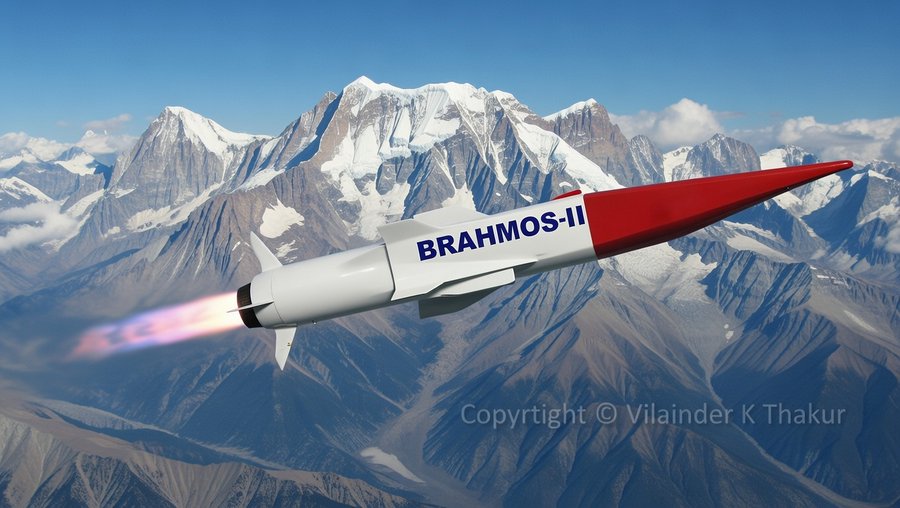
The development of the missile was reportedly paused earlier this month, probably due to factors such as high cost, high precision, and air defense (AD) penetration capability of the BrahMos missile, and Russia’s reluctance to transfer hypersonic flight scramjet engine technology, as you can read about in detail in a recent EurAsian Times report.
Meanwhile, the Extended Trajectory–Long Distance Hypersonic Cruise Missile (ET-LDHCM) program is an indigenous scramjet-powered HCM being developed under Project Vishnu. This missile is expected to have a speed of about Mach 8 to 10.
Boasting a range of 1,500 kilometers, the missile could penetrate deeply into adversary territory and target essential assets such as radar systems, command centers, and naval vessels. Like the BrahMos II, it could be launched from land, air, and maritime platforms. Additionally, this missile boasts formidable stealth capabilities, operating at low altitudes and conducting mid-flight maneuvers.
India is also reportedly pursuing the development of the Long Range Anti-Shipping Missile (LR-AShM), a hypersonic missile for the Indian Navy’s coastal batteries. It is designed to ensure that no carrier group can approach within 1,500 kilometers of the Indian coastline in an attempt to exert military pressure on the nation.
According to the Indian MoD, the missile follows a quasi-ballistic trajectory. It achieves hypersonic speeds starting at Mach 10, maintaining an average speed of around Mach 5.0 through a “multiple-skip” maneuver. Notably, a quasi-ballistic trajectory differs from a ballistic trajectory in that it is inherently unpredictable.
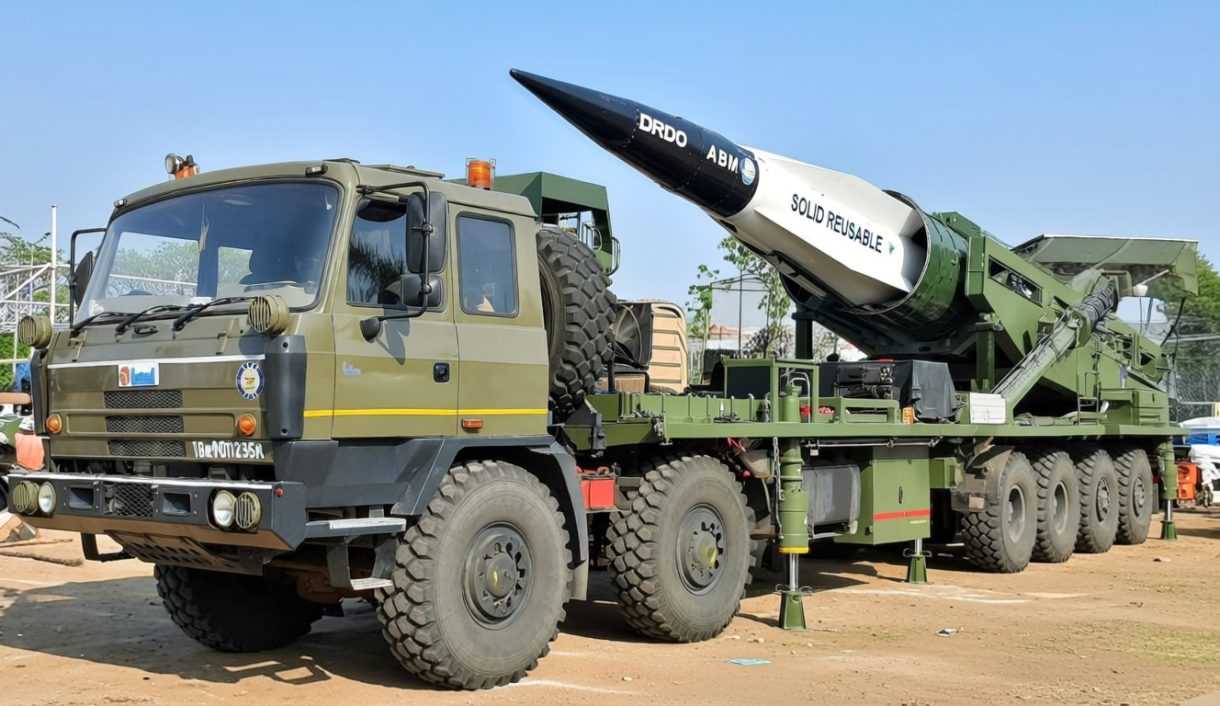
Additionally, the DRDO is working on the Dhvani Hypersonic Glide Vehicle, a derivative of the HSTDV. The missile is around 9 meters long and 2.5 meters wide, with a blended wing-body shape. Its cutting-edge heat protection system, which uses ultra-high-temperature ceramic composites, can withstand temperatures during atmospheric reentry ranging from 2,000 to 3,000°C. Its radar cross-section is significantly reduced by the stealth-optimized design, which includes smooth curves and slanted surfaces, making it nearly undetectable to hostile tracking systems.
Boost-glide flight involves lofting a hypersonic glide vehicle (HGV) to altitudes of approximately 40–100 kilometers using a booster rocket. The HGV then dives steeply toward Earth, attaining hypersonic speed under gravity, before transitioning to a flatter glide trajectory, trading altitude to counter atmospheric drag.
While these projects are at various stages of development, advances in scramjet testing position India at the forefront of the hypersonic race.
- Contact the author at sakshi.tiwari13 (at) outlook.com
- Follow EurAsian Times on Google News