

The Lowy Institute’s 2026 Asia Power Index is out, and China is not the most powerful country in Asia – the United States is.
However, the comprehensive power gap between the US and China is at its narrowest on record.
The US remains Asia’s top power with an overall score of 78.9, followed by China at 73.6. The gap between the two has narrowed to just 5.3 points, the smallest margin since the Australian think tank began publishing the annual index in 2018.
Together, the US and China are the only two superpowers in Asia, both scoring above 70 points.
India follows in third place. With a score of 40.5, it remains the region’s only major power, according to the 2026 rankings.
Behind the top three are 13 middle powers, with scores ranging from 15 to 40. These include Japan in fourth place, Russia in fifth, and Australia in sixth, followed by South Korea, Singapore, Indonesia, and Malaysia.
The report warns that despite widespread rhetoric about a “middle-power moment” on the global stage, superpowers increasingly dominate the international order.
China Does Not Gain, But the US Stumbles
The report notes that the narrowing gap in comprehensive national power between the US and China stems less from Beijing’s rise than from Washington’s own missteps.
“This narrowing divide owes more to Washington’s missteps than to any major advances on Beijing’s part,” the report states.
The United States’ unresolved war with Iran, which began in February 2026, has eroded American military capabilities by depleting long-range missile and interceptor stockpiles and profoundly undermining perceptions of US diplomatic influence both regionally and globally.
Notably, other think tanks have also highlighted the strain on US munitions.
Earlier this month, the US-based Center for Strategic and International Studies (CSIS) warned that Washington has burned through nearly all of its pre-war Precision Strike Missile (PrSM) inventory, almost three-fourths of its Patriot interceptors, more than half of its THAAD interceptors, one-third of its Tomahawks, and 25 to 35 percent of its SM-3 and SM-6 stockpiles.
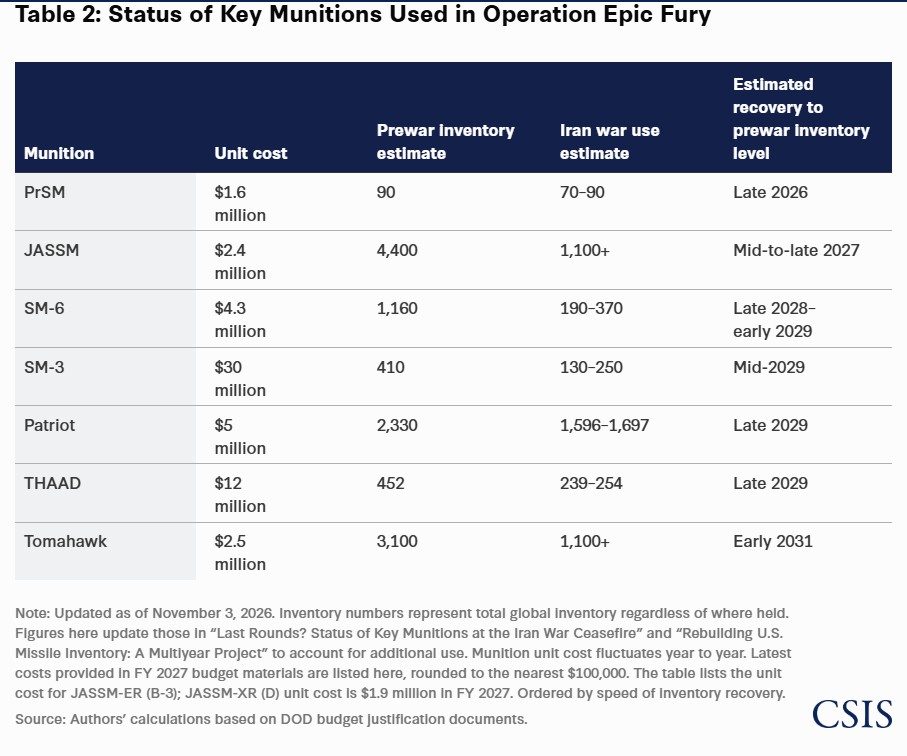
The think tank estimated that the US will take two to five years to replenish those critical munitions and return to pre-war inventory levels.
Another major factor is that the war in Iran forced the US to withdraw substantial military resources and diplomatic attention from Asia and divert them to the Middle East.
The Lowy Institute does not include Middle Eastern nations in its Asia rankings.
For instance, in August, the Asia-Pacific region was left without a single US aircraft carrier after the USS George Washington deployed from Yokosuka, Japan, to the Middle East.
Similarly, in March 2026, the US redeployed THAAD components and Patriot batteries from South Korea to the Middle East to bolster regional air defenses.
This shift in assets has weakened the US military posture in the Asia-Pacific.
“The conflict in the Middle East, following coordinated US and Israeli strikes on Iran in February, has fueled perceptions of Washington’s waning interest in Asia,” the report states.
The war also meant that over the past year, the US held fewer joint exercises and defense dialogues with its primary regional allies, including Australia, Japan, and South Korea.
Meanwhile, China has continued to modernize its armed forces.
“Its maritime warfare capabilities continue to expand, particularly in sea control and sea denial, while it maintains a sizable lead over the United States in ground-based missiles and ground forces,” the report notes.
Still, the paper emphasizes that even with the overall military gap at its narrowest, Washington maintains a visible lead over Beijing in several key domains.
For instance, the US military budget is nearly three times China’s, and Washington retains clear advantages in land warfare, air power, and transportation capabilities, which “allow it to deploy its forces and project military power across the globe.”
The report warns that although the United States maintains a considerable edge in ballistic missile submarines and long-range maritime forces, such as aircraft carriers and amphibious landing vessels, Beijing’s ability to deploy force quickly and at scale in the Pacific now outmatches Washington’s.
A major cause of the decline in comprehensive US power was a series of decisions by the Trump administration, including imposing unilateral punitive tariffs, repudiating international institutions like the UN and the International Criminal Court, engaging in a costly and unpopular war with Iran, and scaling back military exercises with US treaty ally South Korea.
These decisions have further eroded regional confidence in the United States, the report warns.
In fact, the US score for diplomatic influence fell by 6 points to 76.7 this year, marking its fourth straight year of decline and the steepest single-year drop in that category since the Asia Power Index began in 2018.
The report notes that rather than escalating efforts to contain China’s growing power, President Trump has largely embraced the notion of “constructive strategic stability.”
Earlier this month, Trump attended a trilateral summit with Chinese President Xi Jinping and Russian President Vladimir Putin, a gathering several analysts described as a de facto G-3.
This approach has further heightened insecurities among America’s regional allies, who fear that Washington might abandon its security commitments to them to maintain a more stable relationship with Beijing.
“While US–China détente is broadly welcomed throughout the region, Washington’s allies and partners are increasingly anxious about a potential US military withdrawal from the Pacific. They are also struggling to adapt to the Trump administration’s more transactional foreign policy, whereby treaty alliances and institutions no longer guarantee their security,” the report states.
One way US allies are responding to this uncertainty is by strengthening defense ties among themselves.
For instance, the Philippines has signed visiting forces agreements with several nations and a Reciprocal Access Agreement (RAA) with Japan. Manila has also inked deals with Australia to jointly develop defense infrastructure on its territory and with South Korea to buy a dozen fighter jets.
Similarly, Australia has signed an agreement with Japan to purchase Mogami-class frigates as part of its naval modernization, marking Japan’s largest defense export since World War II.
The report warns that if the US continues to rely on tariffs and other forms of political and economic pressure, Southeast Asian nations are likely to diversify their trade and security partnerships as a hedge against American unpredictability.
Moreover, if Washington “remains entangled in the Middle East, US influence in Asia may decline further.”
The US network of alliances is a major source of its strength and a key advantage over China. However, several Trump administration decisions have blunted that edge.
With only a 5.3-point gap separating US and Chinese comprehensive power, losing key allies such as South Korea, Japan, and the Philippines could prove detrimental to Washington’s standing in Asia.
Notably, the US held a substantial 9.5-point lead over China when the Lowy Institute launched the Asia Power Index in 2018.
As recently as 2024, the US still held a 9-point lead.
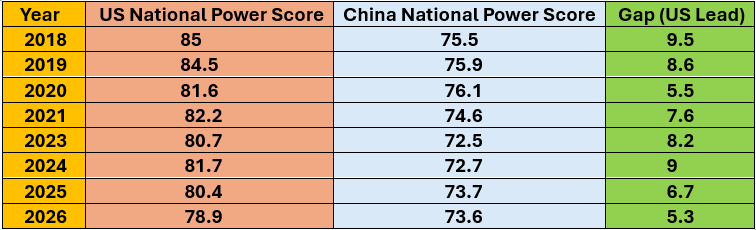
Over the past two years, however, that margin has narrowed sharply, dropping to an unprecedented low of 5.3 points this year.
If this trend continues, China could overtake the United States as Asia’s foremost power within the next decade, a shift that would carry grave consequences not only for Taiwan, Japan, the Philippines, and India, but also for American regional interests.
- Sumit Ahlawat has over a decade of experience in news media. He has worked with Press Trust of India, Times Now, Zee News, Economic Times, and Microsoft News. He holds a Master’s Degree in International Media and Modern History from the University of Sheffield, UK.
- He can be reached at ahlawat.sumit85 (at) gmail.com