When Canada’s new government, led by Prime Minister Mark Carney, launched a review of the F-35 deal with the U.S. in early 2025, many dismissed it as a largely symbolic gesture aimed at sending a diplomatic message to Washington amid Trump’s trade war.
Few expected Ottawa to actually scuttle the deal for 88 F-35 fighter jets, which could not only annoy Trump but also derail Canada’s relationship with its most important security and trade partner.
Nearly a year after ordering the review, and persistent arm-twisting by Washington, including public threats that Canada could be kicked out of NORAD if the deal is shelved, the review is still not complete.
Far from it, Canada has even refused to provide a timeline for the review that was supposed to be completed by September last year.
And now, Canada has even suggested it is seriously considering splitting the deal and buying some other foreign fighter jets instead of the F-35.
Ottawa, it seems, is prepared to play hardball with Washington.
Speaking before the Defense committee on April 27, Canada’s Defense Minister David McGuinty said Canada is still reviewing its plan to buy 88 Lockheed Martin F-35 fighter jets and that Ottawa could also purchase some foreign aircraft.
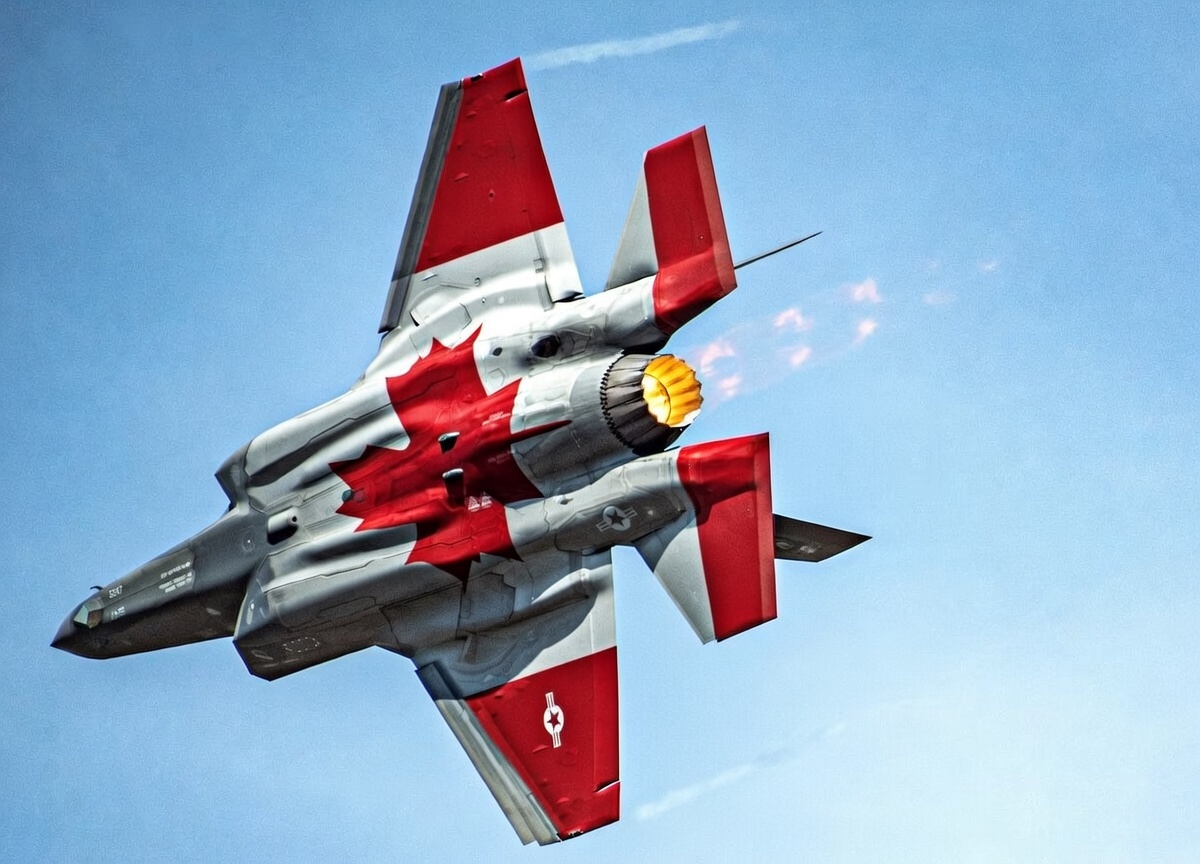
“The review of the purchase of the F-35s is continuing… We are taking the necessary time to study very, very closely the question of the fighter fleet,” McGuinty said.
“The question of other jets from other countries is something that is on the table, that is part of the review,” he added.
Notably, both France and Sweden have pitched their Dassault Rafale and Saab’s Gripen fighter jets, respectively, to Canada.
Saab has even promised to set up a production hub in Canada and to pursue full local manufacturing under its Made-in-Canada fighter pitch.
Besides, Sweden is offering full technology transfer (ToT), source code access for mission systems, sovereign data control, and full independent upgrade and maintenance capability to Canada.
The industrial benefits accruing to Canada by local manufacturing of fighter jets have made Saab’s offer very compelling.
Last week, McGuinty said that it’s “a question now of examining all of the industrial benefits,” adding the federal government is “looking at all of this to make sure we get this right.”
Further, he said that Canada still cannot provide a timeline for the over a year-long review of the purchase of F-35 fighter jets.
“What it says, I hope, for Canadians, is that we’re being very responsible,” McGuinty said, when asked whether the review is being delayed because the Canadian government is worried about the reaction of U.S. President Donald Trump.
“Obviously, the question of the F-35 remains under review,” he added. “The prime minister is engaged. I am very engaged in this issue. My colleagues in our emerging (Defense Investment Agency) are engaged.”
Clearly, after years of delays, friction, and internal review, the US-Canada F-35 saga remains far from resolved.
In January 2023, the Canadian government inked a CAD19 billion (US$14.2 billion) deal with Lockheed Martin to acquire 88 F-35 fighter jets in four tranches by 2032. The purchase was meant to replace the aging CF-18s of the Royal Canadian Air Force (RCAF).
However, Prime Minister Carney announced in 2025 that he would review the purchase of the F-35 beyond the 16 that have been paid for and are expected to be delivered by the end of 2026.
The review came as the US President Donald Trump imposed unprecedented tariffs on Canada, humiliated the Canadian leadership, and called on the country to become the 51st state of the US.
The Canadian government earlier asserted that it needs to “make sure that the contract in its current form is in the best interests of Canadians and the Canadian Armed Forces.”
After placing the purchase under review, the Carney government also indicated it was considering buying a European jet. Three different 4.5th-gen fighters, including the Rafale, Eurofighter Typhoon, and the Gripen-E/F, have since been in the reckoning.
A Parliamentary Budget Office (PBO) report published in November 2023 estimated that the cost to Canadian taxpayers of owning and operating a fleet of F-35 fighter jets over the next 45 years would reach a whopping US$73.9 billion. This calculated sum included the aircraft’s life cycle costs, from planning and development to use, maintenance and repair, and disposal.
A more recent report from Auditor General Karen Hogan stated that Canada’s planned purchase of F-35A fighters is facing a host of challenges, including skyrocketing costs, a lack of critical infrastructure, and a shortage of trained pilots.
According to the audit report, the estimated cost of the F-35 purchase has climbed to CAD 27.7 billion, up from the CAD 19 billion projection made by the National Defense in 2023.
The audit estimated that at least an additional CAD 5.5 billion would be needed to secure weapons and vital infrastructure, such as operational bases.
For now, the Canadian government is continuing with its review; however, this is not going to be an easy decision for Canada.
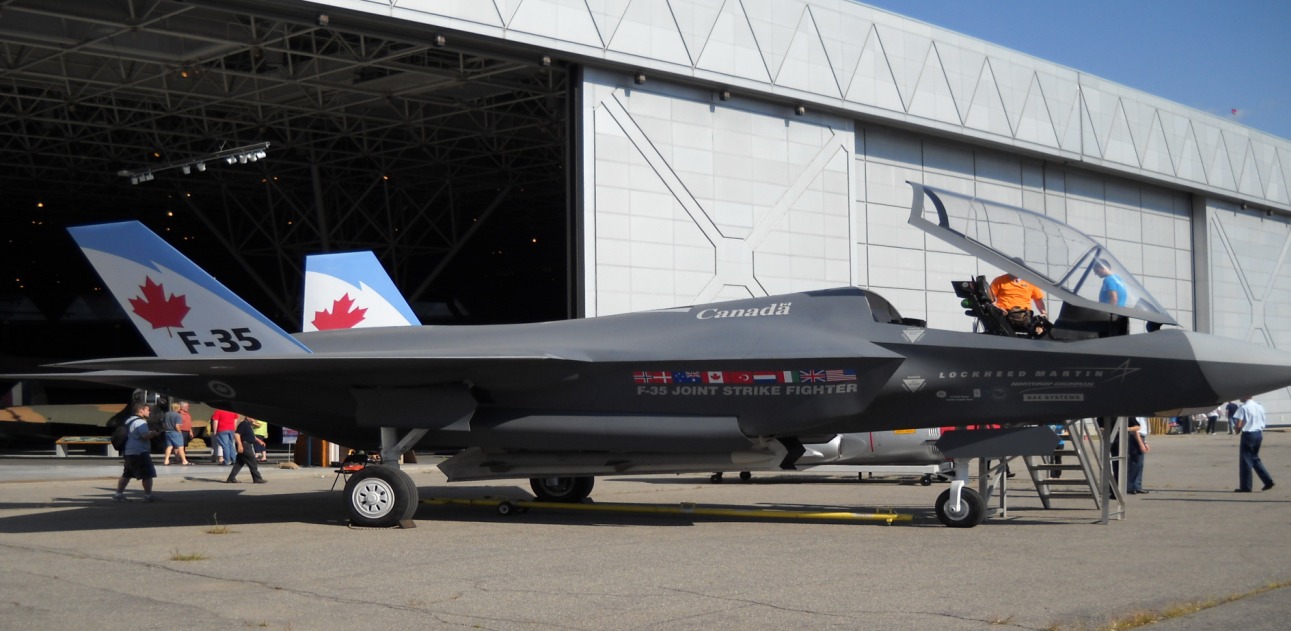
Writing in the Canadian media outlet CBC, senior defense reporter Murray Brewster suggested that, at this stage, it will be challenging to sell the decision, whatever it may be, as purely driven by defense needs.
“The Liberal government, senior officials, and even the chief of the defense staff have taken pains to downplay the political aspect and emphasize that when a new government takes over, it is natural to review big purchases. Fair enough. But these kinds of reviews are usually done quietly, behind the scenes, and not blasted all over the airwaves.”
That Canada’s F-35 review has irritated the Trump administration is clear from the remarks of the US ambassador to Canada, Pete Hoekstra. Speaking to a Canadian podcaster in August, Hoekstra said that the ongoing review is “an irritant that makes it harder to get to a [trade] agreement.”
Earlier, the US had suggested that not buying the F-35s would endanger NORAD, the binational defense pact with the United States.
While Canada is officially reviewing the F-35 deal, Ottawa understands that if it decides to scuttle it, it could face blowback on a host of issues, including a trade deal, joint military exercises, and intelligence sharing.
Notably, the US is Canada’s biggest security and defense partner.
According to SIPRI, the US supplied nearly one-third of Canada’s arms imports between 2021 and 2025.
Canada and the US are two of the founding members of NATO. They are also part of the “Five Eyes” intelligence-sharing alliance, which includes the US, Canada, Australia, New Zealand, and the UK.
Ottawa and Washington have also signed NORAD, a binational defense command for North American airspace and maritime approaches, and Canada is planning to join the Golden Dome project, US President Trump’s ambitious ground- and space-based missile defense system.
Similarly, the US is Canada’s biggest trade partner.
For instance, the Canadian exports to the US, at US$403–420 billion, accounted for 72–76% of all Canadian exports.
Similarly, Canadian imports from the US, at US$262 billion, accounted for 59% of total imports.
The bilateral Canada-US trade stood at US$720 billion, accounting for 65-70% of all Canadian trade.
Therefore, Canadian trade with the US is more than double its trade with all other countries combined.
Given this level of existential trade and security relations, the question is: can Ottawa really afford to annoy Washington by canceling the F-35 deal, which will cost Canadian taxpayers less than US$50 billion?
Not to forget that the Canadian Air Force is in dire need of modernization, and the F-35 is one of the most lethal strike fighters in the world.
Many defense experts have suggested that while Canada is delaying the review, this so-called ‘internal review’ is ‘theatrics’ wrapped in as a ‘strategy.’
“I suspect what they will find is that there are no good alternatives to proceeding with the F-35 procurement as planned, and that the fighter force is just unable to wait,” said Justin Bronk, Senior Research Fellow for Airpower and Technology, at the Royal United Services Institute (RUSI), a UK-based think tank.
Similarly, Lt Gen (ret.) Yvan Blondin, former commander of the Royal Canadian Air Force, argues that at least for Canada, “there’s no reason to cancel…” “Just buy it,” Blondin suggests.
Andrew Latham, Senior Washington Fellow at the Institute for Peace and Diplomacy, argues that the public “review” language is a pretense while actual spending and procurement momentum show Canada is already “going all in” on the F-35 and will not walk away.
He notes that funding long-lead components locks in the deal and narrows alternatives.
“Canada can keep pretending it is still at the start of the decision tree. The purchase of long-lead parts suggests it knows better,” Latham said in an article in February this year.
Furthermore, Latham argues that Canada is already so deeply integrated in NORAD and continental defense that buying any other jet would create a host of complications, including sensor fusion and real-time data sharing.
So, one wonders whether Ottawa is seriously reviewing the F-35 deal or if Canada is only bluffing to assuage national sentiments?
- Sumit Ahlawat has over a decade of experience in news media. He has worked with Press Trust of India, Times Now, Zee News, Economic Times, and Microsoft News. He holds a Master’s Degree in International Media and Modern History from the University of Sheffield, UK.
- VIEWS PERSONAL OF THE AUTHOR.
- He can be reached at ahlawat.sumit85 (at) gmail.com