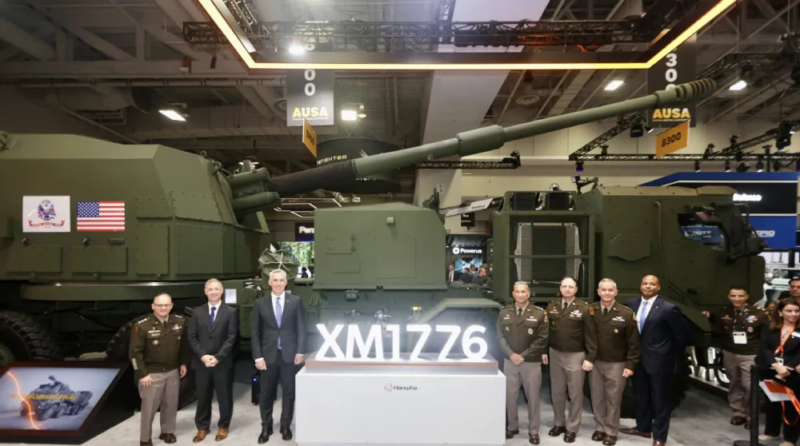
EurAsian Times has repeatedly argued that artillery is by no means becoming obsolete. That assessment was reinforced on October 12 when Hanwha Defense USA and the U.S. Army unveiled the XM1776 Mobile Tactical Cannon—the American version of Hanwha’s K9 Mobile Howitzer—at an official naming ceremony at the HDUSA booth during the Association of the U.S. Army’s 2026 Annual Meeting and Exposition (AUSA).
HDUSA also announced that the U.S. Army has ordered nine prototype wheeled XM1776 MTC systems, with an option for nine additional MTCs.
“The XM1776 Mobile Tactical Cannon represents the launch of the U.S. Army’s new long-range precision fires modernization effort and its powerful partnership with HDUSA to produce this system at speed and scale,” said Mike Smith, Hanwha Defense USA COO and President of Land Systems. “As we celebrate America’s 250th anniversary, Hanwha is committed to delivering industrial strength, mature capability, and proven technologies that accelerate U.S. production and expand America’s artillery industrial base.”
HDUSA is establishing a Phase I site in Opelika, Alabama, that will serve as the U.S. integration and test facility for the XM1776 MTC and Hanwha’s family of K9 Mobile Howitzers. To accelerate supply chain localization, company leadership will meet with more than 70 existing and potential suppliers to develop an Artillery Industrial Base Coalition in the U.S.
Earlier, the US Army awarded Hanwha Defense USA a deal to supply K9 mobile howitzer prototypes for the new self-propelled howitzer modernization program.
“The agreement provides for the accelerated delivery of six prototype MTC [Mobile Tactical Cannon] systems, with an option for an additional 12,” the US Army said in a statement. “Soldiers will use these platforms in a series of operational experiments to assess performance, reliability, and supportability in realistic combat conditions.”
U.S. troops will operate the prototypes in a series of trials intended to help the Army evaluate its performance, dependability, and supportability. “Data and insights gained from these experiments will directly inform senior leaders’ decisions on future fielding,” the Army added.
Hanwha Defense USA had offered its wheeled K9 platform to the U.S. Army. Other contenders included Elbit Systems USA, American Rheinmetall, General Dynamics Land Systems, and BAE Systems.
The South Korean-origin Howitzer will replace the self-propelled M109A7 and the towed M777 howitzers.
“We’re focused on creating a U.S.-anchored K9 Mobile Howitzer manufacturing network – with Opelika, Alabama, as the current phase I launch point – that can deliver advanced Mobile Tactical Cannons at the speed and scale the U.S. Army needs,” Jason Pak, Hanwha Defense USA Head of Land Systems-Artillery, said in a statement.
Pak added: These are not minor transactions. They reflect US recognition that South Korean industry can deliver quality, speed, and scale that domestic yards and programs have struggled to match.
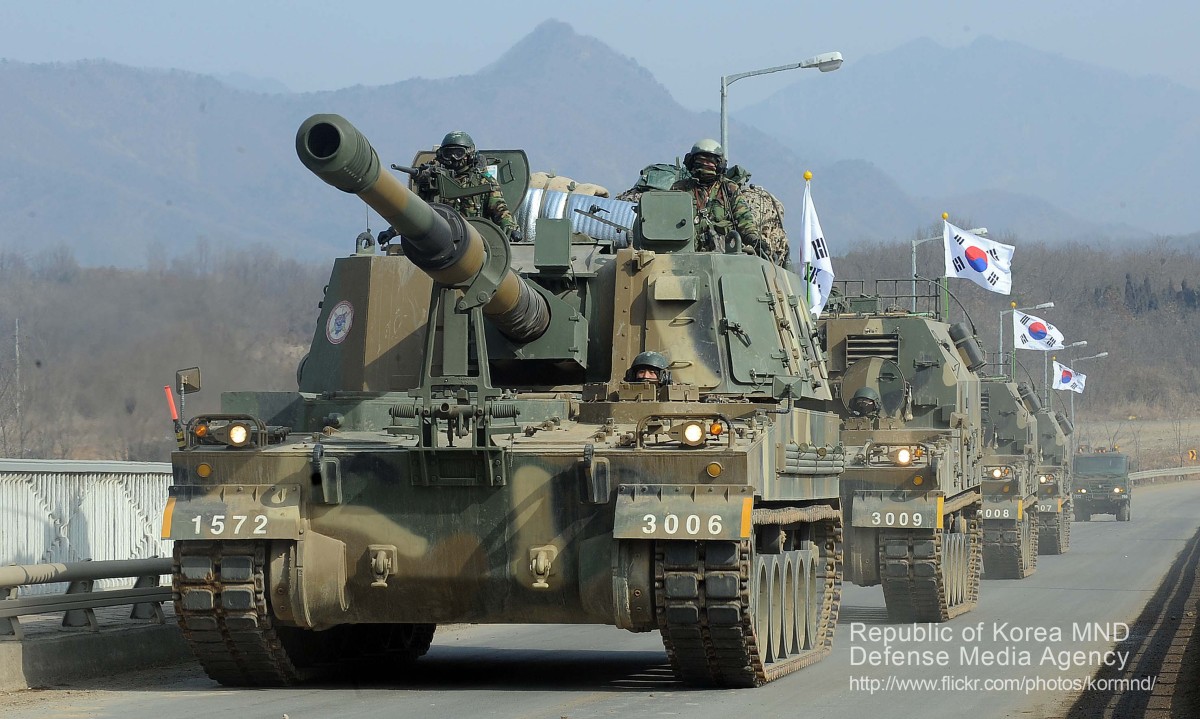
South Korea’s K9 ‘Thunder’ Howitzer
The K9 Thunder has become one of the world’s most sought-after weapons.
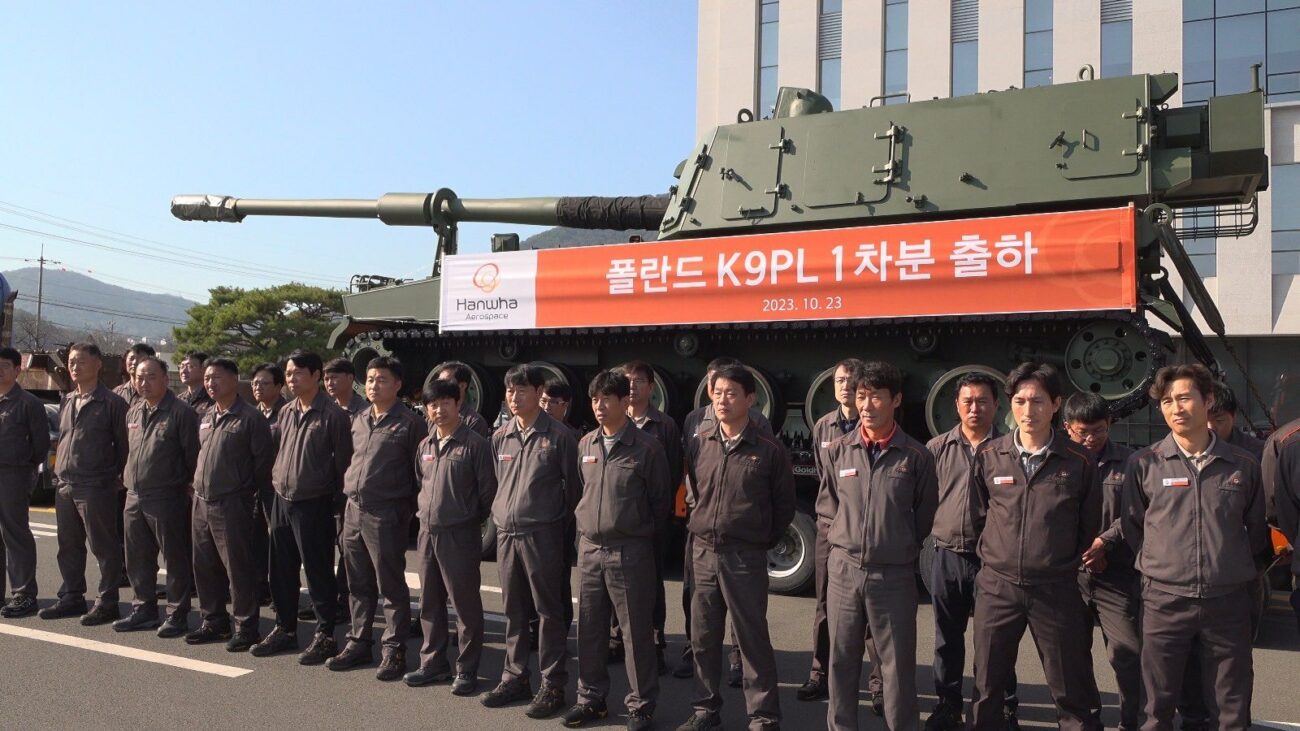
South Korean defense giant Hanwha Aerospace designed and produces the K9 Thunder, a 155mm/52 caliber self-propelled howitzer. It can carry up to 48 projectiles and launch six rounds per minute.
Since its debut in 1999, the K9 Thunder has become a cornerstone of South Korea’s defense exports, accounting for more than half of global self-propelled howitzer orders. As of last year, over 1,900 K9 units have been delivered or are slated for export to various countries.
South Korea operates a large fleet of K9 howitzers, deployed along the heavily fortified demilitarized zone (DMZ) separating it from North Korea.
The K9’s ability to operate in the DMZ’s challenging mountainous terrain is a key feature, thanks to an advanced hydropneumatic suspension that helps it navigate rough landscapes with ease.
The K9’s five-man crew operates in a fully enclosed environment, protected from nuclear, biological, and chemical threats, with 19mm steel armor providing defense against heavy machine-gun rounds and shrapnel.
Additionally, a .50-caliber machine gun mounted on the turret provides close-range defense and limited air-defense capability.
More than a dozen countries have ordered the K9 Thunder and its licensed variants, with deliveries to Australia, Egypt, Estonia, Finland, India, Norway, Poland, Romania, Turkey, and Vietnam completed or underway, and a further agreement signed with Spain in 2026.
Artillery Guns Still in Demand
The Ukraine-Russia war and the widespread use of drones have raised doubts about whether conventional artillery is losing relevance.
Yet both sides’ high shell consumption rates indicate that artillery remains a core source of volume firepower. Drones have supplemented artillery by enabling precision strikes, reconnaissance, and partial mitigation of ammunition shortages.
They have not, however, matched artillery’s capacity for sustained massed fires, longer-range area suppression, all-weather operation, and resistance to electronic warfare, according to assessments from Ukrainian military officials and open-source analyses of the conflict.
For instance, a single FPV drone could carry a small warhead, often comparable in effect to a light mortar round.
Drones are good at scanning large areas and hitting single targets like vehicles or soldiers. But they cannot create the same wide, heavy effect as a 155 mm howitzer battery. Artillery can fire many shells at once to stop enemy movements, weaken positions, or break through defenses.
Artillery has distinctive benefits: it can fire day and night, in any weather, and is somewhat resistant to electronic-warfare jamming. By comparison, drones are highly vulnerable to jamming and may not operate in all weather conditions, making them far less resilient than artillery.
Despite the mass production of drones on both sides, Ukraine alone is believed to consume nearly 200,000 shells per month, and up to 600,000 in intense operations. And Russia, on the contrary, fires nearly a million shells per month during intense operations.
In a November 2024 interview with RBC-Ukraine, Sergey Musienko, Deputy Commander of the Missile Troops and Artillery of the Armed Forces of Ukraine, explained artillery’s crucial role. “At present, artillery remains the main means of destruction on the battlefield. These include missile systems, multiple launch rocket systems, artillery guns, and mortars, which inflict destruction both in front of the front line of defense and at a fairly large range.”
Maj. Vladyslav, artillery battalion commander, 40th Separate Artillery Brigade, was quoted as saying: “Artillery will probably never lose its importance.” He noted that shells cannot be jammed by electronic warfare, work in bad weather, and deliver effects against massed armored assaults that FPV drones alone cannot replicate.
Yuri Knutov, Russian military expert and historian of air defense forces, in an interview with Russia 24 said: “Artillery will still play the role of the queen of the battlefield for a long time. An artillery shell is significantly cheaper than a drone. At the same time, the use of drones depends heavily on weather conditions — rain, fog, and snowfall all affect the ability to use unmanned systems. The role of artillery does not change; sometimes it even increases.”
He added that artillery is becoming more accurate and effective when integrated with drones, describing it as experiencing a “second birth” through better precision, mobility, and automated targeting data from UAVs.
Russia’s continued reliance on conventional artillery is reflected in its reported acquisition of older North Korean 170 mm Koksan self-propelled guns, some dating back more than four decades.
According to the UK-based Open Source Center (OSC), from August 2023 to March 2025, North Korea also shipped at least 15,809 containers to Russia, which would translate into an estimated 4.2 to 5.8 million rounds of artillery ammunition.
Similarly, Europeans are sending over one million artillery shells to Ukraine annually, in addition to the millions by the US.
Clearly, the artillery is back in vogue despite the drone revolution.
- Sumit Ahlawat has over a decade of experience in news media. He has worked with Press Trust of India, Times Now, Zee News, Economic Times, and Microsoft News. He holds a Master’s Degree in International Media and Modern History from the University of Sheffield, UK.
- He can be reached at ahlawat.sumit85 (at) gmail.com