After the Future Combat Air System (FCAS) collapsed earlier this month, the future of another major collaborative project—the Franco-German tank project, the Main Ground Combat System (MGCS)—could be in peril.
The troubled European sixth-generation fighter program, the FCAS (Future Combat Air System), was abandoned earlier this month amid irreconcilable differences between Airbus (representing Germany and Spain) and Dassault (representing France).
France and Germany could not get the industry partners to reach a consensus over work sharing. While Dassault insisted that it must develop the next-generation fighter (NGF) on its own, and Airbus refused to cede ground, concerned that German industry would be left wanting. In the end, Germany pulled the plug on the program, leaving the FCAS dream behind.
The two sides have since moved on, with France vowing to continue developing a next-generation fighter jet through 2040, and German contractor Airbus forming an eight-company consortium dubbed ‘Team Gen 6’ to develop a German sixth-generation fighter.
Soon after the FCAS collapsed, a rift appeared in the Eurodrone program, which is being jointly developed by Germany, France, Italy, and Spain. According to recent reports, Dassault Aviation is demanding compensation from the prime contractor, Airbus, because the French government’s decision to cancel drone purchases has reduced the workshare allocated to the French industry, particularly Dassault, which is responsible for flight control and mission communications systems.
While France has not formally exited the development program, it is no longer committed to acquiring the systems because the drone is too heavy, too expensive, and ill-suited for high-intensity warfare. Instead, it prefers cheaper, lighter, more attritable alternatives.
European Next-Gen Tank In Trouble Too
The CEO of Rheinmetall recently told the media that there is an indication that France may withdraw from the Main Ground Combat System (MGCS) project. “There is always a risk, but nothing has been decided yet,” Armin Papperger told Welt am Sonntag last week.
Further, he added that Paris is considering drastically cutting funding for the project.
Subsequently, a German government spokesman publicly cast doubt on the MGCS, saying the project would focus on “platform-independent” technologies and that it was unclear whether a joint tank would be constructed at all.
Meanwhile, Jean-Paul Alary, CEO of KNDS, the Franco-German company that is developing the tank, told reporters at the Eurosatory show in France that although he could not comment on the MGCS’s current state because it is a political matter, it would be “very bad news” for Europe if the project failed.
The Main Ground Combat System (MGCS), launched jointly by France and Germany in 2017, aims to develop a next-generation battle tank to replace Germany’s Leopard 2 and France’s Leclerc tanks. It is a “system of systems” project that includes a future main battle tank, surrounded by a network of other combat systems, such as artificial intelligence (AI) for decision-making, advanced sensors, robotics, and onboard unmanned aerial vehicles.
Additionally, it is anticipated that other vehicles, both crewed and uncrewed, will be fielded, likely for electronic warfare, air defense, or as platforms to launch directed-energy weapons, drones, or loitering munitions.
Despite being a highly aspirational program, the MGCS has remained marred in troubles and beset by delays, much like the now-abandoned FCAS. In fact, some experts have pointed out that the MGCS has progressed more slowly than the fighter jet program.

The MGCS has faced significant troubles for years amid differences regarding the tank’s design, technology, and industrial responsibilities. For example, while Paris favors a lighter tank for global deployment, Berlin wants to develop a heavier, more heavily armored tank suited for a potential conflict with Russia. Moreover, as in FCAS, there are also political and budgetary tensions over which country’s industry should take the lead, as veteran journalist Prakash Nanda explained in a EurAsian Times article.
Originally, the Franco-German joint venture KNDS, comprising France’s Nexter and Germany’s Krauss-Maffei Wegmann, was supposed to lead the project. However, Germany reportedly used its strong political support to push Rheinmetall’s involvement.
There have since been tensions between the KNDS and Rheinmetall over leadership of program “pillars,” production shares, and contracts. From a French perspective, Rheinmetall’s participation has altered the delicate power dynamics of the project.
In addition to the internal discontent, the project has suffered from political apathy and a lack of funding. As Rheinmetall CEO Papperger recently noted, the shareholding companies have received only €25 million ($29 million) since the project’s inception.
Frustrated by the project’s sluggishness, Rheinmetall unveiled the Panther KF51 in Paris four years ago as an alternative to the joint MGCS tank project. In fact, the cutting-edge tank is being heavily promoted in the export market and is reportedly on the verge of landing a significant order from Italy.
Meanwhile, the MGCS—originally planned for initial deliveries around 2035 and full operational capability by 2040—would not become operational until the mid-2040s, or perhaps, even later.
With the MGCS in doldrums, the KNDS also unveiled another tank, CAPINT, at the Eurosatory defense show in France this week.
The CAPINT is intended as an interim solution until the MGCS is ready, and has been proposed to France as a Leclerc replacement.
With MGCS Uncertain, KNDS Unveils CAPINT
Both France and Germany have realized that they would need new tanks before the MGCS is ready for induction into their respective armies.
Last year, for instance, Germany commissioned key defense contractors KNDS Deutschland, Rheinmetall, and Hensoldt to conduct technical studies that could pave the way for developing a next-generation main battle tank, tentatively dubbed the Leopard 3 or Leopard 2AX, as EurAsian Times reported at the time. The program is expected to deliver a combat vehicle ready for induction by the early 2030s, and is intended to sustain Germany’s armored forces until the arrival of the MGCS.
Similarly, in April 2026, French Armed Forces Minister Catherine Vautrin informed parliament that the country had decided to launch an “intermediate” tank program to reduce the impact of delays on MGCS.
Notably, KNDS is now offering its CAPINT (CAPacité INTérmédire, or Interim Capability), which could start replacing the Leclerc, which is set to be retired by 2037-38.
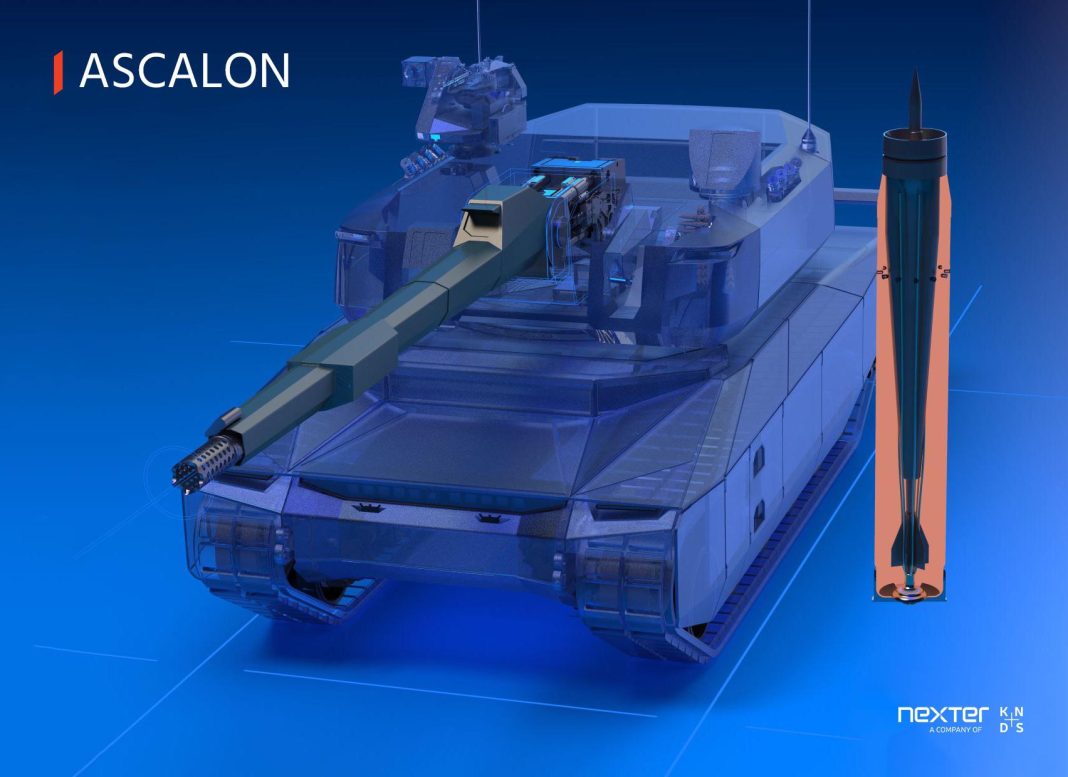
The CAPINT is special because it combines the hull of a German Leopard 2A8 tank with a French turret and main gun. Furthermore, the tank will feature increased firepower, counter-drone systems, an open digital architecture, and “connectivity with robotised wingers,” as noted in the publicity material from KNDS.
Focus CAPINT, le nouveau char by @KNDS_France pic.twitter.com/JhtT4A4Pdi
— KNDS France (@KNDS_France) June 15, 2026
The turret will use a 120mm ASCALON smoothbore cannon from KNDS France, which will eventually be equipped with a 140mm cannon. Notably, the 120 mm ASCALON has the advantage of being entirely compatible with all NATO-standard 120 mm ammunition, in contrast to larger-caliber guns previously suggested for future tank programs
The CAPINT’s three crew members will be housed in an “armored citadel” at the front of the vehicle, which will be protected by active and reactive protection technologies in addition to passive composite armor.
KNDS will develop an active protection system distributed across the turret and hull to provide its protective effectors with greater coverage.
Several cutting-edge technologies designed for the MGCS will be integrated into the CAPINT, including fully integrated AI, the previously described passive, reactive, and active defense systems, counter-drone warfare, and beyond-line-of-sight engagement capability. The CAPINT could also be integrated with an unmanned ground vehicle.
KNDS states that it will finish a CAPINT demonstrator tank as early as 2030.
If France decides to proceed, it might deliver the first series-production prototypes in 2035, with frontline deployment in 2037, right in time for Leclerc’s decommisioning.
In summary, while both France and Germany are merely seeking to maintain their combat capability amid the MGCS delay, the push for the CAPINT and the German Leopard 3 could threaten the MGCS program, especially amid disagreements over designs and partnership.
- Contact the author at sakshi.tiwari13 (at) outlook.com
- Follow EurAsian Times on Google News