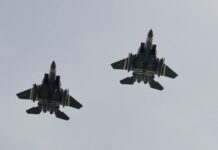
The Indian Air Force (IAF) is reportedly acquiring combat aircraft from the United Kingdom as it grapples with a dwindling squadron strength and agonizing delays in the delivery of its indigenous jets.
The IAF’s squadron strength is currently at 29 fighter squadrons as opposed to a long-standing sanctioned requirement of 42 squadrons, which is apparently considered necessary to fight a two-front war with China and Pakistan.
To add much-needed numbers to its Air Force, India has issued a formal Letter of Request to France to procure 114 Dassault Rafale fighter jets in a government-to-government deal. The country will buy some of these jets off the shelf and manufacture the rest locally. In addition, the country also has an active offer to buy Su-57 stealth fighters from Russia.
Interestingly, though, the United Kingdom — a close defense partner of New Delhi — has also emerged as a source of fighter procurement for India, albeit with a catch!
At one point, the Eurofighter Typhoon—developed jointly by the United Kingdom, Germany, Italy, and Spain—competed against the French Rafale for the IAF’s MMRCA (Medium Multi-Role Combat Aircraft) contract. At the time, the aircraft was aggressively pitched to the IAF, with the then-British Prime Minister personally persuading India to buy the Typhoon. However, the French fighter ultimately emerged victorious in the final selection.
Earlier this year, India once again indicated that it is not yet done with British fighter jets.
In March 2026, the Indian Ministry of Defence (MoD) officially expressed interest in two sixth-generation fighter jet consortia: the Global Combat Aircraft Program (GCAP) led by the UK, Italy, and Japan; and the Future Combat Air System (FCAS) led by France, Germany, and Spain, as the EurAsian Times reported at the time.
A lot has since changed, especially as the FCAS has fallen apart, leaving the GCAP as the only multinational next-generation combat aircraft program. India could either join forces with the UK, Japan, and Italy to develop a sixth-generation fighter or purchase the aircraft as an importer, as Japan had earlier offered.
However, as of now, the IAF is neither looking back at the Eurofighter nor has it decided to proceed with the GCAP. Instead, it has decided to procure used SEPECAT Jaguars from the Royal Air Force (RAF) rather than a brand-new fighter jet, in what appears to be an attempt to sustain the existing Jaguar fleet.
IAF Is Buying Old Fighters
The SEPECAT Jaguar is a low-flying, sea-skimming fighter-bomber developed jointly by the UK and France. India selected the Jaguar in 1978 as its Deep Penetration Strike Aircraft (DPSA). It subsequently received 18 aircraft from RAF stocks and 40 flyaway aircraft built by British Aerospace (BAe). Additionally, India’s Hindustan Aeronautics Limited (HAL) received a license to produce the aircraft locally, along with a technology transfer.
The first of these jets entered service with the IAF in 1979. Currently, the only air force to operate the type, the IAF has about six Jaguar squadrons (120 fighters) in its inventory.
According to reports, the service is acquiring 9 legacy Anglo-French SEPECAT Jaguars, along with over 150 categories of spares and components from the UK. The imported jets will be cannibalized for spare parts and reusable sub-assemblies to sustain the existing IAF Jaguar fleet, since Britain, France, and HAL have all ceased production of the aircraft and many of its components.
Some of these RAF jets, wrapped in white protective coverings, were spotted at a British port in photos that emerged online, with open-source trackers concluding the jets are already on their way.
SO they are already on the way ! https://t.co/5Gf1euks7Y pic.twitter.com/bdHMSXdPQg
— Alpha Defense™🇮🇳 (@alpha_defense) June 19, 2026
The imported aircraft are usually cannibalized to extract parts, including landing gear, hydraulics, avionics, and Rolls-Royce Adour engines, to make up for shortages. On their part, neither the IAF nor the Indian MoD has confirmed the acquisition.
However, we know this wouldn’t be the first time the IAF obtains used legacy fighters.
The IAF has purchased airframes, spares, and sub-assemblies from past Jaguar operators, including France (which retired its Jaguars in 2005), the UK (which decommissioned its jets in 2007), and Oman (which retired these legacy aircraft in 2014).
#BlastFromThePast When I did the story in 2018 about IAF “harvesting organs” from retired or mothballed #Jaguar fighters around the world, while grappling with a shortage of jets. The saga continues, with IAF down to just 29 fighter squadrons from a sanctioned strength of 42.5 pic.twitter.com/Q7qsVQhnnC
— Rajat Pandit (@IamRajat_Pandit) June 19, 2026
Jaguars in IAF
SEPECAT Jaguar is a supersonic attack aircraft designed for close air support and nuclear strike roles. Christened ‘Shamsher’ by the IAF, the warbird has been a crucial part of India’s nuclear triad for about 47 years now.
When the Jaguars joined the IAF in 1979, their precise weapons aiming, attack systems, and navigation capabilities marked a significant advancement in the IAF’s existing technological capabilities. The service was particularly impressed by the aircraft’s dual engines, which improved its survivability and its ability to operate from short, partially built airstrips.
Most of this still holds true today.
Notably, the Jaguars became obsolete when short-range surface-to-air missiles became prevalent in combat because they needed to fly higher to deploy stand-off weapons. However, the development of long-range surface-to-air missiles increased the vulnerability of high-flying aircraft and made low-flying strategies to avoid enemy radars useful again.
These aging fighters remain relevant because the IAF adopted them for medium-altitude stand-off strikes, as previously detailed in a EurAsian Times report.
The war in Ukraine further emphasized the importance of low-level penetration in contested airspace. For example, Ukrainian combat aircraft fly at very low altitudes, below the enemy’s radar horizon, to evade detection during missions. They zoom higher as they get closer to the launch location, fire their weapons, and then “hit the deck” again.
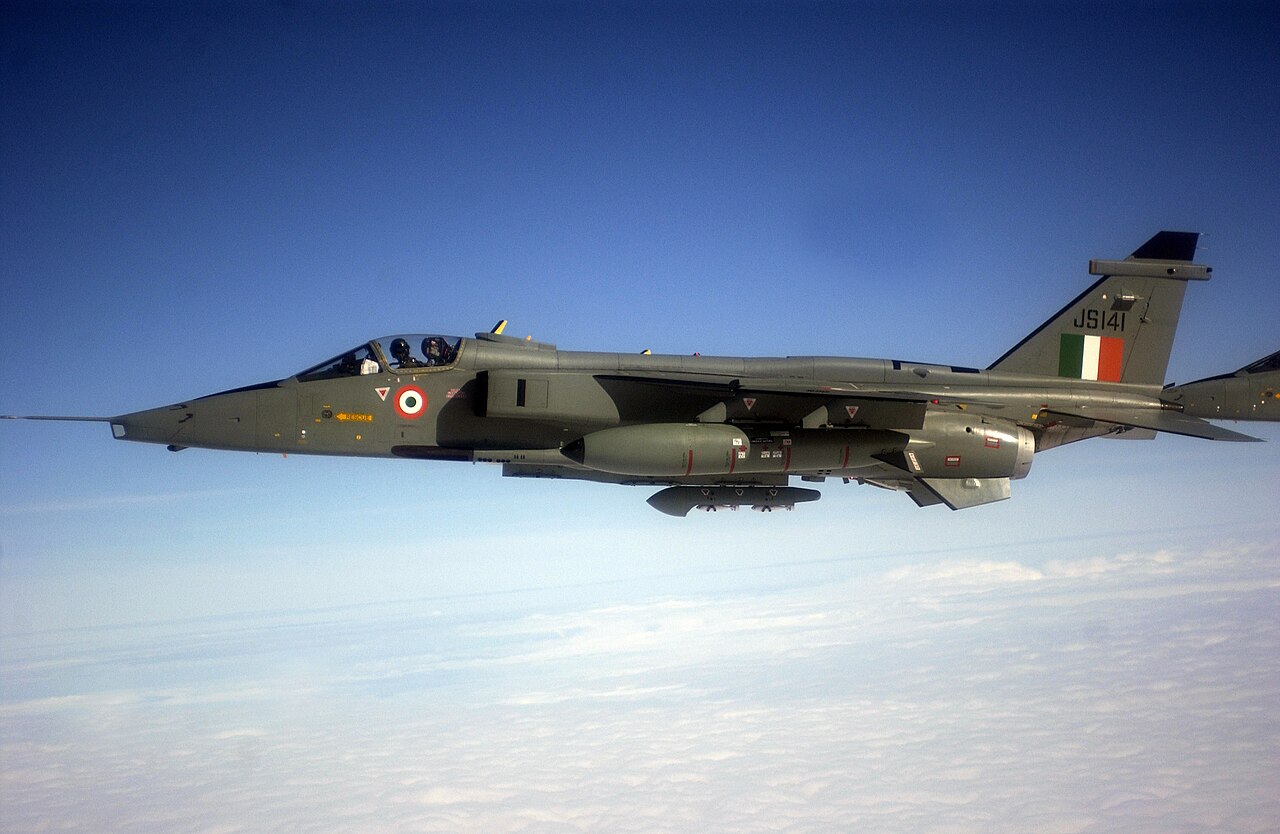
The Jaguar can, in fact, go 350 nautical miles (650 kilometers) while flying low thanks to its “lo-lo-lo combat radius of action.”
Furthermore, despite its age, the aircraft has done remarkably well in combat.
In 2019, the Jaguars served as decoys to divert the Pakistan Air Force’s F-16s from the target during the IAF’s Balakot operations inside Pakistan. They took off from Ambala air base and joined the Su-30MKIs, making a high-speed flight towards Bhawalpur, Pakistan, as decoys. The goal was to trick Pakistani fighters into thinking that an Indian fighter aircraft attack on Bahawalpur was imminent.
Taking the bait, the Pakistan Air Force (PAF) F-16 fighters maneuvered to halt the Jaguars. The Jaguars never crossed the Line of Control, but the strategy helped clear the path for the Mirage fighters to breach the Pakistani airspace for the strikes.
Notably, India’s Jaguar fleet has suffered peacetime attrition due to frequent air crashes throughout its long service life — at least 12 crashes between 2015 and 2025, and about three crashes in 2025 alone, including one each in March, April, and July. According to reports, at least 12 Jaguars crashed in the decade prior to 2025.
Additionally, the aging airframe has had a consistently low or mediocre readiness rate.
Despite these issues, the aircraft remains a crucial nuclear delivery platform, alongside the Mirage-2000H, which significantly enhances its operational utility.
The IAF, in collaboration with HAL and DRDO, has steadily improved the Jaguar’s stand-off assault and strike ranges, as well as its target acquisition capabilities, since it was first inducted into the IAF in the early 1980s. The upgrades, known as DARIN (Display Attack Ranging Inertial Navigation), have been carried out in three phases: DARIN-1, DARIN-2, and DARIN-3, and are meant to increase the service life of the jets.
The DARIN-3 upgrade includes a new open-architecture mission computer, a glass cockpit with multifunction displays, improved inertial navigation, autopilot, data recorders, precision weapons integration, and more.
Under this program, Honeywell F-125IN engines (27.7 kN dry thrust, 43.8 kN with afterburners) were to replace the Jaguar Adour 811 engines (25 kN dry thrust, 37.5 kN with afterburners). However, it was subsequently determined that the cost of purchasing the US engines and having HAL install them was too high. The program was shelved.
Jaguar’s two Rolls-Royce Turbomeca Adour Mk 811 turbofan engines are losing thrust due to wear and tear, lowering their operational capability. However, it has been assessed that, despite their low thrust and the IAF’s lack of investment in new engines, the Jaguars will remain relevant for at least the next decade.
“Clearly, the Jaguar is a potent platform despite being somewhat underpowered. It could be retained in service longer than currently projected to prevent the unacceptable depletion of IAF fighter aircraft inventory,” former Jaguar pilot, Squadron Leader Vijainder K. Thakur stated. However, he added, “longer service retention could only be achieved by reducing the aircraft’s monthly flying hours.”
India plans to begin phasing out its Jaguar strike aircraft starting in 2027-2028, with the complete phase-out scheduled by 2035 or later. But, for now, the Jaguar remains a vital “dark horse” in the IAF’s arsenal.
- Contact the author at sakshi.tiwari13 (at) outlook.com
- Follow EurAsian Times on Google News