The British Royal Air Force (RAF) deployed Eurofighter Typhoons equipped with AGR-20A APKWS (Advanced Precision Kill Weapon System) for air defense missions in the Middle East in May 2026. And now, all non-UK operators of the Eurofighter want to do the same.
This was revealed by Richard Hamilton, Managing Director, Air Operations of BAE Systems, the company that manufactures the APKWS.
“I would say all that there is strong interest from all of the [Eurofighter] users – all 10, recognizing that Türkiye is not yet a user. We are seeing it from the global fleet of [Eurofighter] users,” Hamilton said on 18 June 2026 at the company’s Warton facility in northern England, as reported by Janes.
The Eurofighter Typhoon is developed by a consortium comprising the UK, Germany, Spain, and Italy. In addition to these member states, the aircraft has been purchased by Austria, Kuwait, Oman, Qatar, Saudi Arabia, and, more recently, by Turkey.
The 9 Squadron, based at RAF Akrotiri in Cyprus, operated the Eurofighter Typhoon integrated with APKWS, as announced by the UK Ministry of Defense (MoD) on May 17. The Ministry did not provide further information, including on its use against an actual drone, but did add that the integration had proven successful.
“Now in operational use by 9 Squadron, the APKWS enhances Typhoon’s versatility and enables the aircraft to respond more flexibly to evolving threats. The system strengthens the RAF’s ability to maintain persistent air defense while managing costs and resources more effectively,” the RAF said in an official statement at the time.
The deployment of the Eurofighter-APKWS combination was swift, as BAE Systems had test-fired its laser-guided 70mm APKWS rockets from one of the jets only in April 2026.

“Rapid collaboration between the RAF, Ministry of Defense, and industry partners QinetiQ and BAE Systems enabled the system to move from testing to operational deployment in under two months. Successful trials, including air-to-air engagements conducted by the 41 Test and Evaluation Squadron, demonstrated the system’s effectiveness in real scenarios,” the Royal Air Force emphasized in the statement.
The Eurofighter operators are likely seeking APKWS, primarily for cost-effectiveness, increased magazine capacity, and rapid response to the growing threat of low-cost drones and one-way attack munitions in high-intensity operations, such as those in Iran and the drone- saturated battlefield in Ukraine.
Typically, the air-to-air missiles employed by advanced fighter jets to neutralize a drone cost hundreds of thousands of dollars or more per unit, creating a massive cost differential, given that the kamikaze drones are worth only a few thousand dollars.
For example, a Meteor carried by the Eurofighter Typhoon costs about $2.5 to $ 3 million per unit, whereas a Shahed-136 drone, widely used by adversaries such as Iran and Russia, costs just $35,000 to $50,000. This cost mismatch creates a massive asymmetry that favors the adversary, especially in a protracted conflict.
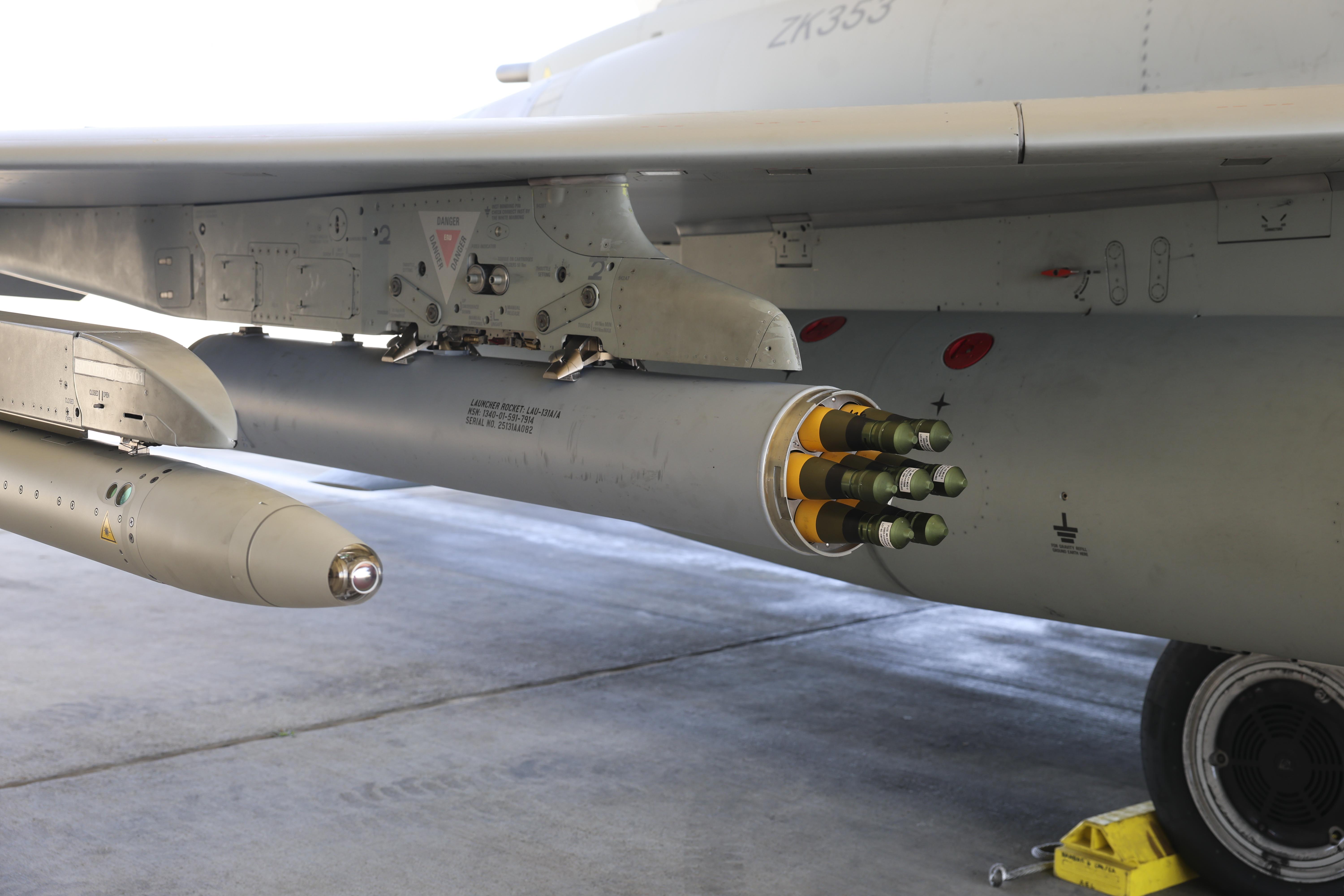
In contrast to a typical precision-guided missile, the APKWS-guided 70mm rocket costs roughly $20,000–$30,000 per engagement, giving pilots an option that is more proportional to the target, while keeping higher-end missiles available for faster or more complex threats in a dynamic modern battlefield. This could be particularly critical when facing mass drone attacks or swarms, where using expensive missiles against cheap targets quickly depletes stocks and becomes economically unsustainable.
In addition to being affordable, the APKWS also provides a combat aircraft magazine depth.
An APKWS is carried in a standard rocket pod that can hold seven rockets. Aircraft such as the Eurofighter Typhoon can carry multiple pods on available pylons, enabling dozens of engagements per mission. This essentially turns the aircraft into an affordable drone-killing machine whilst eliminating the need to return to base to boost firepower.
In the words of the RAF, “The Advanced Precision Kill Weapon System (APKWS) gives RAF pilots a highly accurate option to destroy aerial targets and allows them to engage drones at a fraction of the cost of traditional air-to-air missiles. This improves sustainability and ensures more efficient use of munitions during prolonged operations. APKWS uses a laser targeting system that turns unguided missiles into low-cost precision weapons able to take down enemy drones and other threats.”
The Counter-Drone APKWS Rockets
The Advanced Precision Kill Weapon System (APKWS), designated as AGR-20 or APKWS II, is a laser-guided rocket system developed primarily by BAE Systems in collaboration with the US. It transforms standard unguided Hydra 70 (2.75-inch or 70 mm) rockets into precision-guided munitions by adding a mid-body guidance kit.
The kit adds folding wings for stability and control, essentially creating a round that is roughly one-third the cost and weight of comparable precision-guided missiles. Additionally, it uses semi-active laser homing for precision strikes, typically achieving low circular error probable (CEP) suitable for point targets.
This approach provides an affordable, low-collateral-damage option for engaging soft, lightly armored targets and cheap drones, filling the gap between unguided rockets and more expensive missiles.
The core innovation of APKWS is its Distributed Aperture Semi-Active Laser Seeker (DASALS) technology.
The guidance section, which is inserted between the rocket motor and the warhead, features laser seekers in the leading edges of its forward control canards. This mid-body design preserves compatibility with existing Hydra 70 inventories, launchers, and platforms without requiring modifications to the firing system or extensive crew retraining, thereby facilitating integration.
The United States has also prioritized integrating APKWS onto its fighter jets as a counter-drone measure. For example, the F-16, the F-15E, and the A-10 Warthogs have all been equipped with these rockets.
The weapon system has been combat tested. Ukrainian F-16s have been seen carrying LAU-131/A 7-round rocket pods loaded with APKWS II since December 2025.
And more recently, the A-10 Warthogs were spotted equipped with APKWS rockets while flying sorties in support of “Operation Epic Fury.”
It is probably the successful use of APKWS for counter-drone missions by the US and Ukraine that prompted BAE Systems to integrate the rockets onto the Eurofighter Typhoon and the UK to deploy them operationally in the Middle East to swat drones.
- Contact the author at sakshi.tiwari13 (at) outlook.com
- Follow EurAsian Times on Google News