The US President’s aspirational ‘Trump-class’ battleship project appears to be moving at a breakneck speed, with the US Navy requesting billions of dollars in funding in Financial Year 2027. Meanwhile, the future of the largest aircraft carriers in the US Navy, the Ford-class, has come under scrutiny.
The US Navy plans to spend about US$46 billion over the next five years on designing and developing the Trump-class battleship, the service officials said on April 20, 2026. The construction of the first ship is set to begin in fiscal year 2028.
The Navy is reportedly requesting about $1 billion in advance procurement in FY27 and $837 million for research and development for the new ship, which is expected to feature high-powered laser-based armament, electromagnetic rail guns, and hypersonic missiles.
“The Guided Missile Battleship (BBG(X)) program supports the expansion and modernization of the Nation’s large surface combatant fleet, reinforcing maritime dominance,” reads the budget documents. “The Battleship is based on the validated requirement for high-end surface capability … that cannot be met by current fleet assets.”
As Trump stated, two ships will be initially constructed, with the first already named USS Defiant (BBG-1). The Navy eventually wants to have 20 to 25 ships in the Golden Fleet.
Speaking on the sidelines of the Sea Air Space Symposium, Secretary of the Navy John Phelan emphasized that the Navy is already in talks with contractors on the design of the futuristic battleship, noting that the Navy wants a fast production schedule.
“We have been talking to two different vendors as we speak right now, and then it’ll be a function of how we get through that design process with them, and then their capacity in their yards, what we think they can do,” the Secretary stated. “Because we’re looking to really get moving on this and lay the keel in ’28.”

The Navy is reportedly requesting about $17 billion in procurement financing for the first ship in FY28 and about $13 billion for the second ship in 2030.
When asked how much each battleship would cost, Phelan said that the figures cited in the documents are preliminary estimates and could change when the Navy determines specifics, such as whether or not the battleship will be nuclear-powered.
“We’ll see where we really settle down as we get through that and start to rationalize some of the costs,” he said. “So let’s see where we land on that first ship, and then what the economies of scale get us to as we move through it.”
The budget request indicates that the Navy is pressing ahead with the project despite widespread skepticism and criticism.
Experts have argued that large and heavy battleships like the USS Defiant would be vulnerable, emphasizing that although this ship will carry hypersonic and nuclear weapons, it would still be akin to a “bomb magnet” because of its size and displacement. Additionally, they have cast aspersions about the feasibility of the program, citing the exorbitant cost of developing the ship, which is the same as (or more than) that of building aircraft carriers, adding that it also contradicts the US Navy’s distributed firepower doctrine.
Reacting to the criticism, Phelan said on the sidelines of the symposium: “I’ve heard the critiques [that’s] too vulnerable, too expensive, too big. We’ve heard that before about carriers and about submarines, and yet, when it matters most, those are the platforms combatant commanders call for first.”
However, critics of the project lambasted it on social media once again, stating that it will likely be canceled once Trump leaves office, causing losses of billions of dollars for American taxpayers.
Notably, the funding request has heightened discomfort because the future of the US Navy’s largest aircraft carrier—the Ford class—seems uncertain.
Secretary Phelan said that the US Navy is reviewing the design and costs, and indicated that the cancellation of future versions of the carrier design has not been ruled out. He said that the objective of the review, expected to be completed by next month, is to examine “the costs of the designs and the systems to make sure that they make sense and they have all the systems and requirements that we want going forward.”
When asked if the review could eventually result in a cancellation, Phelan said, “It’s too early to say, but we will have carriers.”

Further, the Ford-class aircraft carriers were not listed among the ships the Navy intended to purchase in Navy budget documents. Instead, the paperwork just stated “aircraft carrier.” Meanwhile, other vessels, such as the Arleigh Burke-class destroyers and the Columbia-class submarines, were identified by their class.
In addition to the USS Gerald R. Ford, which has been on a record deployment since June 2025 and has proved to be crucial in the American war on Iran, the Navy has three more carriers of the class under construction, including the USS John F. Kennedy, the USS Enterprise, and the USS Dorie Millier.
Phelan told journalists that the review would look at the next two planned but uncontracted carriers, designated USS William Jefferson Clinton and USS George W. Bush.
Interestingly, this comes as Trump has expressed his distaste for the US Navy’s new EMALS carrier-launching system developed for the Ford-class carriers on multiple occasions and has called for a return to steam-powered catapults used in older carriers.
Trump-Class Battleship Nearing Reality
“As commander in chief, it’s my great honor to announce that I have approved a plan for the Navy to begin the construction of two brand-new, very large — largest we’ve ever built — battleships,” Trump announced from his Mar-a-Lago residence in Palm Beach, Florida, in December 2025. It would be “the fastest, the biggest, and by far, 100 times more powerful than any battleship ever built,” he said.
According to publicly available information, the battleship is envisioned to be 840-880 feet long, or three times the size of an Arleigh Burke-class destroyer. It will displace 35,000-41,000 tons or more than double the largest US Navy surface combatants, the Zumwalt‑class destroyers (15,000 tons), and will be manned by a crew of 650-850 people.
The warship’s mammoth frame will enable superior firepower, larger missile stores, and the potential to launch Surface-Launched Cruise Missiles and hypersonic missiles, including Nuclear and Conventional Prompt Strike.
The planned armament for the battleship includes one 32 MJ Railgun with Hypervelocity Projectile (HVP), Surface Launch Cruise Missile-Nuclear (SLCM-N), 128 cells Mk41 Vertical Launching System (VLS), two 300 kW or two 600 kW lasers, four 30mm guns, two counter UxS Systems, 12 cells CPS hypersonic missiles, and two RAM launchers.
This conforms with Trump’s previous assertion that the new “battleship” would field firepower “100 times more than anything built.”
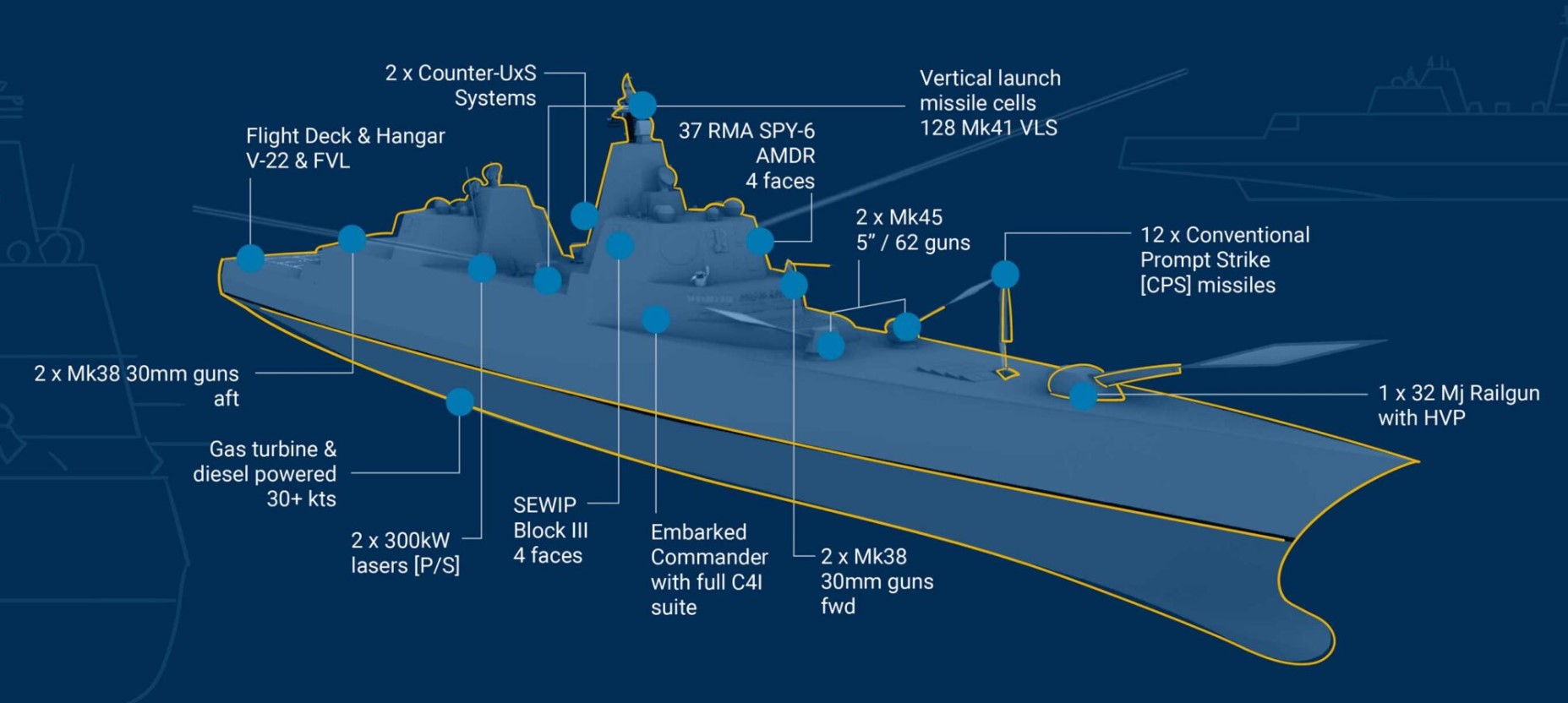
The ship will be protected by AN/SPY-6 radar and counter-drone defense systems, among other measures currently being worked out.
Additionally, the ship’s propulsion is currently under consideration, with indications that it will most likely be conventionally powered.
As previously noted by the Pentagon, the new Trump-class battleships will replace the Navy’s plans to develop a new destroyer class, the DDG(X). However, the sea service intends to incorporate the capabilities it had planned to employ on that platform into the new Trump-class ships.
Nonetheless, doubts over the program persist.
The US-based think tank, Center for Strategic and International Studies, said, “The ship’s design will take many years. At the “30,000 to 40,000” tons cited by the president, the ship is much larger than anything the United States has built in the last 80 years, other than aircraft carriers. The truncated DDG-1000 class (only three built) displaced 15,000 tons but still took 11 years from program initiation (2005) to commissioning of the first ship (2016). The battleship will be more than twice as large and more complicated—nuclear-capable with directed-energy weapons.”
Delays in the development and construction of the ship, due to its complexity, have been a recurring theme in many observations. For reference, the Constellation-class frigate was canceled after a three-year delay, and the USS John F. Kennedy carrier was two years behind schedule due to elevator and certification problems.
Analysts predict the battleships will face similar overruns from novel technologies, adding that the delays could span multiple administrations, increasing the odds of their cancellation after billions in sunk development costs.
Meanwhile, Bernard Loo, senior fellow at Singapore’s S. Rajaratnam School of International Studies (RSIS), earlier described the proposal as “a prestige project more than anything else,” citing the example of Japan’s World War II superbattleships Yamato and Musashi, the biggest ever constructed, which were sunk by carrier-borne aircraft before they could partake in the conflict.
Moreover, there is growing concern that, while the project costs billions of dollars, it would also fail to align with the US Navy’s distributed firepower operations, which were specifically designed to counter the threats of a modern battlefield vis-à-vis near-peer adversaries like China and Russia.
While much remains to be seen, it appears that Trump’s namesake project is closer to reality than previously believed.
- Contact the author at sakshi.tiwari13 (at) outlook.com
- Follow EurAsian Times on Google News