Cellphone use is a major cause of road accidents in the US and globally. However, in a bizarre incident, a South Korean audit report found that the 2021 mid-air collision between two Republic of Korea Air Force (ROKAF) F-15 fighter jets occurred because the pilots were taking photos and videos.
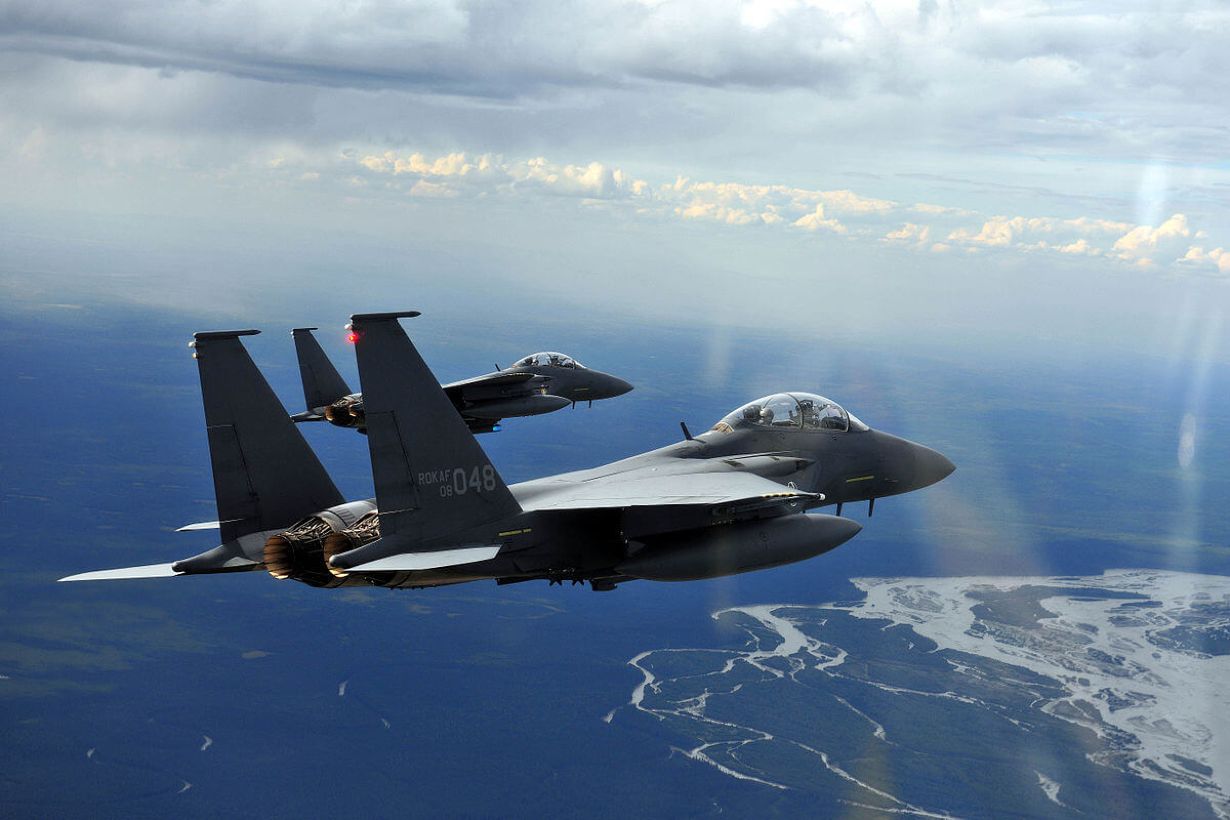
The incident occurred during a routine formation flight mission near Daegu in December 2021. The two F-15 jets were flying back to base after completing the mission when they collided mid-air.
Despite substantial damage to the aircraft, both fighter jets landed safely, and all pilots escaped unhurt, according to Seoul’s Board of Audit and Inspection.
Though repairing the damaged aircraft cost the military 880 million won (US$596,000).
An inquiry into the incident found that the mid-air collision occurred because pilots in both aircraft were distracted while taking pictures and videos.
The Air Force did not publicly disclose the incident at the time and internally disciplined the responsible pilot, a senior lieutenant on his last flight with the unit before a transfer, to pay the full repair amount of US$596,000. The wingman pilot, who has since left the Republic of Korea Air Force (ROKAF) and now works with a commercial airline, has appealed against the decision.
While Seoul’s Board of Audit and Inspection still found the wingman pilot responsible for the crash, it reduced the fine amount to one-tenth of the total repair cost, i.e., US$59,600 or 88 million won.
The Board of Audit and Inspection found that at the time of the incident, it was a “widespread practice among pilots to take personal commemorative photos during flights.”
Therefore, the report found that the ROKAF shared some of the blame for the incident as it failed to frame strict rules prohibiting the use of personal phones and video recording while on flight.
What the Board of Audit and Inspection Found
The Seoul Board of Audit and Inspection published its report on April 22.
According to the report, Senior Lieutenant A, then an Air Force pilot, was conducting a flight mission in an F-15K at the 11th Combat Wing in Daegu on December 24, 2021. The mission involved two F-15Ks flying in formation.
During the pre-flight briefing, Senior Lieutenant A stated, “This is my last flight before a transfer, so I will take photos of the flight after completing the mission.”
Senior Lieutenant A flew the wingman aircraft and followed the lead aircraft to complete the mission. While returning to base, he began taking commemorative photos with his personal cellphone camera. Observing this, the lead pilot instructed the rear-seat crew member to film Senior Lieutenant A’s aircraft on video, saying, “I will take the photo for you.”
Senior Lieutenant A then abruptly ascended his aircraft without informing the lead pilot, flipping the plane to position himself above the lead aircraft for a better photo. This maneuver brought the two aircraft dangerously close. Senior Lieutenant A performed an evasive maneuver by tilting his aircraft nearly vertically and moving to the left of the lead aircraft.
Meanwhile, in order to avoid a collision, the lead aircraft rapidly lowered its altitude, South Korean publication The Chosun Daily reported, citing the audit findings.
Despite these evasive maneuvers, the two aircraft eventually collided. The mid-air collision damaged the lead aircraft’s left wing and the wingman aircraft’s tail stabilizer.
Both planes landed safely, but repairs required replacing six parts on Senior Lieutenant A’s aircraft and 45 parts on the lead aircraft, costing 878.71 million Korean won.
Following the crash, Senior Lieutenant A was suspended. He later retired from the Republic of Korea Air Force and joined a private company as a commercial pilot.
The Air Force applied the Accounting Officials Responsibility Act, which holds officials accountable for property damage caused by intentional or grossly negligent acts, and ordered Senior Lieutenant A to compensate 878.71 million Korean won.
Senior Lieutenant A petitioned the Board of Audit and Inspection to review the Air Force’s order.
While he acknowledged and regretted that his inexperienced maneuvering caused the collision, he argued that he was not an accounting official and, thus, was not liable to pay a fine. He also argued that the lead pilot had implicitly agreed to his maneuver.
The Board of Audit and Inspection noted that the Accounting Officials Responsibility Act includes “property users” as accounting-related officials, and pilots qualify as such while operating aircraft. It also rejected Senior Lieutenant A’s claim of implicit agreement, citing statements from other pilots that his maneuver was sudden and unapproved.
Nonetheless, the Board reduced the payable fine to one-tenth of the total repair cost, agreeing that taking commemorative pictures of the last flights was an established and widespread practice among the pilots and the country’s Air Force had failed to frame rules prohibiting such practices.
The report also noted that Pilot A had expressed his intention to take pictures during the pre-flight briefing, implying tacit approval from his seniors.
The report also noted that Senior Lieutenant A had managed to land the aircraft despite substantial damage, and that he had long served as a fighter pilot since his commissioning in 2010, and had contributed to aircraft maintenance through test flights.
In the end, the wingman pilot had to pay a fine of 88 million won.
Previous Examples of Mobile Phone Use Causing Air Accidents
While the incident sounds unique and bizarre, unfortunately, this is not the first incident in which mobile phone distraction, or taking of pictures and videos for reels, has been blamed for an aviation crash.
For instance, in May 2014, a small single-engine plane (Cessna) crashed at night in Colorado, USA, killing the pilot and one passenger.
Investigators recovered a GoPro that showed the pilot and passengers repeatedly taking selfies with cell phones (including using flash) during low-altitude flights the day before and on similar trips.
The inquiry report concluded that cellphone use for selfies likely distracted the pilot, contributing to spatial disorientation and loss of control in instrument meteorological conditions.
Similarly, during a low-altitude pipeline patrol flight in 2021 in the US, the pilot of a Cessna 182 was distracted by posting to Snapchat on his mobile device. He struck a radio tower guy wire, causing a fatal crash. The inquiry commission report cited the social media activity as the probable cause, noting reduced attention to the flight path.
There are also instances in which the use of a mobile camera in the cockpits of commercial planes led to rapid descents, but the pilots were able to avoid a fatal crash.
Still, such instances are much more rare in fighter jets, as stricter protocols, formation discipline, and cockpit resource management training minimize distractions.
Furthermore, the fighter jets’ extreme speed and G-forces make using mobile phones even riskier.
The South Korean mid-air collision of two F-15 fighter jets is perhaps the only such example where two friendly aircraft crashed due to the use of mobile phones.
The South Korean Air Force did not disclose the circumstances of the crash for nearly four years; however, the public unveiling of the audit report will perhaps bring attention to the fact that the use of mobile phones in fighter jets, even for a brief moment, could be fatal.
- Contact EurAsian Times at editor (at) eurasiantimes.com
- Follow EurAsian Times on Google News