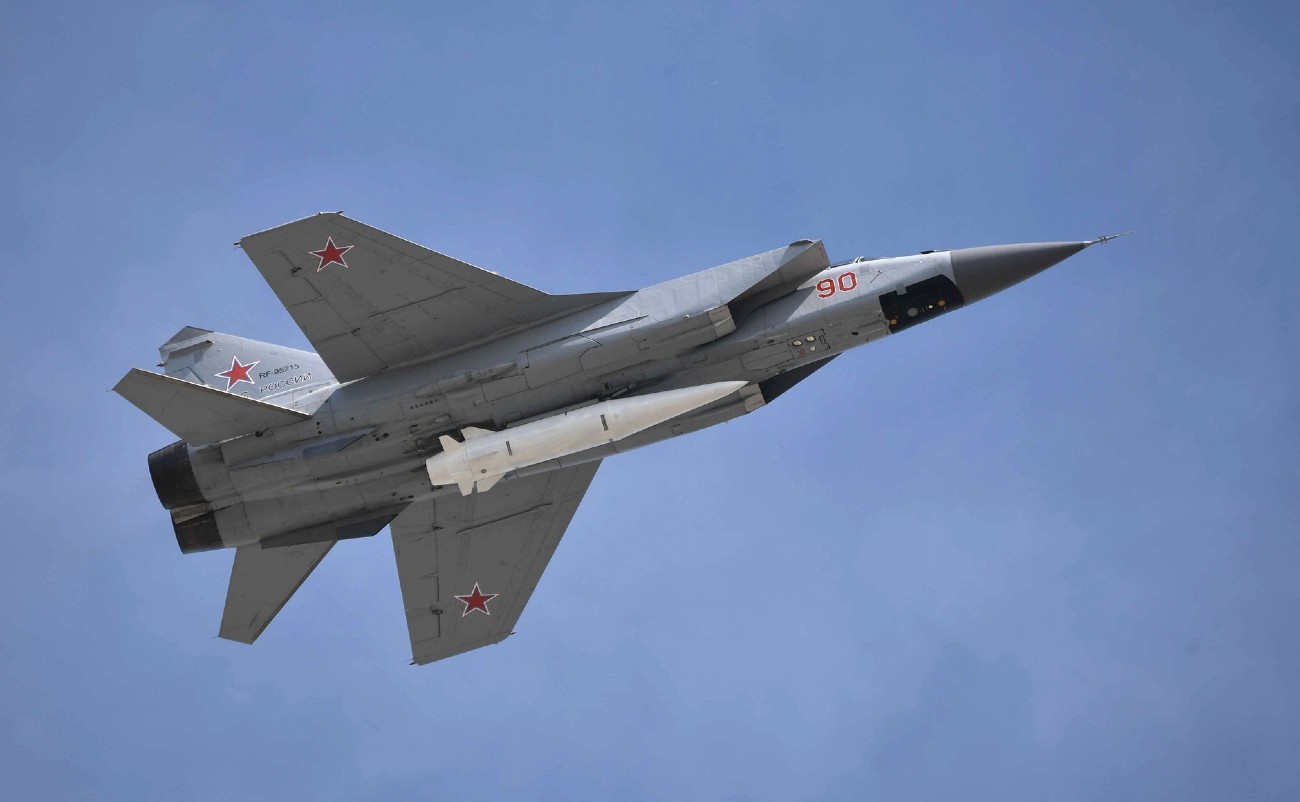
A Ukrainian firm has developed a “game-changing” electronic warfare system called “Lima” that, it claims, can neutralize the prized Russian hypersonic missile, Kinzhal.
Cascade Systems, a Ukrainian defense company that developed Lima, disclosed in April 2026 that the system downed 26 Russian Kh-47M2 Kinzhal aeroballistic missiles in the first three months of 2026, bringing the total to 58, as widely reported by Ukrainian media.
The claims were subsequently confirmed by some representatives of the Nichna Varta (Night Watch) military unit, which operates the system.
“In the areas where Lima operates, we record the highest possible effectiveness in protecting facilities. Specifically, we managed to down 58 of the 59 Kinzhal missiles launched on the facilities we protect. The system creates an electronic barrier that blocks the satellite navigation of kamikaze drones and significantly disrupts enemy precision weapons that rely on satellite navigation for guidance,” a representative told Ukrainska Pravda.
Meanwhile, the CEO of Cascade Systems explained that the electronic warfare system adds an extra layer of security that does not rely on kinetic interception, such as missiles, to defend locations, enabling air defense resources to be employed more effectively. Further, he stated that Lima helps prevent the use of limited anti-aircraft missiles against every threat or the use of backup interception systems in the event of a large-scale attack.
“This is an asymmetric response: instead of an exhausting missile-versus-missile duel, we use a tool that causes a critical deviation of the enemy’s precision weapons from their target at the final stage of flight,” the CEO was quoted as saying.
KINZHAL KILLER: Ukraine’s ‘Lima’ Electronic Warfare system can jam Russia’s Kinzhal hypersonic missiles. Operating at ranges of at 300 Km, Lima can induce flight deviations that can cause in flight breakups. pic.twitter.com/bYdh3yqCpp
— Chuck Pfarrer | Indications & Warnings | (@ChuckPfarrer) May 2, 2026
Earlier, the Ukrainians claimed they had downed multiple Russian Kinzhal missiles, using Patriot interceptors. However, the stockpiles of these lethal surface-to-air missiles have dwindled recently, and NATO allies have been unable to meet Kyiv’s demand for adequate supplies due to limited numbers in their own arsenals.
A video of Lima engaging hostile aerial targets was subsequently published and has been shared on social media, where it continues to be widely discussed.
❗️❗️❗️ 🇺🇦 Since the beginning of 2026, Ukraine’s electronic warfare system “Lima” has disrupted and diverted 26 Russian Kinzhal-type aeroballistic missiles. In total, 58 such missiles have either failed, missed their targets by a wide margin, or detonated elsewhere.
🔹 Reports… pic.twitter.com/m8or014KWq
— NSTRIKE (@NSTRIKE1231) April 20, 2026
Besides the Kinzhal, the manufacturer claimed that Lima has diverted almost 10,000 drones and 33 cruise missiles in the first quarter, and neutralized more than 98% of guided aerial bombs. Furthermore, it emphasized that these new platforms are integrated into the entire Ukrainian air defense system, ensuring that Russian aviation forces are diverted from their targets to the safest possible zones.
“The integration of Lima into the air defense network adds another layer of protection, enabling it to down drones and missiles that have already penetrated the outer interception ring. This creates a genuinely layered defense and significantly increases the share of enemy aerial weapons that fail to reach their targets,” said Maksym Skoretskyi, Head of the Electronic Warfare Department of the Ground Forces of the Armed Forces of Ukraine.
How Does Lima Work?
LIMA is a strategic-level, stationary Electronic Warfare (EW) platform that uses a hybrid “three-type” approach, unlike other tactical jammers. The approach includes: Jamming, which overwhelms satellite navigation signals such as Russian GLONASS or GPS; Spoofing, which broadcasts fake signals to mislead the weapon’s navigation system; and a cyber attack on the receiver, which essentially corrupts data within the receiver itself.
Notably, Russia’s long-range weaponry is guided by multidirectional satellite navigation antennae. While weapons ranging from Kinzhal to Shaheds can navigate in various ways, such as by tracking their own motion or using visual orientation, they default to satellite navigation when available. Additionally, Russia uses multi-channel CRPA (Controlled Reception Pattern Antennas) such as the Kometa-class to resist jamming and spoofing by steering toward real satellite signals and nulling interference.
These CRPAs use a variety of small antennas to detect spurious signals.
Up until recently, spoofing a CRPA required more nearby signal-broadcasting stations than the CRPA had sub-antennas. Then, Chinese developers created mathematical models that enabled CRPAs to circumvent that strategy and sell them to Russia.
“These antennas were created to counteract a number of EW units that exceeds the number of units in the antenna,” Alkhimyk of the Night Watch unit explained to the Kyiv Independent.
According to Alkhimyk, the Ukrainian breakthrough was to prevent the CRPA antennas from identifying the source of the spoofing signal. This allowed the Ukrainians to use just 32 Lima stations to sever Kinzhal’s link to the satellite signals that were guiding it.
More importantly, in addition to spoofing and jamming, Lima also produces a third kind of signal that hacks the Kinzhal while it is in flight.
“The third type of signal is a cyberattack,” Alkhimyk said. The attack, he said, targets the Kinzhal’s receiver. “In order for the receiver to make a decision, it has to download a lot of technical data from the satellite. We worked out how to load that data in such a way that it pulled incorrect data and didn’t update for a long time after it left our zone.”
Ukraine has projected Lima as the first of its kind to successfully combat sophisticated CRP. “The system really has no analogs,” Maksym Skoretskyi told the Kyiv Independent. “Nobody had managed to carry out suppression of 16- and 32-channel CRPA antennas before this, much less at these kinds of distances,” he stated, adding that Lima was effective “in 58 of 59 applications” against Kinzhals.
It is noteworthy that Ukraine has successfully developed countermeasures to prominent Russian threats, such as fielding cheap interceptor drones to down Shahed-like one-way attack drones deployed by Russia.
However, the claims about Lima downing a ballistic missile—the first such feat achieved anywhere in the world—have received mixed responses.
For example, Dylan Malyasov, a Ukraine-based journalist, wrote on X: “The assertion that Ukraine’s Lima electronic warfare system neutralized 26 Kinzhal missiles defies basic physics. Even in the footage being cited, you can clearly see at least one missile suffering what appears to be a structural or mechanical failure mid-flight — a component physically separating and falling to the ground. That is not EW. That is a defect. Electronic warfare disrupts guidance systems, sensors, and communications. It cannot alter the physical integrity of a ballistic missile’s airframe or propulsion unit.”
In contrast, Igor Sushko, who regularly comments on the ongoing military developments in Ukraine, called Lima a “technological breakthrough,” emphasizing, “No other nation has a system that can disable incoming ballistic missiles. The Ukrainian government likely released this information now because the Russians finally found out.”
Despite backing Ukraine’s claims, several experts have cautioned that the system and Ukrainian claims may be “too good to be true.”
However, Fabian Hoffmann, a Doctoral Research Fellow at the Oslo Nuclear Project and a non-resident fellow at the Center for European Policy Analysis, broke down the claims made by Ukrainian sources in a detailed blog, which was summarised in a thread on X.
“Reports have periodically emerged suggesting Ukrainian EW systems have denied GNSS guidance to incoming Russian ballistic missiles, including the 9M723 and Kh-47M2 Kinzhal. Without satellite-based correction, these missiles rely solely on inertial guidance. Integration drift causes accuracy to degrade progressively — from a CEP of 5–10 meters to potentially 200 meters or more,” he noted in a detailed post on X.
Further, he acknowledged that achieving this in practice could be demanding. “Effective jamming of ballistic missile targets likely requires high-elevation line-of-sight, a phased-array antenna, a radar for tracking, sufficient early warning, and sustained signal denial across the midcourse phase,” he noted.
Fabian admitted that whether Ukraine has fielded such a system cannot be certainly established, but added that “the analysis suggests it is at least plausible. Tighter enforcement of Western sanctions may also be quietly increasing Russia’s missile vulnerability to Ukrainian EW.”
Russian sources and military bloggers have refuted these claims, arguing that spoofing or hacking a high-speed hypersonic missile like the Kinzhal, which uses inertial navigation and GLONASS updates and has a terminal seeker at Mach 5+, is extremely difficult.
- Contact the author at sakshi.tiwari13 (at) outlook.com
- Follow EurAsian Times on Google News