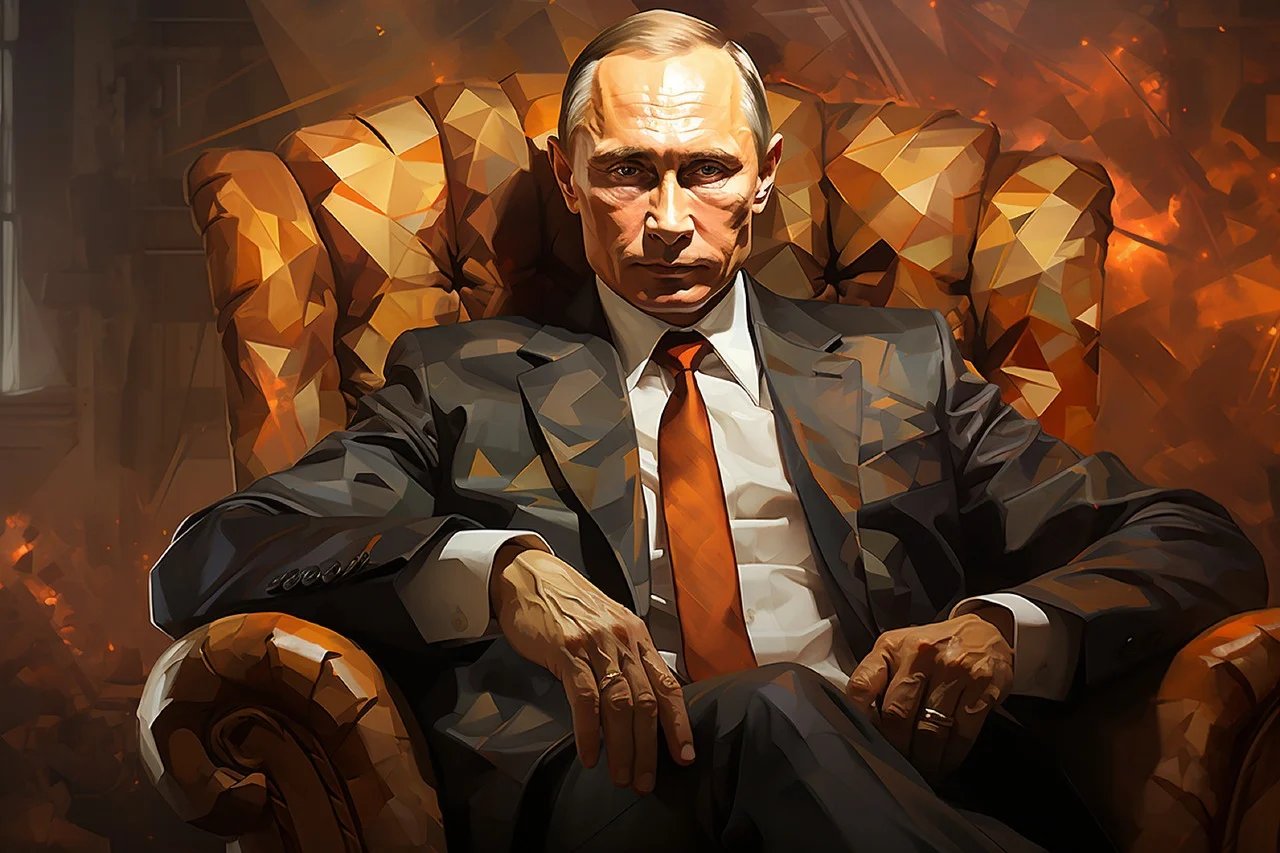
In the fifth year of the Ukraine War and unable to make any meaningful gains on the battleground, the Russian President Vladimir Putin is increasingly paranoid about a coup against him, or perhaps even an assassination attempt.
The top leadership in the Kremlin has been on a high alert since the beginning of March, adding a double layer of security around Putin and dramatically reducing his public appearances to avert any such attack.
In fact, such is the paranoia in the Kremlin that the security services have significantly toned down the May 9 celebrations in Moscow and have not invited any State Duma members to the Victory Day parade on Red Square, so that the public presence around Putin can be significantly cut down.
This was reported by US media outlet CNN and Important Stories, a leading Russian independent investigative outlet, based on an intelligence report prepared by an EU member state.
Parts of the report were confirmed by independent sources within Russian security services, the outlet claimed.
In fact, President Putin has already faced a serious coup attempt against himself during the Ukraine War.
In June 2023, Yevgeny Prigozhin, founder of the Wagner private military company, which fought heavily in Ukraine, started moving rapidly towards Moscow with an armed column.
Prigozhin has been feuding with Russia’s top military leadership, particularly Defense Minister Sergei Shoigu, over resources, credit, and plans to subordinate Wagner under the regular army.
On June 23, 2023, after accusing the Russian military of attacking the Wagner group, Prigozhin first seized the Southern Military District headquarters in Rostov-on-Don and then started moving towards the Russian capital, shooting down a Russian military aircraft and two helicopters en route.
However, a compromise was reached just in time, and Prigozhin halted his advance towards Moscow when he was just 200 km away.
He later agreed to withdraw his armed column to Belarus.
Prigozhin died in a plane crash in August 2023, widely seen as retaliation for subordinating Russian military command. However, the episode exposed serious weaknesses in Russia’s military command, loyalty issues, and Putin’s vulnerability during the war situation.
Notably, nearly three years after Prigozhin’s rebellion, Putin has still failed to make significant advances on the ground, while the Russian casualty figures are mounting.
The failure to take the war to its logical conclusion has indeed made the position of Russian elites, with Putin at the top of the power pyramid, vulnerable.
According to CNN, cooks, bodyguards, and photographers who work with the president are banned from traveling on public transport. Visitors to the Kremlin chief are screened twice, and those working close to him can only use phones without internet access, the dossier says.
Other security measures enforced include:
- Visitors to the Presidential Administration undergo two levels of screening, including a full-body search by FSO officers.
- The FSO has significantly reduced the list of locations regularly visited by the president; neither he nor his family visits their usual residences in the Moscow region and Valdai anymore.
- Since the beginning of the war in Ukraine, Putin has often taken refuge in renovated bunkers, particularly in the Krasnodar region, where he may work for weeks, while Russian media continue public communication using pre-recorded footage.
- No visits to military infrastructure have been organized this year, in contrast to frequent trips in 2025.
- Communication networks in certain districts of Moscow are periodically shut down.
- FSO officers conduct large-scale checks using canine units and are also deployed along the Moscow River, ready to respond to possible drone attacks.
- The FSO now controls and approves any informational or media publication involving the president.
- These employees are also banned from using public transportation and must move exclusively using FSO transport; surveillance systems have been installed in the homes of cooks, photographers, and bodyguards.
Furthermore, due to multiple high-profile assassinations of Russian military figures hundreds of miles behind the frontline and some even in the capital Moscow, Putin has been forced to extend the highest security level for ten senior military figures.
Surprisingly, the former Minister of Defense and Secretary of the Security Council of the Russian Federation, since May 2024, Sergei Shoigu, is himself associated with the risk of a coup attempt, the intelligence report claims.
Notably, the arrest of his former first deputy, Ruslan Tsalikov, on March 5, 2026, is seen as a violation of informal guarantees of safety for elites, weakening Shoigu’s position and increasing the likelihood that he himself may face criminal prosecution.
The arrest of Shoigu’s deputy and the possible surveillance of Russia’s Secretary of the Security Council, Shoigu himself, highlights the level of paranoia in the Kremlin, where anyone, no matter how high up, is a potential suspect.
However, the intelligence report could also be the result of a Western disinformation campaign to weaken the enemy’s morale and sow seeds of doubt, suspicion, and mistrust within the enemy’s armed forces.
Notably, irrespective of the intelligence report from the unnamed European country, Putin, despite his multiple failures and mistakes in the Ukraine War, still enjoys very high approval ratings in the country.
For instance, according to VTsIOM, a state-owned Russian Public Opinion Research Center, Putin enjoyed a 65.6% approval rating in mid-April.
Though this was the lowest approval rating for Putin since the start of the Ukraine War in February 2022, it was still much higher than most of the Western leaders, such as Trump, Macron, and Starmer.
According to Levada Center, an independent Russian pollster, Putin enjoyed 79% approval ratings in April 2026.
Similarly, according to FOM, a Kremlin-affiliated Public Opinion Foundation, though Putin’s approval rating is at its lowest since the start of the Ukraine War, nearly 73% of Russians still think that Putin is doing a “rather good” job.
Clearly, despite the palpable frustration over the slow pace of the war, many Russians also feel that, at least at this stage, there is no viable alternative to Putin who can lead the country with firmness and moral authority at this difficult juncture.
For this story, I spoke with a few Russian expats. Some of them believe that invading Ukraine was a mistake and that diplomacy should have been given more time.
However, even these Russians believe that any leadership change at this juncture would be disastrous for Russia and its war in Ukraine.
Therefore, chances of a military coup against Putin are almost negligible. However, a Ukrainian-sponsored drone attack on the President can not be ruled out.
Notably, Ukrainian leadership has made no secret of the fact that every Russian military and political leader associated with the war is a target and should fear for their life.
In December 2025, Russia alleged that Ukraine launched a wave of 91 drones at the residence of President Vladimir Putin in the Novgorod region.
Moscow claimed to have intercepted all drones with no damage, calling it an assassination attempt, while Kyiv strongly denied the claims as a “complete fabrication”.
Still, a Ukrainian drone attack on Putin can not be ruled out, but given Putin’s strong approval rating, chances of a military coup against him are extremely slim.
In fact, it’s the Western leaders of the US, the UK, France, and Germany who enjoy some of the lowest approval ratings.
According to Morning Consult, the Indian Prime Minister, currently in the 12th year of his third term, enjoys the highest approval rating at 70 percent.
Whereas, Trump’s approval rating has sunk to the historical low of 38 percent. The UK’s Keir Starmer is even behind, enjoying just 27% approval rating.
Germany’s Friedrich Merz is even behind at 19 percent. Notably, both Starmer and Merz are in their first terms.
France’s Macron, in his second presidential term, enjoys the lowest approval ratings of 18 percent.
Despite the slow progress in the war, Putin’s domestic position, at least for now, seems secure. However, the Russian security services can not let their guard down as drone attacks on the top leadership can not be ruled out during an active war situation.
- Contact EurAsian Times at editor (at) eurasiantimes.com
- Follow EurAsian Times on Google News