China has displayed a full-scale J-10CE mock-up in Azerbaijani markings at the sixth Azerbaijan International Defense Exhibition (ADEX-2026), which opened at the Baku Expo Center on September 30.
China National Aero-Technology Import & Export Corporation (CATIC), which represents Aviation Industry Corporation of China (AVIC), made its debut at ADEX this year by bringing a range of advanced aviation equipment, including the J-10CE fighter jet, L-15A advanced trainer aircraft, Y-20 transport aircraft, Z-20 helicopter, and Wing Loong drones.
Notably, this comes days after photos of a full-scale J-10CE (Vigorous Dragons) mock-up displayed at ADEX 2026 surfaced on social media, showing Azerbaijan’s national flag markings.
Whether this display leads to a sale of J-10C jets remains to be seen, but analysts see it as a potential pathway.
Azerbaijan has not hinted whether it wants to buy the J-10CE. However, reports of its interest in the aircraft have circulated since the Azerbaijani Air Force Commander, Lieutenant General Namig Islamzade, was photographed examining the aircraft during the Zhuhai Air Show in China in November 2024, as the EurAsian Times reported at the time.
Azerbaijan Air Force already operates the JF-17 Block III fighter produced jointly by China and Pakistan. If Azerbaijan goes ahead and acquires the aircraft, it would become the third country to acquire the J-10C after Pakistan and Uzbekistan, and the second country in the world to operate both the JF-17 and the J-10C after Pakistan.

China, for one, has been pushing the J-10CE in the export market by emphasizing that the aircraft has been tested in combat. Pakistan deployed the J-10CE against India during the May 2025 conflict and claimed to have downed multiple Indian Air Force aircraft, including the Rafale, using the long-range PL-15 air-to-air missiles.
IAF called them “Manohar Kahaniya” or Pulp Fiction tales and, in turn, claimed downing nearly a dozen PAF warplanes, including F-16s and JF-17s.
China has positioned itself as a reliable non-Western arms supplier to countries looking to modernize their militaries while reducing reliance on Russia.
Azerbaijan’s existing experience with Chinese avionics, sensors and weapons systems—gained through its JF-17 Block III fleet—could make the J-10CE an attractive option. Chinese experts have presented the more capable J-10CE as a natural high-end complement in a high-low mix, better suited to complex missions than the lighter JF-17.
Coupled with Azerbaijan’s recent acquisition of the Chinese HQ-9BE long-range air-defense system, a J-10CE purchase would integrate Chinese platforms into a cohesive combat architecture for Baku’s forces.
Baku has been considering replacing aging Soviet-era MiG-29s and Su-25s and bolstering its overall military posture to counter Armenia. This could potentially create a perfect opportunity for China’s state export machinery.
Armenia, an arch-nemesis of Azerbaijan, meanwhile, maintains a very limited fighter jet inventory. The bulk of the Armenian Air Force consists of a small number of Su-25 Frogfoots, many of which it lost in the war with Azerbaijan in 2020. It also has older Su-25s and just four Su-30SMs.
Previous reports indicated that Armenia has been in talks with India to acquire 8–12 Su-30MKI multirole fighter jets, in a package variously estimated at $2.5–3 billion, though neither government has confirmed a contract.
Meanwhile, Armenia has emerged as one of the most important buyers of Indian arms, having acquired the Pinaka multi-barrel rocket launcher, the Akash surface-to-air missile system, Swathi weapon-locating radars, ATAGS 155 mm towed howitzers, and the MArG 155 wheeled artillery system.
J-10C
The J-10C is a single-engine, 4.5-generation delta-canard multirole fighter. Its export version, the J-10CE, uses the indigenous Shenyang WS-10 turbofan and carries an AESA radar and an infrared search-and-track sensor. It can be armed with the PL-10, a short-range missile with an imaging-infrared seeker, and the longer-range PL-15.
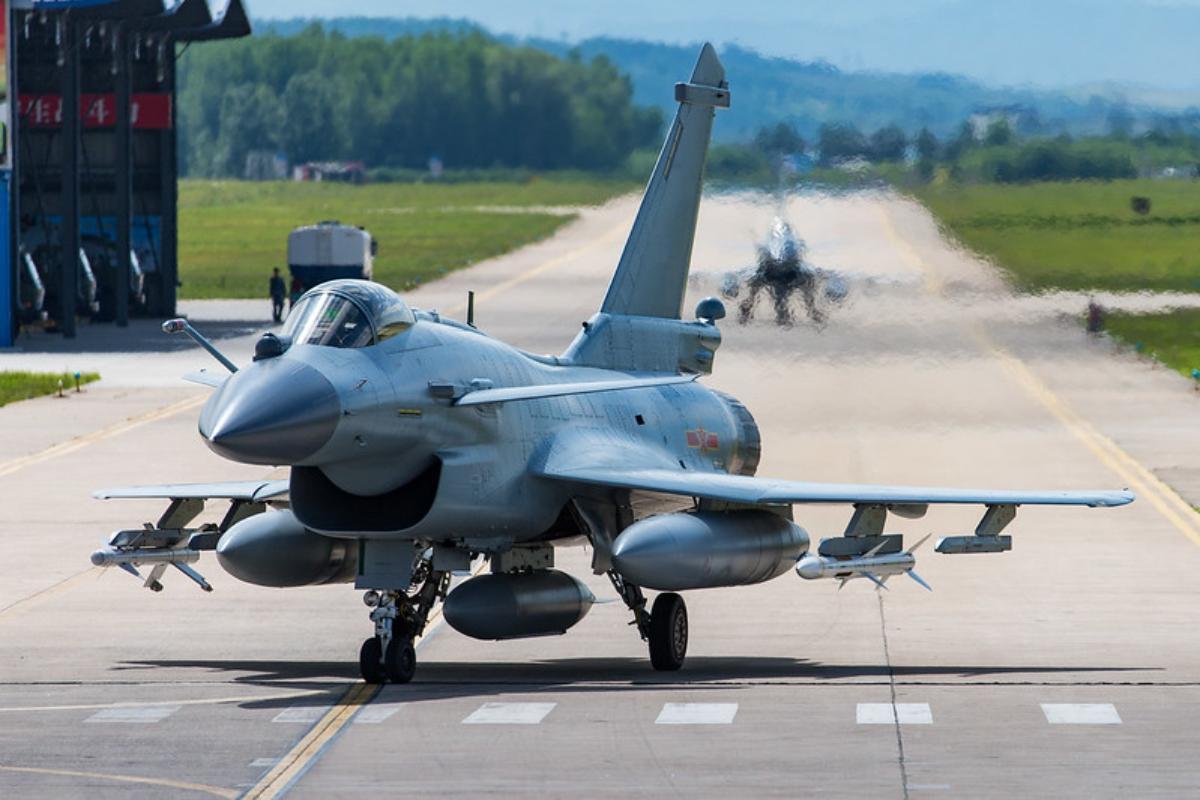
It also has a glass cockpit, an electronic-warfare suite, beyond-visual-range engagement and precision strike, with in-flight refueling on configured aircraft. A targeting pod supports laser- and satellite-guided munitions. Chinese media often liken it to later F-16s; like the F-16, it uses fly-by-wire to control an unstable airframe.
Chinese state media say the J-10CE will continue to be upgraded for export. Designer Li Jun told China Daily it can be tailored for air superiority or strike, with optional payloads, and that its AESA radar and network-centric systems outperform older mechanically scanned setups. Claims of gallium-nitride radar upgrades, radar-absorbing coatings and engine changes remain unverified.
“The J-10CE can adapt to customers’ needs, including air superiority and strike against ground targets, and can be customized based on the environments and mission requirements of different users. We can also offer optional payload packages to clients,” Li said, making a direct appeal to countries looking to upgrade their fleets.
“The aircraft’s avionics system has received a generational upgrade. Its Active Electronically Scanned Array radar system can rapidly detect and track targets, far outperforming traditional mechanically scanned radars,” Li stated. “The jet boasts powerful features, including network-centric cooperative combat, beyond visual range multiple target engagement in intense electromagnetic scenarios, and multimodal precision strikes. It can also prevail in medium- and low-altitude dogfights,” he added.
However, these reports could not be independently verified.
Despite a coordinated export campaign, the J-10CE has had limited success in the export market.
Countries like Bangladesh and Indonesia have both expressed interest in the jet, but it has not culminated in a deal. Moreover, Egypt recently decided to procure additional Rafale jets (it was also pitched the J-10C).
- Contact the author at sakshi.tiwari13 (at) outlook.com
- Follow EurAsian Times on Google News