As it weighs the future of its F-35 purchase amid sustained tensions with the United States, Canada has quietly moved to arm its next-generation aircraft with a powerful new weapon that could be carried internally by the stealth fighter.
Canada signed a $564 million deal with the Norwegian company Kongsberg to purchase the Joint Strike Missile (JSM), becoming the sixth operator of the missile, after the US, Norway, Australia, Japan, and Germany.
“By integrating the JSM into Canada’s next-generation fighter fleet, KONGSBERG will provide the Royal Canadian Air Force [RCAF] with a critical operational advantage,” the company said in an official press statement. Meanwhile, Eirik Lie, the CEO of Kongsberg, said, “We are pleased to welcome Canada as the sixth country to select the JSM. The acquisition of the Joint Strike Missile can fundamentally improve the operational range and effectiveness of Canada’s fighter fleet.”
The Norwegian company also announced investments in Canada through the country’s Industrial and Technological Benefits (ITB) Policy.
“These are aimed at creating long-term industrial capacity by stimulating job creation, developing dual-use technologies, and strengthening the defense industry through collaboration between industry and academia.”
The Joint Strike Missile, or JSM, is an air-launched evolution of Kongsberg’s Naval Strike Missile (NSM), specifically adapted to fit inside the F-35’s internal weapons bays.
On its part, Canada signed a 2023 deal for 88 F-35A Lightning II fighters with the government and Lockheed Martin after years of diplomatic back-and-forth. However, Prime Minister Mark Carney put the purchase of 88 F-35 stealth fighters under review in March 2025 amid heightened tensions with the Trump administration.
Even as it reviews the future of its F-35 purchase, Canada is legally and contractually committed to the initial 16 F-35As, the first of which is likely to be delivered later this year.
The Kongsberg release does not specify the number of missiles Ottawa has ordered, so it is unclear whether its investment in this missile is intended only for 16 jets or for more. Nonetheless, the contract award for JSM demonstrates that Canada is actively planning to equip its F-35 fleet—whether it consists of 16 or 88 jets—with advanced internal weapons.
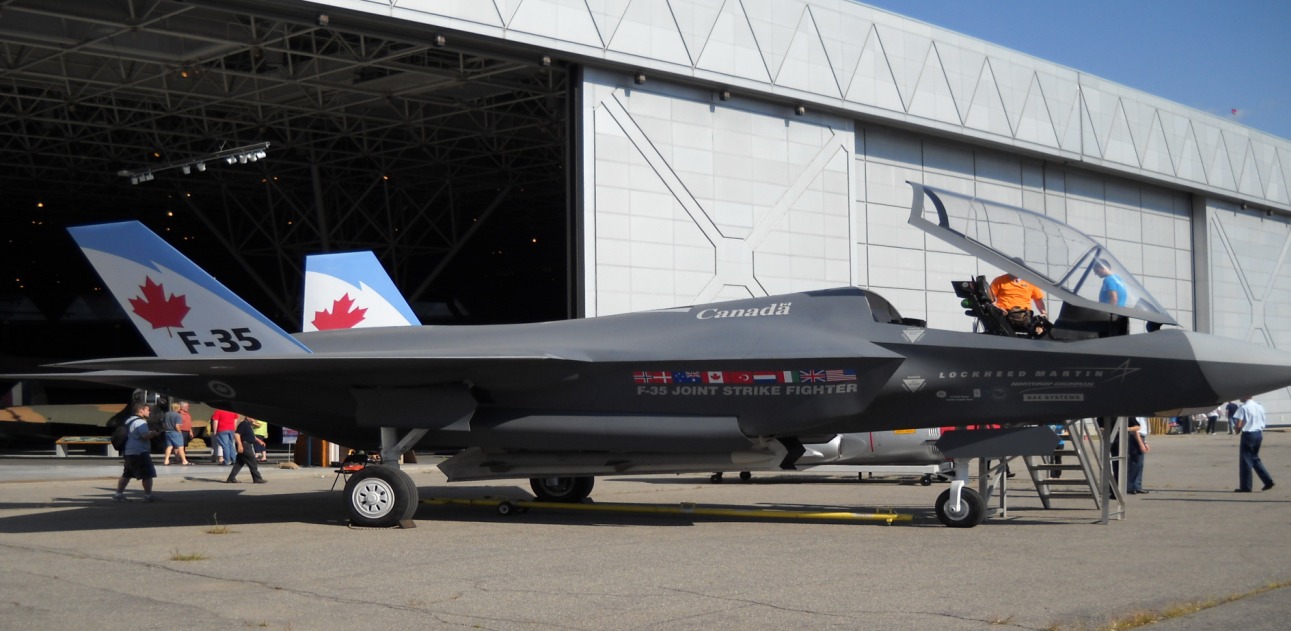
The F-35 review, expected to be published by the end of summer 2025, has been indefinitely delayed, with no clarity on when a decision will be made.
In the past year, the Carney administration has shown enough indications that it is not yet prepared to relinquish the F-35 even in the face of a protracted trade spat with Washington and regular arm-twisting by the Trump administration.
This became amply evident when it began making payments for key components of 14 additional F-35s earlier this year, as reported by EurAsian Times.
The payments were reportedly made for the purchase of “long-lead items,” or essential components such as avionics, structural assemblies, and other components that must be acquired years in advance due to a complex, worldwide production backlog at Lockheed Martin. These parts must be purchased far in advance of the delivery of a finished aircraft, and Ottawa’s putting money into them is a hint that the F-35 purchase is on the table.
Notably, the Canadian Prime Minister has been urged by several conservatives and RCAF officials to complete the purchase because the F-35 is the only fifth-generation stealth fighter available to the RCAF that can ensure interoperability with the US under the NORAD framework and counter threats from nations like China and Russia.
In fact, Lt.-Gen. Jamie Speiser-Blanchet, the commander of the Royal Canadian Air Force (RCAF) and a strong proponent of the F-35, even traveled to Lockheed Martin’s Fort Worth production facility to sign the fuselage bulkhead for the first Canadian F-35.
Some analysts even believe Carney has no intention of abandoning the F-35 at all, and that the review was merely an eyewash and a symbolic move intended to convey a diplomatic message to Washington.
Canadian F-35 + JSM
The Joint Strike Missile is a fifth-generation, long-range, precision-guided, stand-off missile developed in collaboration by Raytheon and Kongsberg.
Unlike other major long-range cruise missiles, including the Lockheed Martin-made AGM-158 JASSM (Joint Air-to-Surface Standoff Missile) and its Long Range Anti-Ship Missile (LRASM), the JSM can be carried inside the weapons bay of the F-35.
Notably, F-35’s fifth-generation stealth, advanced sensors, and sensor fusion allow it to penetrate defended airspace while remaining difficult to detect. The F-35’s integration of JSM, which is specifically designed for internal carriage, would enable the aircraft to launch powerful stand-off attacks without sacrificing its low-observable profile.
The JSM has a range of roughly 275–350 kilometers and flies at high subsonic speeds.
Equipped with advanced multi-mode guidance, including an imaging infrared seeker with automatic target recognition, the missile uses precise GPS/INS navigation and a low-altitude flight profile to exploit both marine and land terrain. Its sophisticated mission planning system allows exceptional flexibility in target engagement.
The four-meter-long weapon features folding wings, air intakes, and tail fins for aerodynamic efficiency, with the imaging infrared seeker in the nose, a fuel tank, and a 125 kg high-explosive fragmentation warhead in the center section.
The Joint Strike Missile system features a data link that can be used with both the Link 16 network and conventional military gear. After launch, a two-way networking data link allows the missile to communicate tactical information with aircraft. Additionally, it ensures the operator can abort missions in flight, retarget, update targets, and record bomb hits.

The combination of JSM and F-35 will provide Canada with “first look, first shot” capability.
The F-35’s sophisticated radar, electro-optical systems, and data fusion would enable pilots to detect and track targets at extended ranges while remaining hidden.
Once targets are detected, F-35 pilots could launch the JSM from beyond the reach of most enemy defenses, using its infrared imaging seeker, GPS/INS navigation, and two-way datalink for in-flight updates or retargeting. This would allow pilots to neutralize high-value maritime threats, such as enemy warships, or heavily protected land targets, including air defenses, command nodes, or infrastructure, while minimizing risk to pilots and aircraft.
The F-35 and JSM combination is particularly valuable for Canada’s specific operational needs in the Arctic and the North Atlantic, as well as for NORAD missions, as Russian and Chinese forces are increasing activity in these regions.
In addition to bolstering continental defense and preventing attackers from moving freely in Canadian approaches, the stealthy F-35+JSM combination would allow long-range strikes from forward operating sites or during patrols. Additionally, it would improve interoperability with allies in the US and NATO, enabling the F-35 to exchange targeting information throughout the coalition network.
Typically, the JSM’s precision and target discrimination reduce collateral damage and increase mission success rates, thereby allowing a smaller Canadian force to punch above its weight by conducting deep strikes that disrupt enemy operations far from the front lines in a large-scale conflict, if any.
Against that backdrop, the move to buy JSM signals that Canada is keeping the F-35 door open and investing in its armament while exploring diversification with Saab. The JSM purchase is a low-risk, high-value addition that works whether Canada buys 16 or 88 F-35s.
- Contact the author at sakshi.tiwari13 (at) outlook.com
- Follow EurAsian Times on Google News