Is Iran’s insistence on asserting its continued control over the Strait of Hormuz boomeranging, helping countries like Syria and Turkey in the process?
This question comes to mind after going through a report that, surprisingly, appeared in today’s edition (July 13) of the state-controlled Tehran Times.
“The Strait of Hormuz remains Iran’s most valuable asymmetric leverage against Washington, but repeated disruption of traffic through the waterway carries a rising cost, including damage to China, Iran’s top oil customer, and a stronger push by coastal Gulf States and Turkey toward pipeline alternatives that could erode the chokepoint’s strategic value”.
The above report is based on the interview that Silvia Boltuc, the Managing Director of “SpecialEurasia” (a media and consulting agency that provides region‑focused intelligence on Eurasia), gave to the Tehran Times.
A relatively underreported ongoing geopolitical/geoeconomic development in the Middle East is the emergence of Syria as an important trading centre in the world. Syria, apparently, is taking full advantage of its geographic position due to the war in Iran.
With its rail, road, port, and land links between continents, Syria could become a centre of new trade and energy corridors, with the assured help and support from not only Gulf Arab states, Jordan, and Turkey but also the United States and France to circumvent the Strait of Hormuz.
Ironically, Tehran’s closure of the waterway has thrown an economic lifeline and strategic advantage to an enemy, interim Syrian President Ahmed al-Sharaa, who ousted the Iran-allied Assad regime in December 2024.
Ahmed al-Sharaa once had a $10m (£7.5m) US bounty on his head. But now he has become US President Donald Trump’s firm favourite to find a way to loosen Tehran’s chokehold on a key conduit for shipments of gas and oil.
During the NATO summit in Ankara last week, Trump described the Syrian ruler as “fantastic”, who, according to him, has done a “great job” bringing together a country that was “a real mess, very disjointed”.
He announced that the US would remove Syria from a list of designated state sponsors of terrorism – on top of lifting sanctions last year – after meeting Sharaa on the sidelines of the Nato summit in Turkey. The deal will help pave the way for American businesses to invest in Syria, which the US government has encouraged by issuing an investor guide with specific guidance for the oil, gas, electricity and banking sectors.
Just before the NATO summit, French President Emmanuel Macron conducted a historic official visit to Damascus, becoming the first Western European leader and head of an EU state to visit the nation since the rebel-led ouster of longtime ruler Bashar al-Assad. Accompanying him was a massive delegation of French business investors.
During this visit, the French President emphasised France’s interest in maintaining and bolstering its support for Syria’s development through a “partnership with a lasting impact” and “the construction of a regional hub for energy corridors”. He cited the tensions in the Strait of Hormuz as an example of the need to diversify trade and energy routes, which opens up opportunities for French companies and investors.
Incidentally, Syria’s strategic location – with a large stretch of Mediterranean coastline and a land mass connected to oil-rich Middle Eastern nations – makes it easy to connect to global trade, if there are proper infrastructural facilities to truck or move energy supplies through dedicated pipelines to coastal ports where goods can be loaded onto commercial vessels bound for Europe and further afield.
Using this route would allow countries to bypass maritime trade through the Strait of Hormuz, reducing Iran’s leverage by attacking commercial vessels in transit.
And this is what has started happening in Syria.
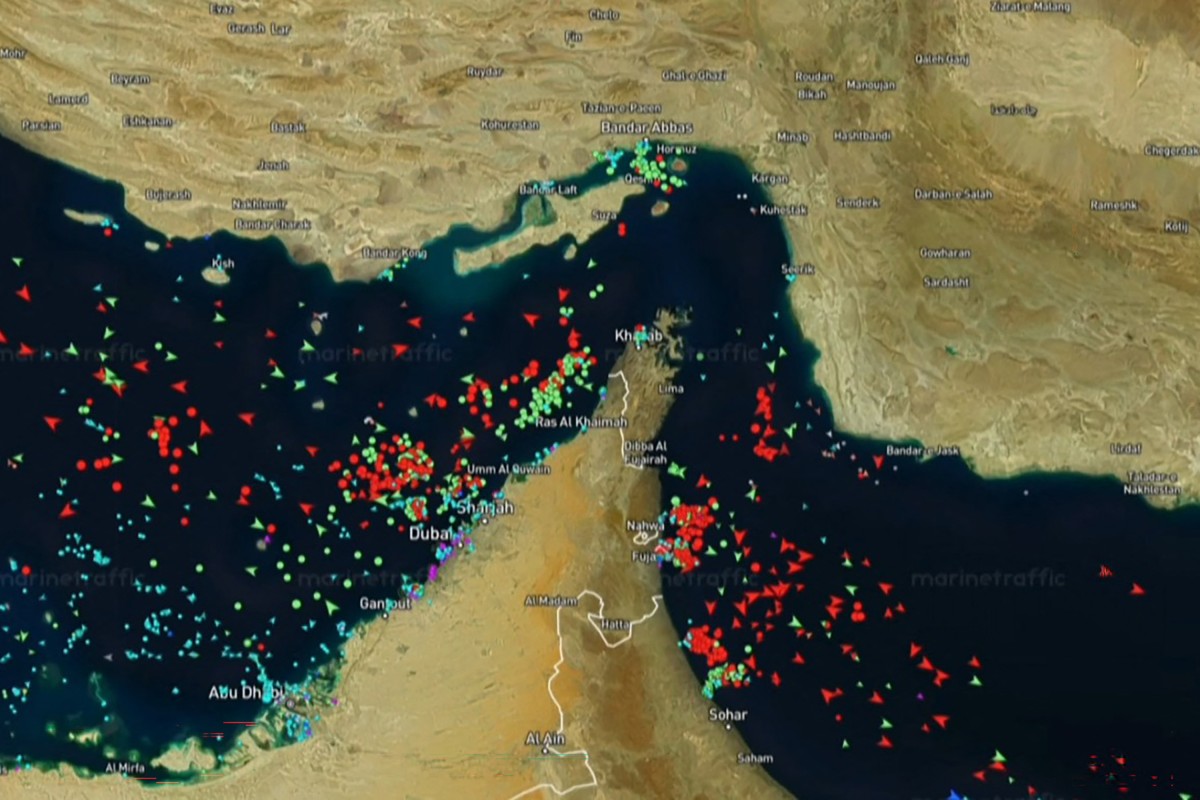
Iraq is preparing to export crude and naphtha on tankers from Syrian ports. The United Arab Emirates and the Gulf countries are planning to use Syria’s Mediterranean port of Baniyas, which has already been shipping out Iraqi fuel oil during the conflict.
Reportedly, since the closure of the Strait of Hormuz in March, Gulf states have been importing thousands of tons of timber, cement, soy, corn, consumer goods, and livestock through Syrian ports of Latakia and Tartus each month.
Incidentally, in July 2025, the United Arab Emirates rented out 80% of the Tartus port, with DP World, an Emirati logistics company, renovating and managing the port as part of a 30-year, $800 million deal.
Tartus today is said to be humming as a lifeline for the UAE, which was previously reliant on the Strait of Hormuz for 80% of its seaborne food and consumer goods imports.
Besides, there are talks of reviving the Kirkuk-Baniyas pipeline, a 621-mile line built in the 1950s to export Iraqi oil through the Mediterranean that had been destroyed seemingly beyond repair during the Syrian war.
Significantly, in April, Turkey, Jordan, and Syria formed a trilateral government committee to build new rail corridors, with Saudi Arabia set to join shortly. They plan a network following a path similar to the old Hejaz railway, built by the Ottomans in 1908 from Damascus to Medina, in what is now Saudi Arabia, to ferry Muslim pilgrims and passengers for the Hajj.
As envisioned, this new track would be designed specifically to link up to the Saudi Arabian Railway, which, as of 2030, is to be connected to the under-construction Gulf Cooperation Council railway linking all six Gulf Arab states’ capitals, industrial zones, seaports, and logistical hubs.
If all these plans are implemented, Syria by 2031 would be at the center of a comprehensive system connecting Europe, Turkey, the Levant, and the Gulf; and the Mediterranean, Red Sea, and Persian Gulf, it is said.
And what is further important to note is what many Gulf Arab officials have told the press in recent weeks. According to them, attempts to establish new corridors through Syria would not be hampered even if the Strait of Hormuz reopens.
They say that their economy and sovereignty cannot be allowed to be held hostage by blackmail from Iran or any other country, and there must be alternatives.
Three additional reasons seem to strengthen the above strategic logic of Gulf countries.
One, any oil that leaves the Gulf through Hormuz must sail 12,000 km around Africa to reach Europe, or 6,000 km through the Suez Canal. From a Syrian Mediterranean port, the same oil reaches Southern Europe in 5-7 days. For Europe, this cuts shipping time and costs significantly.
Two, Syria is not starting from zero. Tartus already hosts a Russian naval logistics facility. Latakia has commercial port capacity. Before 2011, Syria had two working oil terminals and pipeline links with Iraq. The Iraq-Syria pipeline once carried 300,000 bpd before it was shut in 2003 due to US sanctions. In other words, ingredients of a system already exist.
Three, even for countries like India and China, who buy 70% of Gulf oil, Hormuz is a single point of failure. A Syrian route would add redundancy to the Strait of Hormuz. For Europe, it would even reduce dependence on Russian pipelines, Turkish straits, and Hormuz all at once.
However, there are also some reality checks on the idea of Syria emerging as an alternative to the Strait of Hormuz that need not be ignored.
First, Syria’s stability as a country is still in question. Terror groups, for instance, are still operating within Syria. In early June, an Iraqi fuel tanker was attacked on a highway in northern Syria.
The country is still a war zone, and no insurance company will cover oil tankers in a war zone. Syria would need a stable government, de-mined ports, and protection for pipelines from ISIS or militia attacks. That requires a speedy political settlement.
Secondly, the steepest hurdle to any new Middle East corridor in Syria is the cost. Syria lacks basic financial and banking infrastructure, and the legacy of decades of sanctions means international transactions are tough to process, and payments are hard to track.
Syria needs billions of dollars to repair existing tracks and lay new. Syria’s ports need massive upgrades to increase their uploading capacities. Of course, the Gulf countries, the World Bank, and now the Western countries, including the US, are promising help. But then, Syria has other priorities, too, particularly when its people, including the returnees ( who had fled to other countries due to the Civil War), need improved living conditions.
Thirdly, there is the Russian factor that is still relevant in Syria, something the Gulf States, the US and France need to take into account.
All told, the new Syrian leadership continues to rely on Moscow for vital security and economic support, cementing Russia as an enduring power broker in the region.
As EurAsian Times once discussed, Russia retains crucial geostrategic assets in the country, notably the Hmeimim Air Base and the Tartus naval facility, which allow Moscow to project power into the Mediterranean. Syria continues to depend on Russian equipment and technical expertise to maintain its armed forces. Russia also remains the primary supplier of oil and wheat to Syria.
Fourthly, despite all promises, the fact is that during normal times, the Strait of Hormuz saw 20 million bpd( Barrels Per Day) of oil and 80 million tons/year of LNG passing through it. In contrast, estimates suggest that even with a $20 billion investment in upgrading its infrastructure, Syria could export at most 2 to 3 million bpd. That is 10-15% of Hormuz volumes.
In other words, Syria cannot replace Hormuz in a strict sense of the term. But its impotence lies in the fact that it could act as a pressure valve. During a Hormuz closure, 2-3 million bpd from Iraq via Syria would keep a rise in prices under check and thus help blunt a price shock.
Besides, the Syrian alternative is in line with the other and parallel strategic and economic potential of new cross-border corridors that have the potential to strengthen cooperation in a region that continues to suffer from low economic integration and high political fragmentation.
EurAsian Times had earlier analyzed how some projects intend to provide the building blocks for more efficient overland trade across the Middle East. These include the IMEC, which comprises an “Eastern Corridor” connecting India to the Gulf region and a “Northern Corridor” connecting the Gulf region to Europe. It will include a railway and ship-rail transit network, as well as road transport routes.
This was conceived as a strategic alternative to existing maritime trade routes passing through the Red Sea and the Suez Canal.
But the Hormuz crisis has led to some modifications in the idea. It is now suggested that by integrating new routes through Oman, Egypt, and Syria, IMEC could absorb over 60 percent of the container traffic that transited through Hormuz pre-war, thereby increasing the corridor’s capacity tenfold.
All this implies that Syria is indeed emerging as the defining geopolitical theater in the Middle East.
- Author and veteran journalist Prakash Nanda is Chairman of the Editorial Board of the EurAsian Times and has been commenting on politics, foreign policy, and strategic affairs for nearly three decades. He is a former National Fellow of the Indian Council for Historical Research and a recipient of the Seoul Peace Prize Scholarship.
- CONTACT: prakash.nanda (at) hotmail.com