While global attention remains fixed on the Russia-Ukraine war and the Houthis’ rapid advance in Yemen, Israel is quietly consolidating its territorial gains in Syria.
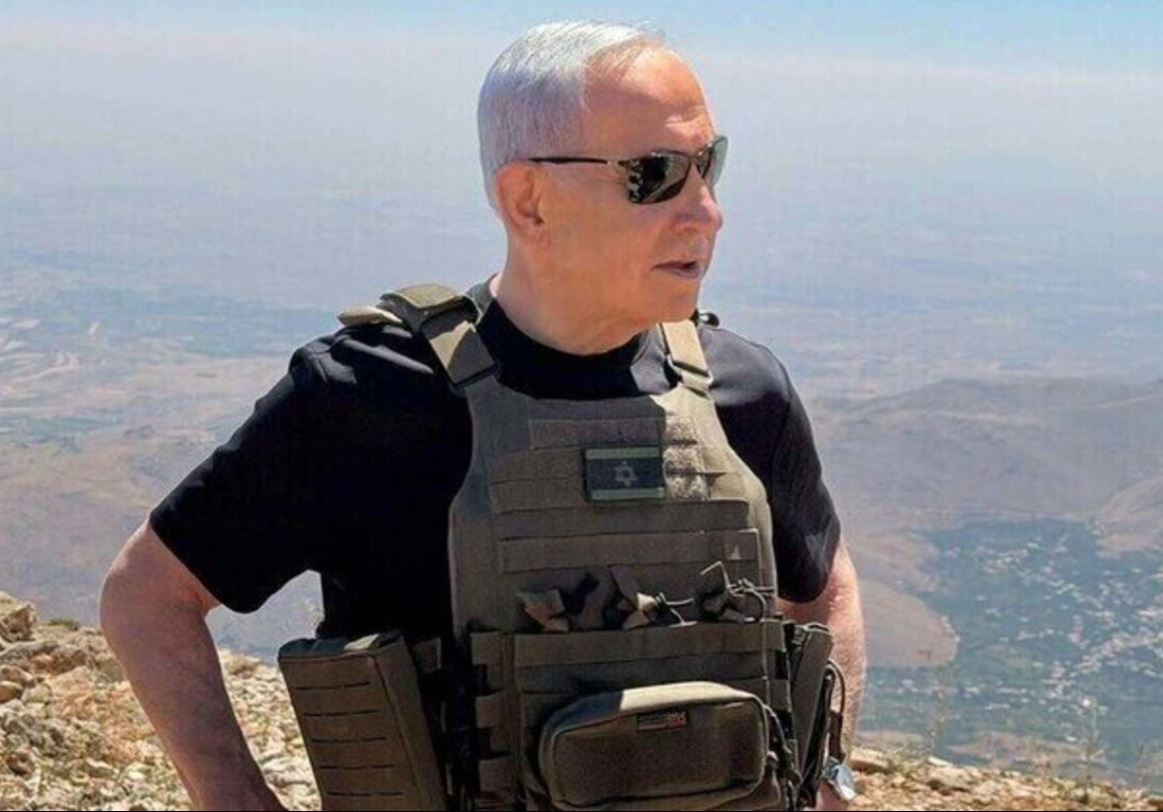
On September 9, Prime Minister Benjamin Netanyahu visited the Syrian border and also toured Mount Hermon’s summit in southern Syria, saying Israel “will not allow any terror army to establish itself on our border, and this is one of our greatest achievements in the war.”
Defense Minister Israel Katz and IDF Deputy Chief of Staff Maj. Gen. Tamir Yadai were also present with Netanyahu.
Netanyahu’s “terror army” remark was a thinly veiled reference to the Hay’at Tahrir al-Sham (HTS), led by President Ahmed al-Sharaa, who was an al-Qaeda operative earlier.
Netanyahu also said that Israel was very close to “regime collapse” in Iran.
“We are committed to defeating the terror regime in Iran – and we will do it,” the prime minister said, overlooking Syria from the top of Mount Hermon, adding that the “entire axis will fall once and for all.”
Netanyahu further said that Israel now controls the entire area from Mount Hermon to the Mediterranean.
“Absolute control that has never been seen before.”
Underscoring the importance of Israeli control of Mount Hermon, Netanyahu said: “On the eve of Rosh Hashanah, we are atop Mt. Hermon. Damascus is right here, Lebanon is right there, the Syrian Golan Heights are right there, and we control the entire area from the Hermon Crown to the Yarmouk River, and from here to the Mediterranean Sea.”
Prime Minister Benjamin Netanyahu visited Mt. Hermon in Syria, together with Defense Minister Israel Katz and IDF Deputy Chief-of-Staff Maj- Gen. Tamir Yadai.
The Prime Minister was briefed at an IDF outpost overlooking Syria by Head of Northern Command Maj.-Gen. Rafi Milo and… pic.twitter.com/pnEYLyKQya
— Prime Minister of Israel (@IsraeliPM) September 9, 2026
The visit by Netanyahu himself and the defense minister was a clear message to Syria and Turkey that Israel is here to stay and that the Syrian territories occupied by the IDF in the aftermath of the chaotic collapse of Bashar al-Assad’s government will stay under Israeli control.
Defense Minister Katz also directly addressed Syrian President al-Sharaa, saying that the Israeli military would maintain its presence in the so-called security zone and would not withdraw from it.
Meanwhile, multiple Arab governments condemned Netanyahu’s visit, including Syria, Kuwait, and Qatar.
Arab Countries Condemn Netanyahu’s Visit
Syrian foreign ministry called the visit an “illegal” and “provocative” move.
Kuwait called it an “illegal entry into Syria’s Mount Hermon” and called on the UN Security Council to take action to halt attacks on the sovereignty of the Arab country.
Jordan’s Foreign Ministry also called it a “flagrant violation” of Syria’s sovereignty and territorial integrity and a “blatant breach” of international law.
Meanwhile, Qatar called it “a blatant violation of the sovereignty of the fraternal Syrian Arab Republic, a flagrant breach of international law, and a serious threat to regional security.”
It is indeed unusual for Arab countries as varied as Jordan, Kuwait, and Qatar to issue statements condemning Israel and in support of Syria.
🇮🇱 WATCH: PM Netanyahu just visited the “Syrian” side of Mount Hermon.
From Tel Aviv to Mount Hermon, Israel stands tall, unshakable, and undefeated. The enemies who thought they could break us on October 7th are now seeing our leaders on their side of the border. pic.twitter.com/v4bcoiJfCU
— Jews Fight Back 🇺🇸🇮🇱 (@JewsFightBack) December 17, 2024
This is even more true as Israel has been in possession of Syrian territories, such as the Golan Heights, at least since the 1967 war.
So, why has Netanyahu’s visit to Mount Hermon led to such a strong reaction from multiple Arab countries?
The answer, it seems, lies in the hilltop’s strategic importance.
Strategic Importance of Mount Hermon
On December 8, 2024, the Bashar al-Assad government collapsed after over a decade of civil war.
The very next day, Israel moved quickly, carrying out more than 300 aerial assaults targeting key Syrian military sites. These airstrikes destroyed key Syrian military equipment, including fighter jets, helicopters, armored vehicles, and arms and ammunition.
At the same time, Israeli ground forces moved further ahead from the Golan Heights into the former UN buffer zone, including Mount Hermon.
The Israeli army occupied the Syrian side of the Mount Hermon mountain range and other strategic points to expand the buffer zone along the border with Syria, The Jerusalem Post reported on 9 December.
Mount Hermon, also known as Mount Al-Sheikh, is one of Syria’s most important mountains, located on the border between Syria and Lebanon.
The occupation of Mount Hermon by the IDF was a key victory for Israel, which consolidated Jerusalem’s control not just over Syria, as far as Damascus, but also over Lebanon.
Further, the site will help Israel strengthen its layered air defense systems.
The mountain range has four prominent peaks. The highest peak is 2814 meters, while the other peaks are at 2294, 2236, and 2145 meters, respectively.
The high ranges not only serve as a natural border between Lebanon and Syria, but their peaks can also be seen from Israel, the occupied Golan Heights, and Jordan, which makes them of exceptional geographical and strategic importance.
In Israel, this peak is also known as “eyes of the nation” because of its exceptional strategic importance for Israel’s early warning and surveillance system.
The high ranges of the mountain allow Israel to monitor a very wide area from here, including parts of Lebanon, Syria, and Jordan. Any rocket or missile launches from these areas towards Israel will be easily picked up by Air Defense radars placed here.
Strategic affairs expert Alaa al-Asfari told the BBC that Mount Hermon is Syria’s highest point, making it a key military outpost for monitoring the entire region.
According to Al-Asfari, Israel wants to establish a “safe zone” by gaining control of the area, stretching from Quneitra to the outskirts of Damascus. He says a presence there will allow Israel to install advanced radars, cameras, and other surveillance equipment, enabling it to keep a constant eye on the entire area.
Furthermore, the mountain had traditionally served as Syria’s southern defensive shield. If the mountain is under Israeli control, it could now serve as Israel’s northern defensive shield and leave vast areas of Syria vulnerable.
This area has traditionally also served as a weapons smuggling route from Iran and Syria into Lebanon.
Naftali Hazony, a former Israeli F-16 pilot, provided insight into the profound significance of Israel’s capture of Mount Hermon. Hazony explained that this strategic maneuver has altered the regional security balance and offers Israel critical advantages over its adversaries.
Israel has conquered Mt. Hermon, the highest mountain in Syria, its peak reaching 2,814m. Syria’s capital, Damascus, is only 40 km away, now within range of Israel’s artillery shells. Here’s why Israel took this mountain:
1/7 🧵 pic.twitter.com/XZdjeeU9RD— Naftali Hazony (@nhazony) December 9, 2024
“Israel has conquered Mt. Hermon, the highest mountain in Syria, its peak reaching 2,814m. Syria’s capital, Damascus, is only 40 km away, now within range of Israel’s artillery shells.”
“For decades, Israel’s northern defenses were overshadowed by Syria’s Mt. Hermon. No longer. The most important natural fortress in the region is now in the hands of Israel. Israel did it quietly, driving into Syria’s abandoned positions and taking them without a fight,” he added.
Hazony further explained that Mount Hermon, because of its dominating position, has long left a blind spot in Israel’s radar coverage into Syria and Lebanon. However, now with the peak in Israeli control, Israel’s radar systems can cover a much broader area.
“Once placed on Mt. Hermon, Israel’s radars will see far into both Syria and Lebanon, providing early warning of incoming low-flying jets and drones. Israel’s intelligence can also leverage the peak, placing sensors to conduct surveillance and intercept enemy communications.”
“The mountains also provide the perfect cover for Israel’s special forces and spies, who can now enter Syria more freely, conducting missions under the cover of darkness,” he added.
“Be it ISIS, HTS, Iran, or Hezbollah, a hostile force advancing toward Israel will now be exposed — at the mercy of Israel’s drones, surface-to-surface missiles, and laser-guided bombs. Residents of northern Israel can sleep more soundly knowing that Israel controls this peak.”
However, in Syria, there is a fear that because of the strategic importance of Mount Hermon, Israel would try to keep it permanently, much like the Golan Heights that Jerusalem occupied in 1967 during the Six-Day War and has never vacated.
Prime Minister Netanyahu’s visit clearly signals that Jerusalem will try to extend its control over this area permanently.
That perhaps explains the angry reaction from most Arab states.
- Sumit Ahlawat has over a decade of experience in news media. He has worked with Press Trust of India, Times Now, Zee News, Economic Times, and Microsoft News. He holds a Master’s Degree in International Media and Modern History from the University of Sheffield, UK.
- This is a News + Opinion Article
- He can be reached at ahlawat.sumit85 (at) gmail.com