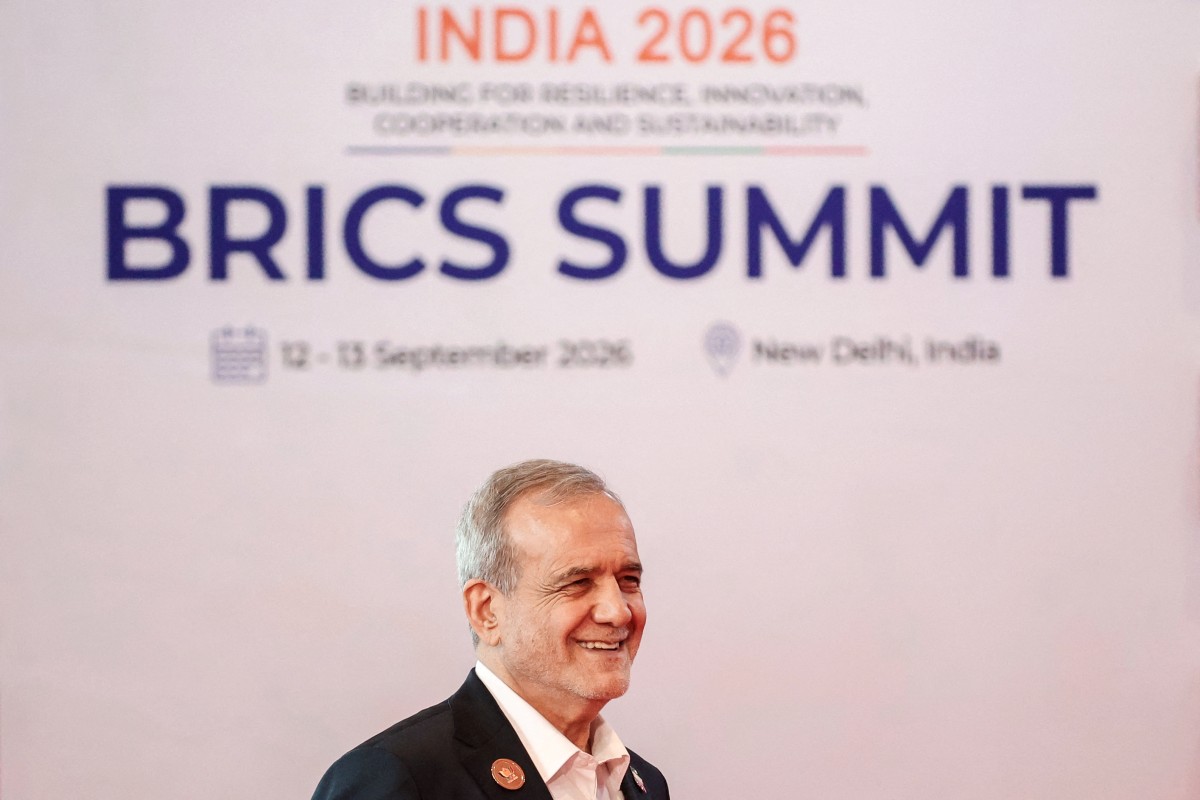
The BRICS New Delhi Declaration — “Building for Resilience, Innovation, Cooperation and Sustainability”, released on September 12, 2026, must be among the longest declarations in diplomatic history. At over 130 paragraphs and 17,835 words, it covers everything from AI to critical minerals to disaster management to start-ups to global financial reform.
But its section on “International and Regional Peace and Security, paragraphs 23 to 39” deserves close reading. It does not seem to reflect balanced diplomacy.
It is a direct, indirect, and sustained censure of Israel, while maintaining a studied silence on Ukraine as if the war there does not affect global peace. For host country India, which counts Israel as a critical friend, this appears a little strange.
In what reads like a totally one-sided declaration of the so-called ICC (International Criminal Court, which, incidentally, is not recognized by India), Israel has been named, scrutinized, and condemned throughout.
Consider the architecture. Para 28 talks of “escalation of tensions in the Middle East/West Asia” and protection of civilians — generic enough. Then para 29 condemns “deliberate attacks on civilian infrastructure and peaceful nuclear facilities under full safeguards” — a thinly veiled reference to Israeli strikes on Iranian nuclear sites in June 2026.
Paras 30 to 36 are entirely Israel-Palestine and Israel-Lebanon. Para 30 expresses “deep concern on continued violence in Gaza despite the ceasefire agreement of October 2025” and condemns forced displacement of Palestinians.
Para 31 reaffirms a Palestinian state within 1967 borders with East Jerusalem as capital. Para 32 opposes forced displacement and “geographic or demographic changes” in Gaza.
Para 33 is the sharpest. It says: “We call for adherence to international law, in particular to international humanitarian law and international human rights law, and condemn all their violations, including the use of starvation as a method of warfare, attacks targeting civilians and civilian objects, including healthcare facilities and other civilian infrastructure, as well as the unlawful obstruction of humanitarian access.”
It then explicitly cites “the provisional measures of the International Court of Justice in the legal proceedings instituted by South Africa against Israel, which, inter alia, reaffirmed Israel’s legal obligation to ensure the provision of humanitarian aid in Gaza.”
This is not diplomatic vagueness. It directly adopts the South African case language against Israel. No global meeting — not even the UN Human Rights Council, not even the OIC — has in a single paragraph used “starvation as a method of warfare,” “attacks targeting civilians,” “unlawful obstruction,” and ICJ proceedings against Israel, all together.
Para 34 rejects “any unilateral measures that seek to alter the legal and historical status of occupied Jerusalem.” Para 35 “condemns the continued violations of the ceasefire and of the sovereignty and territorial integrity of Lebanon. We call on Israel to respect the terms agreed with the Lebanese government and to withdraw its occupying forces from all of the Lebanese territories.” Para 36 condemns all attacks against UNIFIL (United Nations Interim Force in Lebanon ) and mourns four Indonesian peacekeepers, calling for accountability for those responsible — again, pointing at Israel.
In six paragraphs, Israel is told to withdraw, to stop starvation, to stop attacking civilians, to stop obstructing aid, to stop altering Jerusalem, to respect UNIFIL, and to be accountable for killings. It is a complete indictment.
One can have views on the Israeli-Palestinian conflict. But BRICS claims to be a platform for balanced, multipolar diplomacy that respects diverse viewpoints. This is not balanced. This is a one-sided prosecution.
And it is doubly problematic because India was the host. Israel is not just any country for India. It is a critical friend — strategic, technological, agricultural, and defense partner.
In 1992, when India normalized relations, Israel assisted when India faced sanctions. In Kargil (1999), Israeli artillery and drones filled gaps. In agriculture, 32 Centers of Excellence across India focus on Israeli drip irrigation and horticulture. In water management, defense, cyber, counter-terrorism, and intelligence sharing after the 2008 attack on Mumbai — Israel has been a consistent partner without lecturing India on Kashmir or internal politics.
When Hamas attacked Israel on October 7, 2023, India condemned terrorism and stood with Israel. Prime Minister Modi was among the first to call Prime Minister Netanyahu. India has consistently maintained that terrorism in any form is unacceptable ( which the Declaration mentions in its own 40th paragraph) and that Israel has the right to defend itself, even while supporting a two-state solution and humanitarian aid to Gaza.
To allow a BRICS declaration hosted by India to carry the strongest language against Israel seen in any BRICS or G20 or SCO document — accusing Israel of starvation as a method of warfare, citing ICJ genocide proceedings — is not consistent with that history.
If BRICS wants to talk about humanitarian law, it must also mention the October 7 attack on Israel by Hamas at the behest of Iran, hostages still held, rocket attacks on Israeli civilians, and terrorism as the root cause.
The declaration does not mention terrorism even once in its Gaza section. Para 33 condemns obstruction of humanitarian access but says nothing about Hamas diverting aid or militarizing hospitals. Para 30 calls for a ceasefire but does not demand the release of hostages.
This selective citation of international law is precisely what undermines multilateralism. You cannot quote the ICJ against Israel while ignoring UNSC 1701 violations by Hezbollah that triggered the war, or ignoring that the ICJ does not condemn UNRWA’s own staff involvement on October 7.
Besides, the Declaration shows a double standard in its most striking omission—Ukraine.
Paragraphs 23 to 39 speak of polarization, distrust, conflicts in many parts of the world, an increase in global military spending to the detriment of development, risks of nuclear danger, concern over attacks on civilian infrastructure and nuclear facilities, concern over Sudan, Syria, Lebanon, Palestine, and the Cuba blockade.
But there is not a single word on Ukraine. Not one. The war that has defined European security for four years, that has caused a global food and fertilizer crisis, that has led to attacks on the Zaporizhzhia nuclear plant — the largest nuclear plant in Europe under IAEA safeguards — that has seen global military spending rise to $2.7 trillion, that has led to polarization and fragmentation that para 24 laments — is simply absent.
If para 29 condemns deliberate attacks on civilian infrastructure and peaceful nuclear facilities under full IAEA safeguards, does that not apply to Zaporizhzhia? If para 24 is alarmed by the increase in global military spending at the expense of development financing, is the war not the biggest driver? If para 23 calls for peaceful resolution through dialogue and preventive diplomacy, does that not apply to Ukraine-Russia?
In what is a sheer double standard, Gaza is treated as a global peace and security issue requiring explicit naming, shaming, and legal references. Ukraine — where war does not affect peace, apparently — is erased.
Why? Because BRICS includes Russia and Iran as members. The declaration needed consensus. So to achieve consensus, Ukraine was omitted, while Israel — where consensus is easier because no member is close to Israel except India — was made a punching bag.
That is not principled multipolarity. That is selective morality. A grouping that claims to advocate for a multilateral approach respecting diverse viewpoints cannot adopt a text that is ferociously critical of Israel and silent on Russia-Ukraine. Either both conflicts deserve balanced language calling for dialogue, protection of civilians, respect for territorial integrity, or neither should be singled out.
By choosing one-sidedness, BRICS undermines its own claim to be an alternative to Western selective outrage. It simply replaces Western selective outrage with another selective outrage.
One may ask why India, as host, allowed such one-sided language against Israel while maintaining total silence on Ukraine. The answer lies in the drafting drama of September 11-12. Since the US-Israel strikes on Iran in June 2026 and Iran’s retaliation on US bases in the UAE and Gulf, BRICS had failed to issue any joint statement. At the Foreign Ministers’ meet in May, Jaishankar had to issue a Chair’s Summary. On the eve of the New Delhi summit, all text was agreed except one paragraph — the Iran war. Iran demanded clear condemnation of US-Israel; the UAE demanded equal condemnation of Iran. India needed full consensus to claim its chairmanship success, much like the G-20 in 2023.
To secure that trophy, Indian negotiators worked till 4 am, with Modi himself talking to leaders of Iran, Russia and the UAE, even engineering a rare meeting between Iran’s President Pezeshkian and Abu Dhabi’s Crown Prince. The compromise was that Iran and the UAE would both back down from naming each other; language on the Iran war would be made generic — deep concern, protection of civilians, smooth flow of trade — and Iran would be compensated with strong language on Israel-Gaza where all members could agree.
Thus, the unusually harsh indictment of Israel, citing starvation as a method of warfare and ICJ proceedings, and the curious erasure of Ukraine were the price of ensuring Iran signed. For India, consensus became an achievement. But for a critical friend like Israel, and for the credibility of BRICS as a balanced voice, the price was high.
What Should India Have Done?
As host, India had drafting responsibility. India’s Ministry of External Affairs (MEA) is known for its drafting skills and ability to ensure balance. It should have insisted on generic language without naming ICJ proceedings against one country. BRICS is not a court.
Secondly, if Gaza humanitarian concerns were to be reflected, they should have been accompanied by unequivocal condemnation of terrorism, demand for release of hostages, and recognition of Israel’s security concerns — as India does bilaterally.
Thirdly, if Ukraine is too divisive to name, then the Middle East should have been handled generically — call for ceasefire, dialogue, humanitarian access for all, without assigning guilt. Or if the Middle East was named, Ukraine should also have been named with the same language — concern over attacks on civilians, nuclear facilities, need for diplomacy.
Fourthly, India should have reminded partners that for the Global South, energy security — smooth flow of trade and energy that para 28 mentions — is affected by Iranian attacks on the Strait of Hormuz, Houthi attacks in the Red Sea supported by Iran, and by sanctions on Russian oil that affect India’s import basket. One cannot lament supply chain disruption while ignoring Iran’s role.
India’s foreign policy has always been strategic autonomy, not camp politics. Friendship with Israel does not mean enmity with Palestine — India supports a two-state solution and has given $40 million to UNRWA and humanitarian aid to Gaza. Similarly, friendship with Russia does not mean enmity with Ukraine — India has sent humanitarian aid to Ukraine and called for dialogue. That balanced approach should have been reflected in the Declaration hosted by New Delhi.
Allowing a text that reads as if written by one camp against Israel will be noted in Tel Aviv, in Washington, and in European capitals that India seeks to deepen ties with. At a time when India is negotiating trade deals with the EU and an FTA with Israel, and when the India-Israel counter-terror partnership is more critical than ever after Pahalgam and cross-border threats, such one-sidedness should have been avoidable.
- Author and veteran journalist Prakash Nanda is Chairman of the Editorial Board of the EurAsian Times and has been commenting on politics, foreign policy, and strategic affairs for nearly three decades. He is a former National Fellow of the Indian Council for Historical Research and a recipient of the Seoul Peace Prize Scholarship.
- CONTACT: prakash.nanda (at) hotmail.com