

The US Navy is unlikely to rename the USS Doris Miller aircraft carrier (CVN-81) in honor of US President Donald Trump; however, the 45th and 47th American President could be commemorated with a major battleship program.
During Trump’s first term as President, the US Navy announced that the Ford-class carrier would be named USS Doris Miller, recognizing an enlisted sailor who helped defend US forces from Japan’s attack.
However, hints emerged that White House could turn the decision in favor of the serving President, Donald J. Trump.
The Navy had been internally referring to the ship by its hull number, CVN-81, rather than as the USS Doris Miller.
The ship was referred to in the same manner in an Aug. 13 White House executive order, which read: Within 60 days of the date of this memorandum, the Secretary of War, in consultation with the Secretary of the Navy, shall provide to the President, through the Director of the Office of Management and Budget (OMB) and the Assistant to the President for National Security Affairs (APNSA), a plan on the required measures to replace the Electromagnetic Aircraft Launch System and Advanced Weapons Elevators with steam and hydraulic systems for the construction of CVN-81, including timelines and resourcing requirements.
Renaming the carrier was deemed highly controversial, as no carrier has ever been named after a sitting president.
It was originally set to become the first aircraft carrier named after an Afro-American, honoring a Black sailor celebrated for his heroic actions during the Japanese attack on Pearl Harbor.
However, in a statement to CNN, a spokesperson for Acting Navy Secretary Hung Cao said, “There is no intention to change the name of the USS Doris Miller.”
Miller’s great-nephew applauded the news as it preserves Miller’s legacy of “courage, sacrifice, and service to our nation.” “Doris Miller’s story is not just our family’s history; it is American history. His courage deserves to be remembered, honored, and recognized for generations to come,” Bledsoe said.
Former Acting Secretary of the Navy Thomas Modly announced the name USS Doris Miller in January 2020 during a Martin Luther King, Jr. Day ceremony at Pearl Harbor.
“Dorie Miller was the son of a sharecropper,” Modly said at the ceremony, according to a Navy release. “And, he was an American sailor – so designated by the uniform that he wore — the same uniform all sailors wore, and still wear, regardless of race, ethnic background, or political persuasion.”
The US currently has eleven aircraft carriers, more than any other nation. Many carriers are named after former US presidents, such as USS Abraham Lincoln, USS George H.W. Bush, USS Ronald Reagan, USS Dwight D. Eisenhower, USS Theodore Roosevelt, USS Harry S. Truman, USS Gerald R. Ford, and USS George Washington.
However, till now, no carrier has been named after a sitting President.
Additionally, not all aircraft carriers are named after presidents. For instance, the USS Nimitz is named after the admiral who commanded the US Pacific Fleet during World War II. The USS Carl Vinson is named after a Georgia congressman who chaired the House Naval Affairs and Armed Services Committee. The USS John C. Stennis is named after Senator John C. Stennis, also known as “Father of America’s Modern Navy.”
Trump’s Name Not Fading Away
While the US Navy has confirmed it will go ahead with USS Doris Miller, Trump could retain a major naval namesake through the proposed Trump-class battleship program announced in December 2025.
As the centerpiece of his “Golden Fleet” initiative, the administration unveiled plans for a new class of large, nuclear-powered guided-missile battleships—designated BBG(X)—with the lead ship to be named USS Defiant.
“As commander in chief, it’s my great honor to announce that I have approved a plan for the Navy to begin the construction of two brand-new, very large — the largest we’ve ever built — battleships,” Trump announced from his Mar-a-Lago residence in Palm Beach, Florida, in December 2025.
It would be “the fastest, the biggest, and by far, 100 times more powerful than any battleship ever built,” he said.
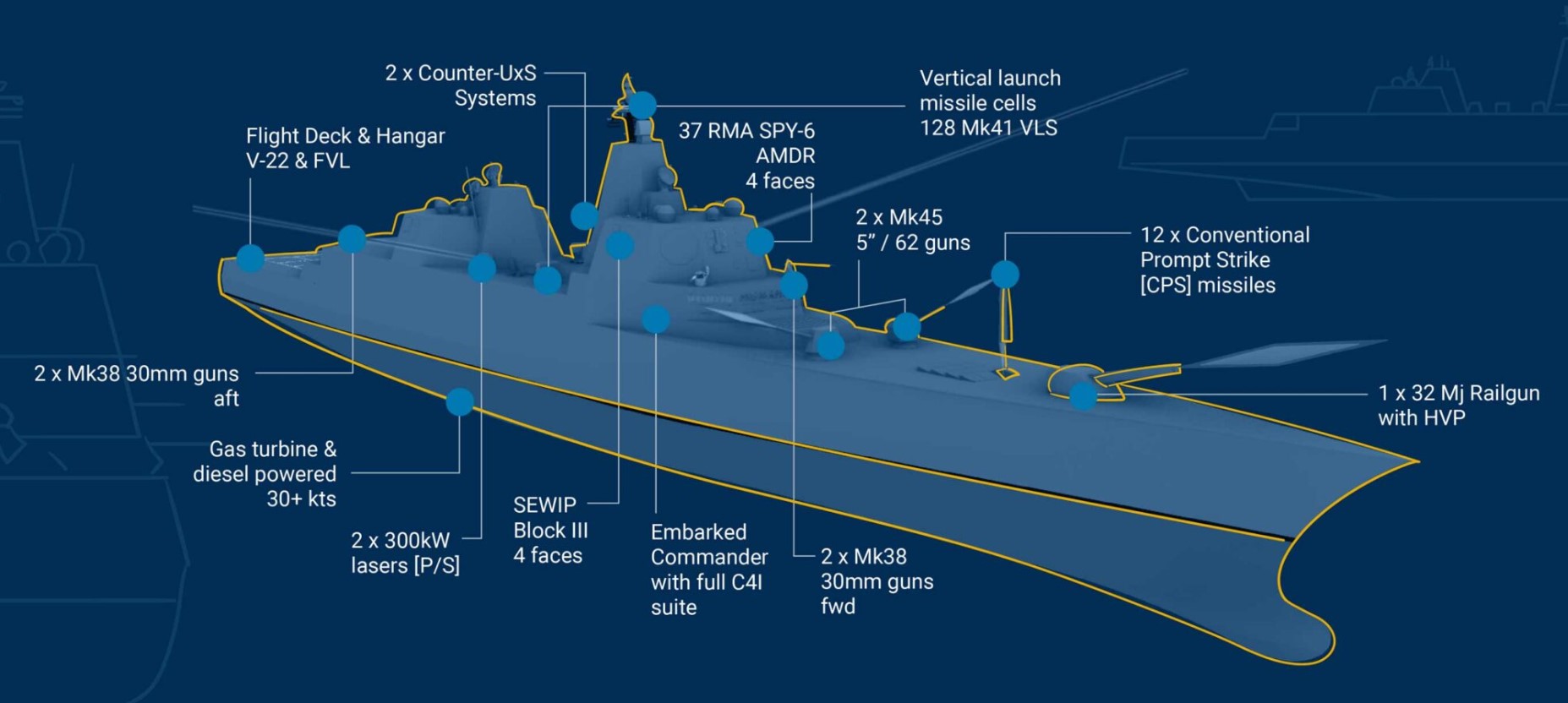
These vessels would be among the largest and most heavily armed surface combatants the United States has built since World War II. According to publicly available information, the battleship is envisioned to be 840-880 feet long, or three times the size of an Arleigh Burke-class destroyer. It will displace 35,000-41,000 tons, or more than double the largest US Navy surface combatants, the Zumwalt‑class destroyers (15,000 tons), and will be manned by a crew of 650-850 people.
The planned armament for the battleship could include one 32 MJ Railgun with Hypervelocity Projectile (HVP), Surface Launch Cruise Missile-Nuclear (SLCM-N), 128 cells Mk41 Vertical Launching System (VLS), two 300 kW or two 600 kW lasers, four 30mm guns, two counter-UAS systems, 12 cells CPS hypersonic missiles, and two RAM launchers.
This aligns with Trump’s earlier claim that the new “battleship” would field firepower “100 times more than anything built.”
The Trump-class battleship could give Trump a prominent place in contemporary naval nomenclature even as the Ford-class carrier CVN-81 remains dedicated to Doris Miller.
However, the Trump-class project faces massive roadblocks.
The Congressional Budget Office estimates the lead ship could cost around $23 billion, with follow-on ships averaging roughly $18 billion, and Senate appropriators recently moved to cut nearly $1.84 billion in near-term funding, citing concerns over maturity, cost, and industrial capacity.
Still, formally naming the class after the President and planning the USS Defiant ensure that Trump’s name remains attached to a major warship concept.
Whether the Trump-class ultimately proceeds to construction will depend on congressional funding, shipyard capacity, and technical maturity in the years ahead, but the announcement itself has already secured the association.
- By: ET Online Desk
- Mail us at editor (at) eurasiantimes.com