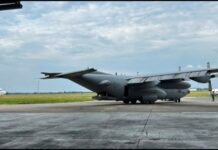


In June 2025, US pilots flew B-2 Spirit stealth bombers on one of the longest, most intense missions in US Air Force history.
The operation was dubbed Midnight Hammer. Their targets were three nuclear sites in Iran: Fordow, Natanz, and Isfahan, which they had been practicing for years.
The B-2 pilots took off from Whiteman Air Force Base in Missouri. Seven B-2s flew east toward Iran. At the same time, other B-2s flew west over the Pacific Ocean as a deception, making people think the warplanes were first headed toward Guam, from where they could strike Iran.
The entire trip took about 37 hours — more than a day and a half in the air.
The pilots had to stay awake, focused, and ready for high-stakes operations.
They refueled many times from tankers in the sky. About 125 aircraft helped in total, including F-22 and F-35 stealth fighters, other fighter jets, besides the refueling aircraft.
As the B-2 bombers neared Iran, the pilots saw a city below them. One pilot said, “Holy s—, that’s Tehran!” They knew this was not practice. It was real.
Once the target was identified, the pilots opened the bomb doors and dropped 30,000-pound bombs — the Massive Ordnance Penetrators, or MOPs.
These MOPs are designed to punch deep into the earth and destroy facilities buried under mountains.
This operation marked the very first time that MOPs were used in combat. The pilots dropped 14 of them. The moment the bombs left the aircraft, the heavily loaded B-2 suddenly felt much lighter and easier to fly.
The pilots turned their aircraft and watched. A big fireball lit up the night sky over the mountain. The bombs hit Fordow and Natanz. At the same time, a US submarine launched Tomahawk missiles at the Isfahan site.
Half of the 14 pilots who flew the mission were Missouri Air National Guard members from the 131st Bomb Wing. The other half were active-duty pilots from the 509th Bomb Wing.
Unlike full-time active-duty pilots, many of the Guard pilots have regular civilian jobs when they are not flying. They train part-time but still flew this high-risk, 37-hour combat mission alongside their active-duty teammates. All of them had graduated from the Air Force Weapons School and had practiced long flights in simulators for years.
After over a dozen MOPs were released, the stealth bombers turned back. None of the aircraft were engaged, and everyone returned safely.
Experts later said the attacks badly damaged Iran’s ability to make nuclear material. One expert said the centrifuge program “no longer exists” the way it did before. Iran would have a hard time rebuilding it.
The pilots said the long flight took a toll on their bodies. They ate simple food, drank a lot of water, and stayed focused. They said everyone’s teamwork — from the people who planned the mission to the crews who fixed the planes, and from both active-duty and Guard pilots—made it possible.
This was the largest B-2 combat mission ever flown. It demonstrated that the USAF can send stealth bombers halfway around the world, stay hidden, and strike heavily fortified targets buried deep under mountains.
It also showed that part-time Missouri Air National Guard pilots can fly alongside full-time airmen on the Air Force’s most demanding missions. Their real names have been withheld for security reasons.
The account is based on interviews by Air & Space Forces Magazine.

B-2 Bomber
The B-2 is a low-observable, or stealth, aircraft that offers the USAF the unique ability to penetrate an adversary’s defenses and hit a target.
The B-2 has a considerable edge over other bombers in the US fleet, thanks to its innovative combination of low-observable technology, excellent aerodynamic efficiency, and a huge payload. Its low observability allows greater flexibility, thereby increasing the aircraft’s sensors’ field of view.
Notably, the B-2’s low observability comes from reduced infrared, acoustic, electromagnetic, visual, and radar signatures. These signatures make it difficult for enemy air-defense systems to detect the stealth bombers.
While most details are classified, the aircraft’s stealth comes from composite materials, special coatings, and its flying-wing design.
After Operation Midnight Hammer, the B-2 has come to be known to the layman as the only aircraft in the USAF inventory to have the capability to carry the GBU-MOP bomb.
In addition to carrying the MOP, the B-2 is one of three bomber types still carrying nuclear gravity bombs and is considered the most sophisticated in the US inventory. The B-2A Spirit stealth bomber was equipped with the B61-12 nuclear bomb, making it the first aircraft in the USAF inventory to be equipped with the lethal weapon.
The B-2 was planned to be a fleet of 132 aircraft. However, Congress ended the program after only 21 had been built, driving the cost per aircraft to nearly US$2 billion.
It is the most expensive military plane ever built. Despite the high price tag, the aircraft continues to receive investment and upgrades because its cutting-edge capabilities are a cornerstone of US combat operations.
The bomber is expected to be replaced by the upcoming next-generation B-21, but the US has invested heavily to keep it relevant.
- Edited by ET Online Desk
- Mail us at: editor (at) eurasiantimes.com