

Roger Wicker, Senate Armed Services Committee Chairman, has called President Donald Trump’s push to use steam-powered catapults on future aircraft carriers a “non-starter.”
“Secretary Cao, returning to steam is a non-starter, and everybody needs to understand that,” Wicker told Acting Navy Secretary Hung Cao during a confirmation hearing for the permanent Navy secretary post.
Tim Kaine, a Virginia Democrat, questioned the nominee about an August presidential memorandum directing the US Navy to develop a plan to equip the upcoming USS Doris Miller and other aircraft carriers with traditional steam catapults and hydraulic weapons elevators.
The memo, issued Aug. 13, targets ships not yet fitted with the Electromagnetic Aircraft Launch System (EMALS) and Advanced Weapons Elevators that define the class.
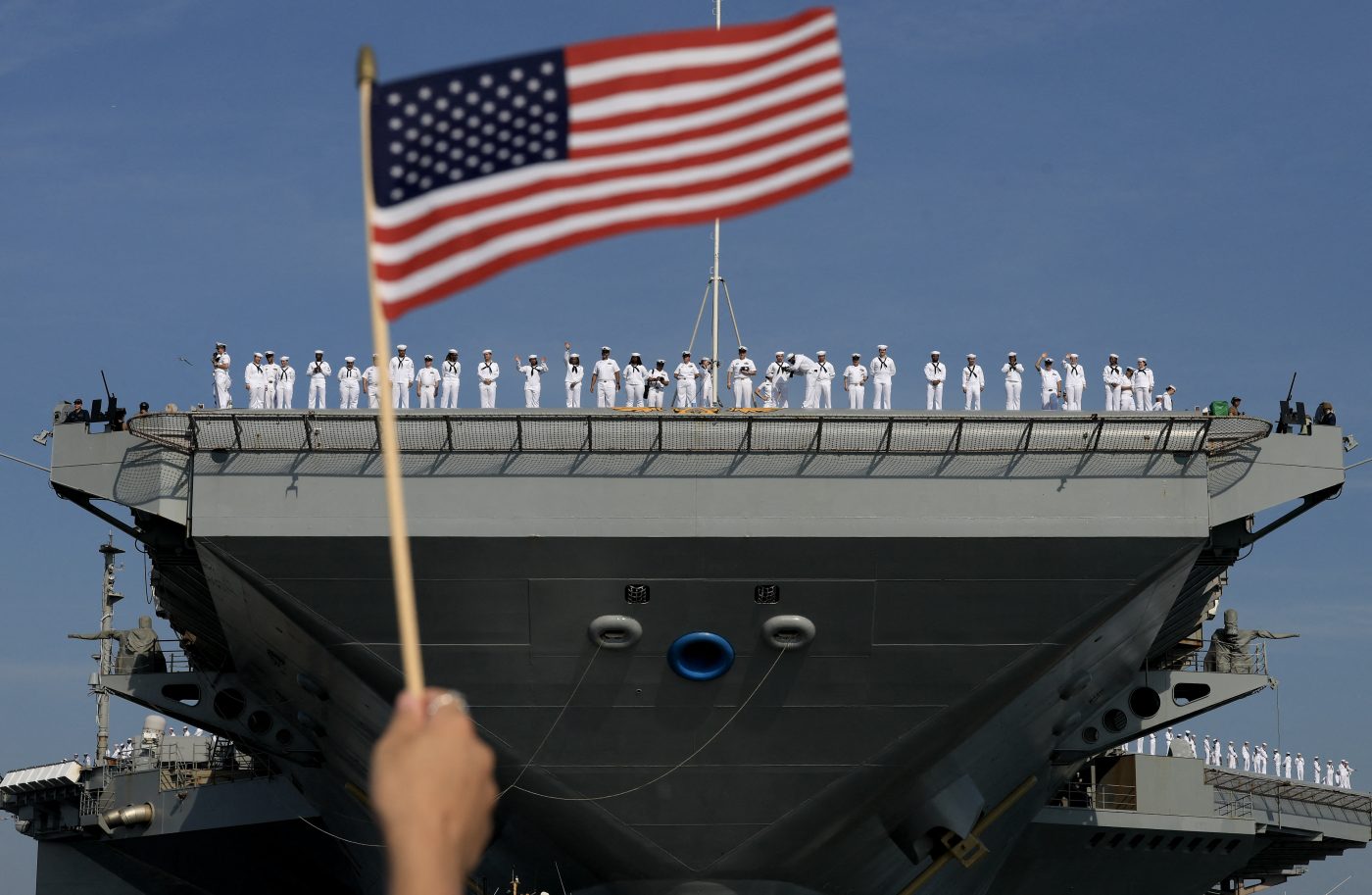
The USS Gerald R. Ford, the world’s biggest aircraft carrier, uses EMALS.
Kaine said he had recently visited the Ford and spoken with flight-deck sailors, many of whom had experience with both steam and electromagnetic systems.
“Based on what the folks on the flight deck told me, the EMALS system works very, very well,” he said. “I do hope you’ll consider the experience of those who’ve been operating these launchers on the Ford in deciding before you go down a path that will be more expensive and also less capable.”
Cao, who has served as acting secretary since April, pointed to development and integration challenges. He said the electromagnetic systems were “delaying our carriers by seven years” and that the Navy faced a period in which it could drop to nine operational carriers.
He emphasized efforts to accelerate deliveries but did not fully endorse or reject a return to steam in the exchange.
In an explanatory statement accompanying their fiscal 2027 defense appropriations bill released Monday, Senate Republican appropriators warned that a major redesign “would result in many billions of dollars in additional costs and many years in program schedule delays.”
They directed the Navy to submit a report comparing the systems on sortie generation rates, aircraft compatibility, elevator performance, manpower requirements, readiness impacts, and combat effectiveness. They also cautioned against “such significant programmatic shifts without substantive analysis, justification, and Congressional approval.”
The appropriators noted that recent combat experience with the Ford “appears to demonstrate greater sortie rates, readiness rates, and combat lethality than previous generation carriers.”
Initial estimates for the design work required to reintroduce steam have been reported at around $10 billion. The United States has not produced steam catapults in roughly 20 years, and earlier Navy assessments indicated that switching could add at least 18 months to construction timelines for ships already optimized for EMALS.
Wicker has previously supported continuing with EMALS. In August, he said there was “overwhelming support in Congress and in the Pentagon for moving forward with EMALS,” noting that some related work occurs in Mississippi.
Why Trump Wants to Discard EMALS
Donald Trump has instructed that future aircraft carriers discard EMALS and use the catapult technology.
Trump announced this as part of a national security presidential memorandum, to “fix critical long-term issues in Navy shipbuilding and ship repair programs and restore capacity and competition to the maritime industrial base.” Trump lamented “an atrophied shipbuilding industrial base,” which he said made constructing and repairing warships slower and more expensive.
Earlier, speaking on USS George Washington, Trump said, “I’m putting out an order, I’m going to sign an executive order, when we build aircraft carriers, it’s steam for the catapults, and it’s hydraulic for the elevators. Do you agree? Everybody agrees.”
Trump claimed the technology is expensive, unreliable, and difficult to repair. “They’re spending billions of dollars to build stupid electric. And the problem, when it breaks, you have to send up to MIT, get the most brilliant people in the world, fly them out. The steam, they said, they can fix it with a hammer and blowtorch. And it works just as well, if not better.”
Trump said that they worked very well for the U.S. Navy for nearly half a century. “They had steam, which worked so beautifully, and it has for 50 years, right? So we’re gonna go back. Seriously, fellas, I want to make that change. I’m gonna do an executive order,” he added.
“I’m not going to let them continue to do this thing. They’re trying to make it work; they’re trying so hard, and they have something that’s perfect. So we’re going to go back on that and the magnets.”
Back in 2017, Trump called the Electromagnetic Catapults “no good.”
Even during a 2019 Navy visit to Japan, Trump called the system “crazy electric” and “very, very complex.”
Steam vs EMALS
Interestingly, a 2019 Pentagon report highlights how the troublesome electromagnetic catapults and new arresting gear on the USS Gerald R. Ford performed terribly during at-sea trials over the past two years.
According to a 2018 Bloomberg report, citing the annual review of the Office of the Director of Operational Test and Evaluation (DOT&E), EMALS suffered 10 “critical failures” across 747 aircraft launches during at-sea trials since USS Gerald R. Ford’s delivery in 2017.
The Advanced Arresting Gear (AAG) had 10 “operational mission failures” over 763 landing attempts in the same period, it said.
This is even though the USS Gerald R. Ford, at US$13 billion, is the world’s most expensive aircraft carrier.
According to the Bloomberg report, the EMALS experienced a critical failure once every 455 launches, nine times the Navy’s desired rate.
Similarly, the carrier’s 11 Advanced Weapons Elevators, or AWEs, which move ordnance and other aircraft stores between the main flight deck and the ship’s magazines, also suffered repeated failures.
Similarly, a DOT&E report published earlier this year lamented that, despite software and hardware upgrades, the USS Gerald R. Ford’s reliability statistics have not improved substantially.
“Despite engineering upgrades to hardware and software, reliability has not appreciably changed from prior years, and reliance on off-ship technical support remains a challenge,” the DOT&E report said.
“As part of an effort to provide short- and long-term improvements to address EMALS reliability degraders, NAVAIR delivered a software update and upgraded all catapult position sensor blocks before CVN 78’s deployment, and is continuing development on further
improvements,” it added.
Similarly, the DOT&E report highlights reliability issues with the Advanced Arresting Gear (AAG) aboard the USS Gerald R. Ford.
“Despite some software and hardware improvements in AAG, reliability has not appreciably changed because the FY23 data reflects many short-duration failures that were unreported in the developmental test, as well as system-of-systems degradations, all of which would have prevented landing.”
“NAVAIR continues to work on short- and long-term improvements to address AAG reliability degraders. However, difficulties such as obtaining replacement parts and the reliance on off-ship technical support remain a challenge,” it added.
In theory, the EMALS and AAG were supposed to improve the USS Gerald R. Ford’s sortie rate; however, persistent issues and repeated breakdowns have kept the carrier’s sortie rate lower than that of the 50-year-old steam catapult launch system.
- Sumit Ahlawat has over a decade of experience in news media. He has worked with Press Trust of India, Times Now, Zee News, Economic Times, and Microsoft News. He holds a Master’s Degree in International Media and Modern History from the University of Sheffield, UK.
- VIEWS PERSONAL OF THE AUTHOR.
- He can be reached at ahlawat.sumit85 (at) gmail.com