“The enemy of my enemy is my friend” is an ancient proverb that describes a pragmatic alliance.
It suggests that two opposing or adversarial states should unite to neutralize a shared, greater adversary, even if they do not share friendly relations.
History offers clear examples.
During the First World War, Germany compelled France and Britain, longstanding adversaries, to unite against a shared enemy. In the Second World War, the danger posed by Nazi Germany forced even the capitalist United States and the communist Soviet Union into an uneasy partnership.
Something similar is happening between Poland and Ukraine.
Russia’s war in Ukraine has forced these two countries, which have historically shared an uneasy, often hostile relationship, to cooperate with each other.
Indeed, Poland has emerged as one of the strongest supporters of Ukraine during this period.
Yet, beneath this wartime solidarity, long-standing tensions persist. Once the immediate Russian threat recedes, these underlying frictions are likely to resurface.
In fact, even during the war, shades of these tensions can be sensed.
On July 1, Poland announced that it won’t transfer additional MiG-29 Fulcrum fighters to Ukraine because Kyiv won’t provide information on drone production technology.
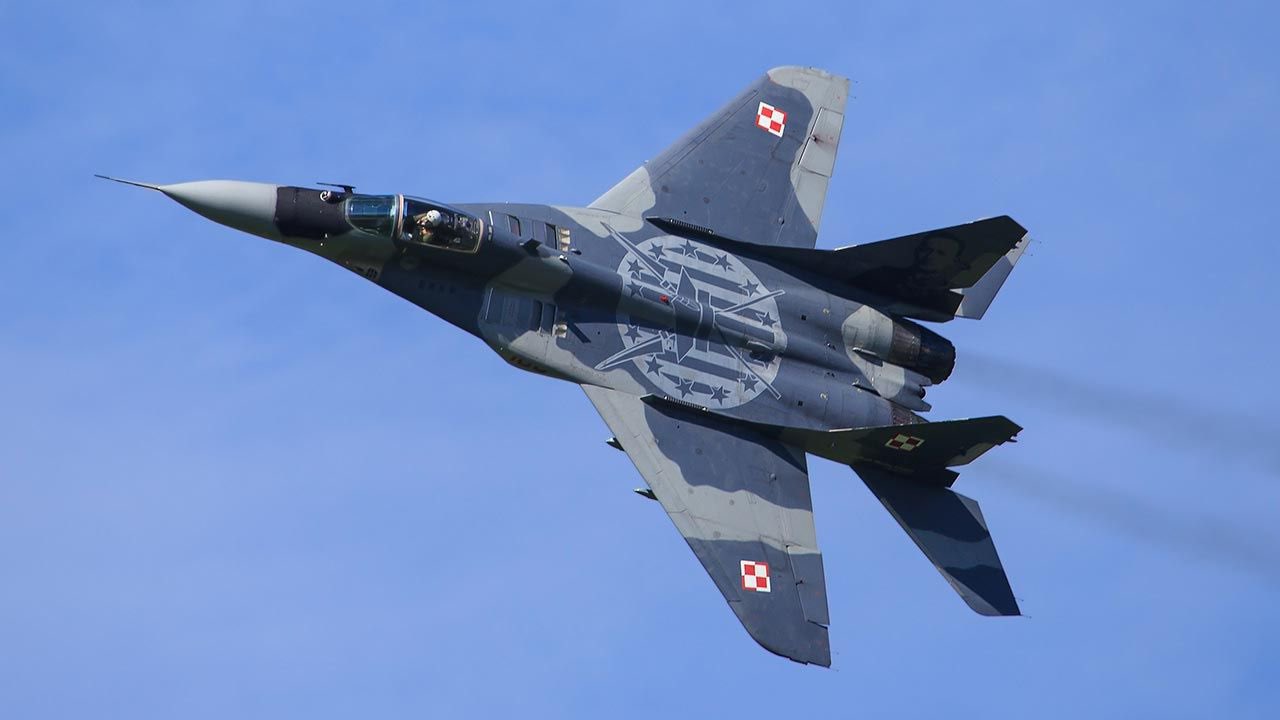
Notably, Poland was one of the first countries to donate fighter jets to Ukraine. In March 2023, Poland donated 14 MiG-29 Fulcrums to Ukraine.
“I proposed what I believe was a very partnership-based approach. MiGs in exchange for drones. The Ukrainians initially agreed, but they did not honor this arrangement, so there will be no MiGs for Ukraine because Poland does not have drones or the capability to use them,” Polish defense minister Władysław Kosiniak-Kamysz told the Polish Polsat News outlet.
Poland’s decision to withhold the transfer of MiG-29 fighters to Ukraine after Kyiv backed out of an agreement to share drone technology may look like a calculated pressure tactic or routine transactional bargaining. In reality, however, it is only the latest in a series of incidents that expose deeper strains in the relationship, strains that have long existed beneath the surface-level narrative of wartime solidarity.
Last month, Polish President Karol Nawrocki stripped Zelensky of the Order of the White Eagle, Warsaw’s top award.
Nawrocki went further, saying that Poland will not support Ukraine’s membership in the European Union. The decision was taken after Zelensky named a military unit after an army battalion that took part in the massacres of Poles during the Second World War.
Polish President Karol Nawrocki has approved the revocation of the Order of the White Eagle awarded to Ukrainian President Volodymyr Zelensky, saying Poland will not support EU membership for those who fail to reject the “cult of totalitarianism and violence.” pic.twitter.com/HRx7vHigTi
— KyivPost (@KyivPost) June 19, 2026
In May, Ukrainian President Zelensky signed a presidential decree granting an honorary title to one of Ukraine’s elite military units. The unit was named “Heroes of the UPA,” short for Heroes of the Ukrainian Insurgent Army.
Zelensky justified the decision by saying it was meant “to restore the historical traditions of the national army.”
The UPA was a guerrilla force active mainly between 1942 and 1945. It was the armed wing of the Organization of Ukrainian Nationalists (OUN), particularly the radical faction led by Stepan Bandera.
While many Ukrainians view the UPA as fighters for Ukrainian independence, the Poles see them differently.
During the Second World War, especially during 1943-1945, armed units of the UPA carried out massive attacks on Polish civilians, killing an estimated 50,000 to 100,000 Polish civilians.
This episode is known in Poland as the Volhynia massacres (or Rzeź wołyńska).
These attacks, critics argue, were part of a systematic effort to ethnically cleanse Poles from the areas of Volhynia (Wołyń) and Eastern Galicia, areas that were historically Polish lands but which later became part of the Ukrainian Republic within the Soviet Union.
Polish President Nawrocki called the naming “outrageous” and “incomprehensible.”
Poland's Nawrocki OFFICIALY STRIPS Zelensky's 'Order of the White Eagle' for naming Ukrainian battalion after UPA NAZI WAR CRIMINALS
'We must not allow the spreading of ideologies responsible for GENOCIDE' pic.twitter.com/Nfw134D6wI
— RT (@RT_com) June 19, 2026
“The Order of the White Eagle is not just an ordinary award. It is a symbol of the Republic of Poland’s highest trust. It signifies a special bond with the Polish state and the nation’s profound gratitude. Such a symbol requires not only merit but also respect for the values that form the foundation of our community.
“Therefore, in light of President Volodymyr Zelenskyy’s consent to name one of the units of the Armed Forces of Ukraine ‘Heroes of the UPA,’ and after consulting with the Chapter, I have decided to revoke the Order of the White Eagle from the President of Ukraine,” the Polish President Nowrocki said in his statement.
He also added that for the “overwhelming majority of Polish society, the Ukrainian Insurgent Army (UPA) remains, above all, a formation responsible for the brutal crimes committed against citizens of the Republic of Poland during World War II.”
This row underscores the contested memory of the Second World War in Poland and Ukraine, and the competing narratives of nationalism that continue to divide the two countries.
It also explains why the relationship between Warsaw and Kyiv, notwithstanding the wartime solidarity, is fraught with deep-seated tensions that are bound to resurface once the Russian threat dissipates.
The Burdens of History
Being neighbors, Poland and Ukraine share a long but often complicated and conflictual history. Of course, there have been periods of cooperation, but for much of the history, their relationship has been marked by territorial disputes, competing versions of nationalism, and mutual grievances.
This has led to conflicts over territory, national identity, and historical memory.
These conflicts came to the fore in the first half of the 20th century, during the two world wars that reshaped modern Europe.
During the First World War, the Austro-Hungarian Empire collapsed in 1918. It created a power vacuum in Eastern Europe, and consequently, both Poland and Ukraine claimed Eastern Galicia, including the city of Lviv.
Ukrainians established the West Ukrainian People’s Republic, declared Lviv as its capital, and tried to take control of the Galicia region. Poland saw this as an attempt to seize historically Polish territory, as Eastern Galicia had been part of Poland for centuries and had a significant Polish population, especially in cities.
This led to the Polish-Ukrainian War of 1918–1919.
After fierce fighting, Poland defeated the Ukrainian forces and incorporated Eastern Galicia, including the city of Lviv, and parts of Volhynia into the Second Polish Republic.
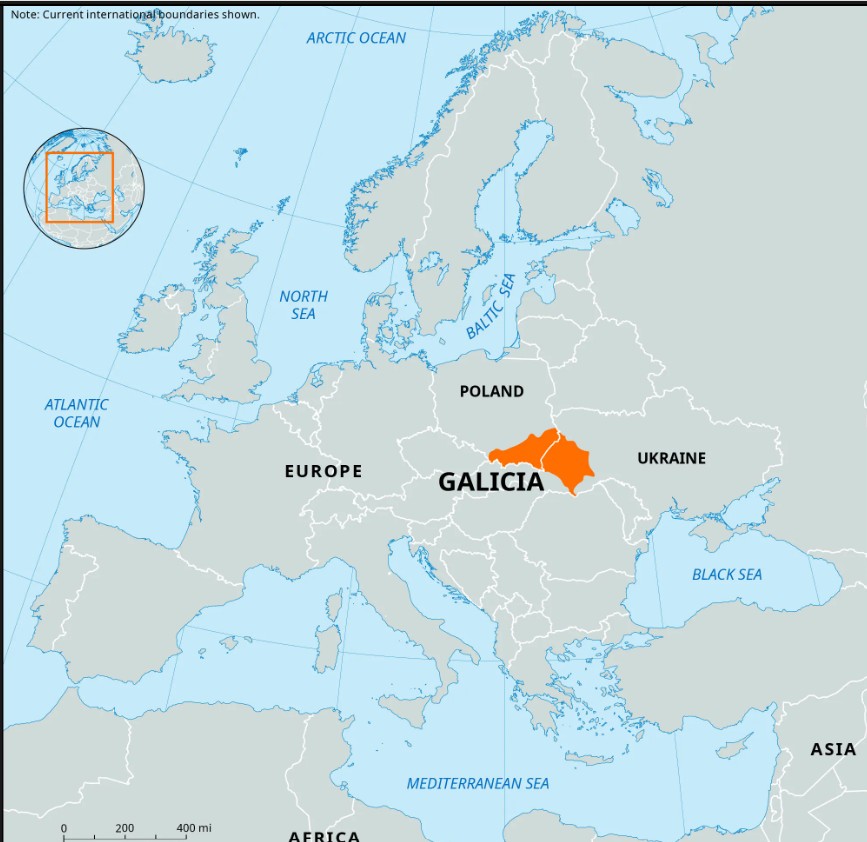
However, Ukraine saw these lands as Ukrainian and saw Polish rule as an occupation.
These areas remained part of Poland till the beginning of the Second World War in 1939.
Germany invaded Poland on September 1, 1939. This triggered the start of the Second World War. In response to the invasion, Great Britain and France fulfilled their treaty obligations to Poland and declared war on Germany two days later, on September 3, 1939.
Nearly two weeks later, on September 17, 1939, the Soviet Union invaded Poland.
Notably, this invasion was part of the Molotov–Ribbentrop Pact, a non-aggression treaty signed on August 23, 1939, between the Soviet Union and Germany, which divided Eastern Europe into German and Soviet “spheres of influence” and included a preplanned partition of Poland.
However, violating the terms of the Molotov–Ribbentrop Pact, Germany invaded the Soviet Union in 1941 and occupied the region of Galicia and the city of Lviv.
During the German occupation, significant segments of the Ukrainian nationalist movement, particularly the Organization of Ukrainian Nationalists (OUN) and its military wing, the Ukrainian Insurgent Army (UPA), collaborated with the Nazis against both the Soviets and the Poles.
The most infamous event was the Volhynia Massacre.
Between 1943 and 1945, the UPA systematically murdered 50,000 to 100,000 ethnic Polish civilians, including women and children, in Volhynia and Eastern Galicia.
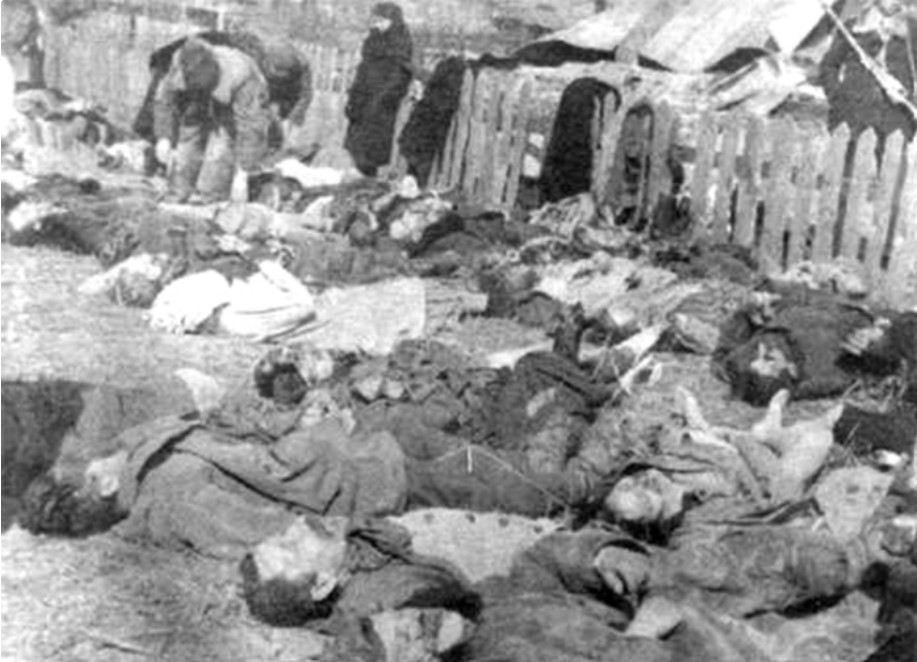
The goal was to ethnically cleanse these areas of Poles, so that a Ukrainian state could be established here with a homogeneous population of Ukrainians.
Many of these civilians were killed brutally, a fact recognized by the Polish President in a recent statement.
“The facts are that at least 100,000 Polish citizens were murdered by the UPA in Volhynia, Eastern Galicia, the Lublin region, and the Subcarpathian region, solely because they were Poles, Jews, or members of other minorities. It is a fact that the victims were residents of villages and small towns – entire families, women, children, and the elderly.
“They were not soldiers on the battlefield. They were defenseless civilians. They were murdered brutally and savagely. It is also a fact that, to this day, the victims have not received a dignified burial,” Nawrocki said.
Notably, in 2016, the Polish Parliament officially recognized the Volhynia Massacre as “genocide.”
“The victims of the crime committed in the 1940s by Ukrainian nationalists were not duly commemorated, and the mass murder was not defined as genocide in accordance with the historical truth,” said a resolution adopted by 432 lawmakers in the 460-seat parliament.
The timing was significant as it happened two years after Russia occupied the Crimean peninsula, underscoring how the painful incident keeps resurfacing even during times of crisis.
This historical memory remains a major source of friction.
In Ukraine, UPA is remembered as an organization that fought for the country’s independence. However, their glorification is seen in Poland as honoring war criminals.
While both countries have sought to move beyond their difficult history and build a foundation for a shared, prosperous future, unresolved wounds from the past have a habit of resurfacing at unexpected moments in the absence of genuine closure, a sentiment expressed by Polish President Nawrocki in his recent statement.
History should not be an obstacle to the future, Nawrocki said, “however, a good future can be built only on the truth.”
“Poland has repeatedly demonstrated that it is capable of shaping the future beyond the burden of the past, but never at the expense of memory,” he added.
- Sumit Ahlawat has over a decade of experience in news media. He has worked with Press Trust of India, Times Now, Zee News, Economic Times, and Microsoft News. He holds a Master’s Degree in International Media and Modern History from the University of Sheffield, UK.
- He can be reached at ahlawat.sumit85 (at) gmail.com