The U.S. Department of War (DoW) has awarded Boeing a massive US$131.23 billion ceiling indefinite-delivery/indefinite-quantity contract for the F-15 Eagle Crest program.
The eye-popping contract for the F-15 Eagle Crest program creates a long-term framework for aircraft production, systems integration, modernization, upgrades, retrofits, sustainment and organic depot maintenance, for the Pentagon and the jet’s international customers, according to a Defense Department announcement.
Work on the broad contract is expected to be completed by August 2037 and will be performed at St. Louis, Missouri.
“The ordering period is expected to end Aug. 24, 2031, with an option to extend the ordering period to Aug. 24, 2036,” the DoW statement added.
The whole US$131.23 billion contract was sole-sourced to Boeing, the manufacturer of the F-15 fighter jet.
The striking US$131.23 billion figure is a contract ceiling, not money handed to Boeing. At award, the Department of War obligated only about US$343,740 in fiscal 2026 research, development, test and evaluation funds — enough to open the vehicle, not to buy an aircraft.
The Eagle Crest program is structured as an IDIQ vehicle. An IDIQ contract does not buy anything, nor does it commit to a fixed purchase order. Rather, it is a purchasing mechanism. It is like a pre-negotiated vehicle through which fixed-contract orders could be placed at a later stage, by both the US and approved foreign customers.
The advantage of an IDIQ vehicle is that when orders do come later, the negotiation process does not have to start from zero. Therefore, the whole process can be expedited.
However, every single order must be approved separately.
The US$131.23 billion figure is a ceiling for Eagle Crest work on the wider F-15 family — new EX jets plus upgrades, retrofits and sustainment of older U.S. and export Eagles — over about a decade.
Another point to note is that not all orders under the Eagle Crest program will translate into new jet orders, as the program also covers upgrades, retrofits, integration, sustainment, and depot-related activities.
Casey Nicastro, a senior analyst at the Center for Strategic and Budgetary Assessments, said Eagle Crest ranks among the larger awards the Defense Department has issued recently. He noted that a 2020 F-16 vehicle for Lockheed Martin topped out at US$62 billion, and that last year’s $151 billion Golden Dome award was split among more than 1,000 vendors.
“The size of the new contract seems to indicate that the Air Force believes aircraft like the F-15EX will still play a significant role in the future of air combat, even as the service moves towards adopting newer systems, like CCAs [collaborative combat aircraft] and F-47s,” Nicastro said.
The DoW statement mentions seven international customers, apart from the US, for the F-15EX Crest program: Japan, Israel, Saudi Arabia, South Korea, Singapore, Indonesia and Poland. Any sales to these countries can be executed only under the Foreign Military Sales program.
However, of the seven potential international customers, only five – Japan, Israel, Saudi Arabia, South Korea, and Singapore – operate a fleet of F-15 fighter jets.
The remaining two, Poland and Indonesia, are yet to place any confirmed order for the fourth-generation heavy fighter jet.
Notably, while Indonesia appears unlikely to order the F-15EX, Poland has officially stated that it has not yet placed an order for the F-15s.
U.S. and International Customers
In April this year, the US Air Force’s fiscal 2027 budget documents unveiled plans to double the F-15EX fleet.
Earlier, the USAF planned to buy 129 F-15EX fighter jets. However, the fiscal 2027 document said that the force now plans to buy 267 F-15EX Eagle II fighter jets in the coming years.
The budget also allocated roughly US$3 billion to the F-15EX, ordering 24 of these aircraft for this fiscal year.
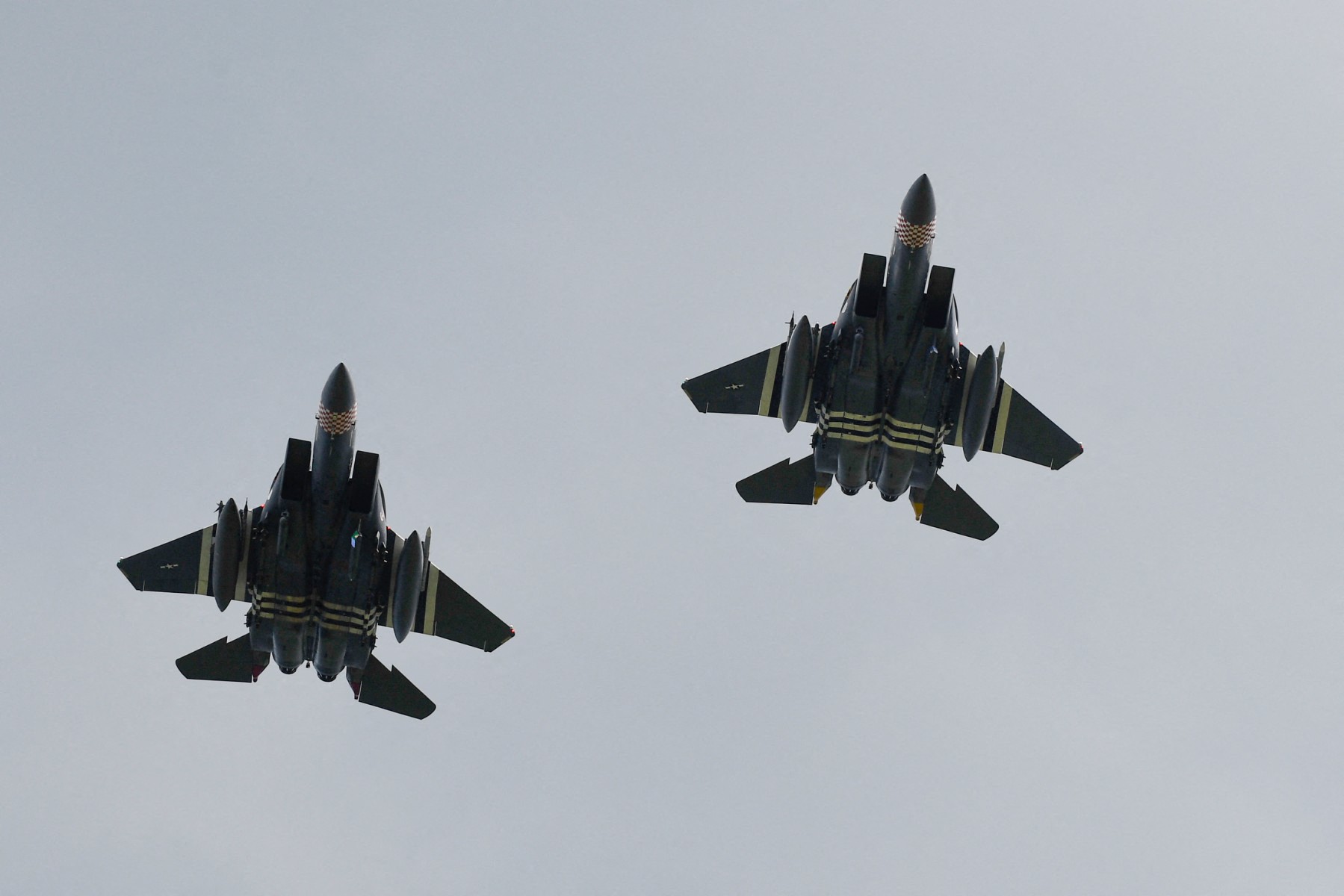
The USAF already operates a fleet of over 200 F-15 fighter jets, including some 40 F-15C/D variants and over 100 combat-coded F-15E variants.
As the USAF begins receiving deliveries of the latest F-15EX variants, the force will gradually retire the older F-15C/D and F-15E variants.
However, the US$131.23 billion contract ceiling will also include upgrade, maintenance, and support packages for older F-15 fighter variants.
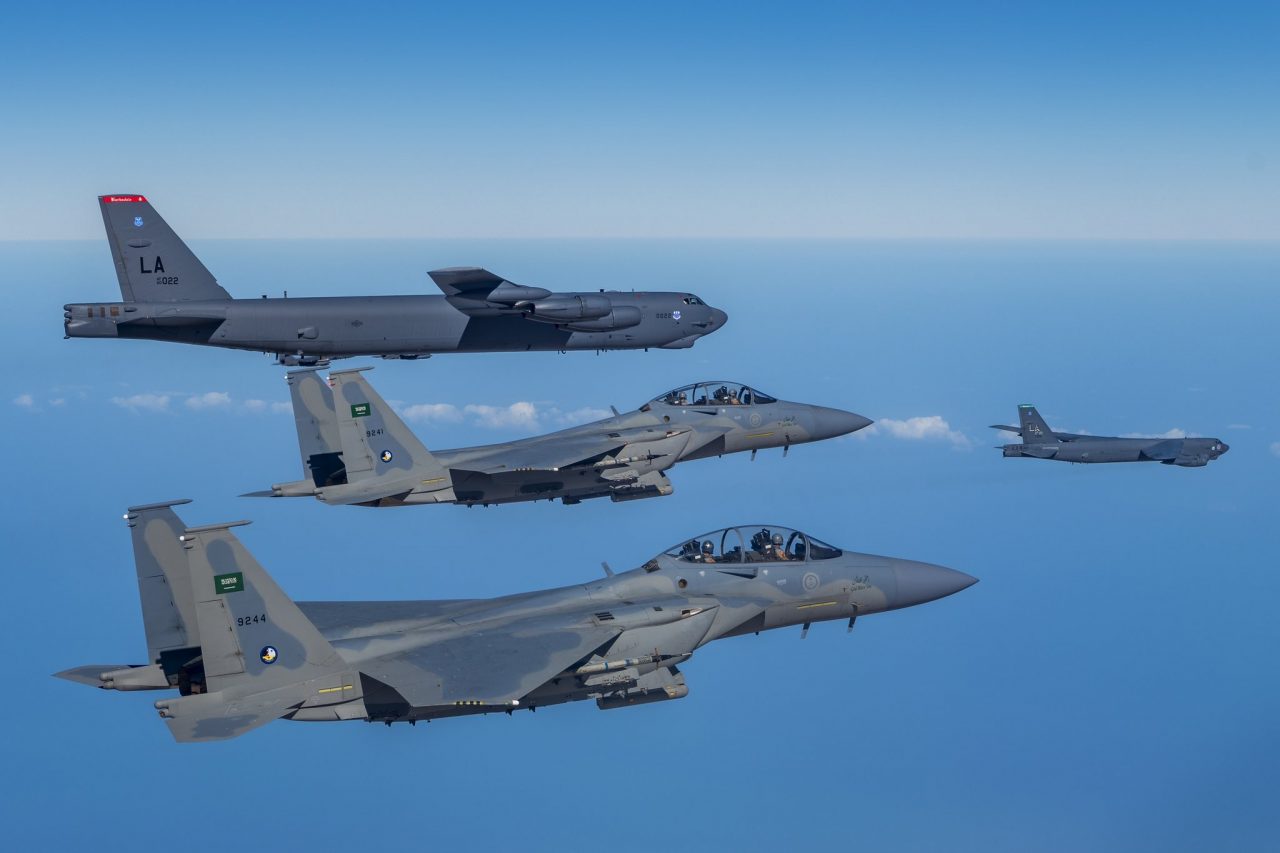
After the US, Saudi Arabia is the world’s second-largest operator of the F-15. Riyadh operates a fleet of nearly 230 F-15 fighter jets, closely followed by Japan, which has 199 F-15 jets in its air force.
The Israeli Air Force has over 75 F-15s. Jerusalem has often used these heavy fighter jets in its operations in Syria, Iran, and Gaza, flying often in close formation with F-35 jets.
Notably, in 2024, Israel ordered 25 new F-15IA aircraft, an advanced variant akin to the US Air Force’s F-15EX Eagle II, with an option to acquire an additional 25 units later. In addition to these new aircraft, Israel seeks to enhance its current F-15I fleet through a “mid-life update modification kit” program, known as F-15I+, which will upgrade the existing models.
The F-15s, including the F-15A/B/C/D Baz and F-15I Ra’am variants, remain integral to the IAF’s operational strategy. These aircraft serve multiple roles, including long-range strikes, air defense, and command-and-control functions.
South Korea has a fleet of 59 F-15s, and Singapore has 40 F-15s in its air force.
Notably, Qatar, another strategic US partner, operates a fleet of 48 F-15s, but its name was conspicuously absent from the list of potential foreign customers for the F-15 Crest program.
However, the list mentions two countries that have never ordered any F-15s – Poland and Indonesia.
Poland and Indonesia’s Role in the Eagle Crest Program
Notably, Indonesia was expected to be the first export customer of the F-15EX fighter jet.
In 2023, Indonesia inked a memorandum of understanding (MoU) with Boeing to acquire up to 24 F-15EX fighters during Indonesian President Prabowo Subianto’s visit to the US.
“We are pleased to announce our commitment to procure the critical F-15EX fighter capability for Indonesia,” Subianto said at the time. “This state-of-the-art fighter will protect and secure our nation with its advanced capabilities.”
However, since the MoU was non-binding, Jakarta did not pursue the contract.
To woo Indonesia, Boeing announced in 2025 that, if Jakarta signs the deal, it will deliver on its 85 percent local-content and offset commitments.
However, Jakarta also started exploring the possibility of buying China’s J-10C fighter jet.
Earlier this February, Boeing announced that it had officially ended its pursuit of selling the F-15EX to Indonesia.
“In terms of our (F-15) partnership with Indonesia, it is no longer an active campaign for us,” Bernd Peters, vice president of business development and strategy at Boeing Defense, told reporters at the Singapore Airshow in February.
However, including Indonesia among potential foreign customers of the F-15 Crest program underscores that the US remains hopeful about an F-15 deal with Jakarta.
Another surprise in the list was Poland.
Interestingly, Poland has never announced an intention to buy the F-15.
On August 25, the Polish Ministry of Defense once again announced, “the Polish Armed Forces do not plan to acquire F-15EX aircraft.”
However, despite these denials, Boeing and the US remain hopeful.
Polish officers have visited Boeing’s facility in St Louis, and in 2025 the then-Inspector of the Polish Air Force, General Ireneusz Nowak, flew the F-15EX himself at Boeing’s facilities.
In fact, the F-15EX could make perfect sense for Poland.
Ever since Russia invaded Ukraine in 2022, Poland has been rapidly modernizing its armed forces.
In the 32-member NATO bloc, after the three Baltic countries of Latvia, Estonia, and Lithuania, Poland spends the highest share of its budget on defense.
According to NATO’s July 2026 estimates, Poland will spend 4.8% of its GDP on defense in the current fiscal.
In recent years, Warsaw has ordered 48 FA-50 light combat aircraft, 180 K2 tanks, 364 K9 howitzers, 250 M1A2 SEPv3 Abrams, and 32 F-35As. The Polish Air Force also has 48 F-16s.
However, Poland lacks a heavy fourth-generation fighter that has a heavy payload and internal fuel capacity.
The F-15EX can engage multiple targets simultaneously and perform a variety of missions per sortie, including air superiority, interdiction, air-to-air and air-to-ground missions, and close air support, thanks to its expanded payload capacity of 23 total weapons stations.
In the Middle East wars, the US and Israel have shown the effectiveness of the F-15 fighter jets by flying them in close formation with stealth F-35 fighter jets.
The US and Boeing understand that, despite the FA-50s, F-16s, and F-35s, the Polish Air Force still needs a heavy, multi-role fourth-generation fighter jet, and the F-15EX fits in perfectly.
- Sumit Ahlawat has over a decade of experience in news media. He has worked with Press Trust of India, Times Now, Zee News, Economic Times, and Microsoft News. He holds a Master’s Degree in International Media and Modern History from the University of Sheffield, UK.
- He can be reached at ahlawat.sumit85 (at) gmail.com