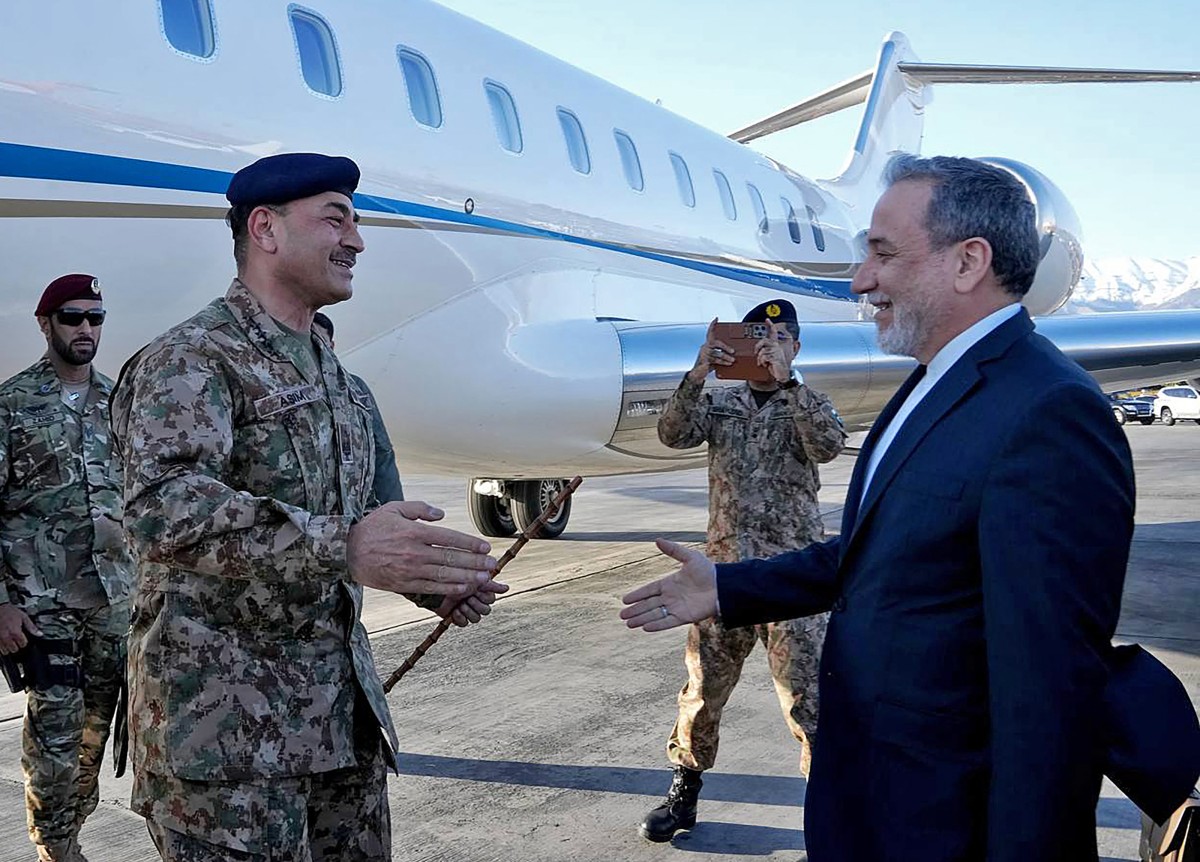
As Pakistan mediates between Iran and the US, the two military institutions that are playing a larger-than-life role in these talks from behind the scenes are Pakistan’s Army and Iran’s Islamic Revolutionary Guard Corps (IRGC).
While on the surface these institutions look diametrically different, in more than one way, they are mirror images of each other.
For instance, while the Pakistan Army is a professional military service focused on national defense and conventional warfare, the IRGC is variously described as a paramilitary group, an ideological praetorian guard, a parallel military force, or a hybrid military-security institution.
Further, while the Pakistan Army has been in service since the country’s founding in 1947, the IRGC was established only after the 1979 Islamic Revolution in Iran.
Similarly, while the Pakistan Army’s main objective is to safeguard the country from external aggression, the IRGC’s primary objective, as per its constitution, is to safeguard the Islamic Revolution, its ideology, and the gains of the revolution.
Of course, in case of any external aggression, the IRGC would aid Iran’s regular army, the Artesh, by fighting asymmetrical warfare, but its primary objective has always been to safeguard the Islamic Revolution.
However, beneath these superficial differences, the two military institutions, the IRGC and the Pakistan Army, are very similar in the scope of their activities and the role they play in the social, economic, cultural, and political spheres of their respective countries.
For instance, both the Pakistan Army and the IRGC act as the glue that holds the whole edifice together. They are the real force that guarantees the existence and continuation of their respective political-military system.
Furthermore, both the Pakistan Army and the IRGC are known as the king-makers in their countries. Both in Iran and in Pakistan, it is impossible to rule without the tacit support of the IRGC and the Pakistan Army, respectively, so much so that they have both been described as a ‘state within a state’.
And despite being military institutions, both the IRGC and the Pakistan Army act as the countries’ largest corporate entities, with commercial interests in everything from construction, oil and gas, mining, smuggling, banking, telecommunications, housing, real estate, and whatnot.
For instance, the Pakistan Army directly or indirectly controls 10 to 12 percent of Pakistan’s land area and a significant portion of its corporate economy.
In her book Military Inc., author and historian Ayesha Siddiqa estimates that the Pakistani military controls significant portions of heavy manufacturing and private assets.
The Pakistan army runs extensive commercial entities, primarily through welfare foundations such as the Fauji Foundation, Army Welfare Trust, Shaheen Foundation, and Bahria Foundation. These entities operate in various sectors, including banking (Askari Bank), cement, fertilizers (Fauji Fertilizer), food, oil & gas (Mari Petroleum), real estate, and security services.
However, while the Pakistan Army’s economic clout is widely known and discussed, the same cannot be said of the IRGC’s economic empire.
However, the IRGC’s economic empire is even bigger than the Pakistan Army’s.
In fact, according to various scholars, while the Pakistan Army has an economic footprint that controls nearly one-fifth of the country’s GDP, the IRGC controls nearly one-third to two-thirds of Iran’s GDP.
Not Just Soldiers – IRGC Controls Ideology, Economy, and War Machine
Formed in 1979 with the initial aim of safeguarding the Islamic Revolution, the IRGC directly answers to the Supreme Leader.
In the immediate aftermath of the Islamic Revolution, the new regime in Iran, led by Ayatollah Ruhollah Khomeini, was apprehensive that the Iranian Army, which had previously been loyal to the Persian King, could not be trusted.
It was feared that the Army would try to overthrow the new regime; thus, Ayatollah Khomeini created a new, parallel paramilitary group, the IRGC, loyal to him and reporting directly to him.
In The Revolutionary Guards in Iranian Politics: Elites and Shifting Relations (2015), author Bayram Sinkaya notes: “A faithful and credible armed force, which owed direct allegiance to Khomeini, the leader of the revolution, was deemed essential for the revolutionary leadership, both to safeguard the revolution and to enforce fundamental social and political changes.”
The creation of such a parallel military force after the revolution was not unique to Iran; the National Guard was established in France, and the Red Guard in Russia, following the revolutions.
The IRGC’s main objective was not to protect the borders, but to safeguard the gains of the Islamic Revolution.
Article 2 of its constitution explicitly states that the corps is tasked with combating “factors and trends that aim to sabotage and overthrow the Islamic Republic of Iran, or act against the Islamic Revolution.”
However, during the eight-year-long Iran-Iraq War (1980-1988), the IRGC fought alongside the Iranian Army, and in some cases, performed better than the professional army, thus gaining legitimacy in the eyes of the Iranian public.
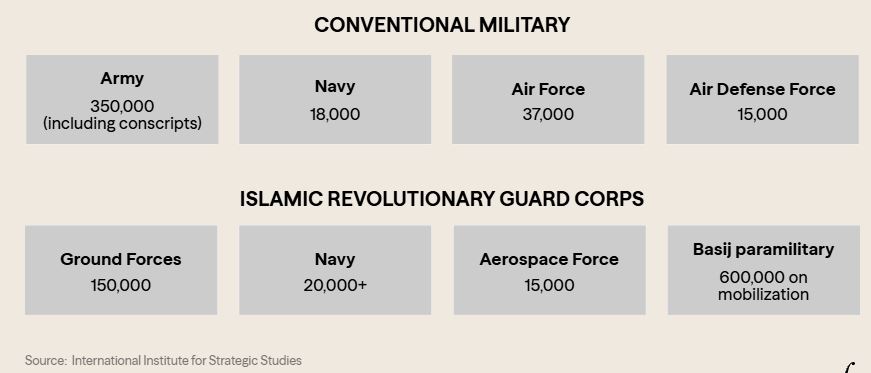
The Iran-Iraq War transformed the IRGC into a more conventional fighting force, with a command structure similar to that of Western militaries. Now highly institutionalized, it remains a force parallel to Iran’s regular armed forces, with upwards of 190,000 troops under its command, according to the International Institute for Strategic Studies (IISS).
Overall, IRGC consists of an estimated 125,000 members across its various divisions. The IRGC’s Aerospace Force, roughly 15,000 strong, commands Iran’s missile and drone capabilities. In the waters of the Persian Gulf and the Strait of Hormuz, the IRGC Navy fields about 20,000 personnel, specializing in strategic maritime operations.
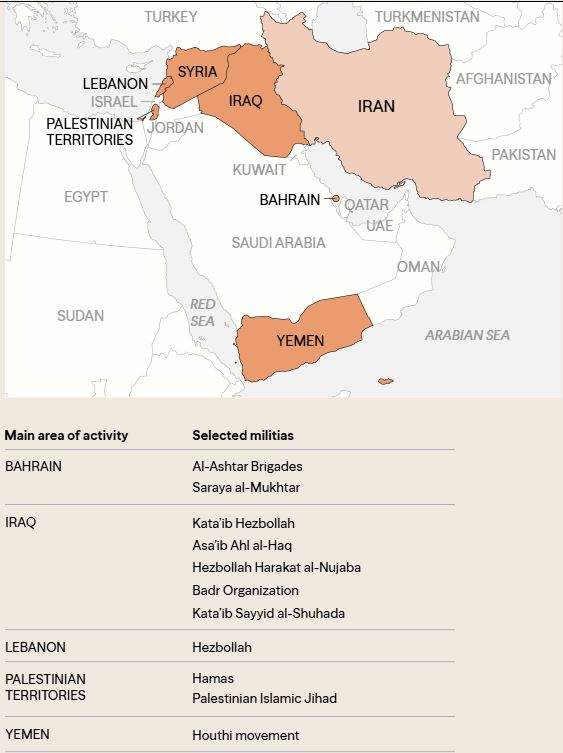
The IRGC also operates the Quds Force, which conducts military operations abroad, supporting Iran’s Axis of Resistance, from Syria to Lebanon, to Yemen in the South.
The Quds force organizes and supports various non-state actors, such as Hezbollah, Palestinian Islamic Jehad, Hamas, Houthis, and others, which provide Iran strategic depth and influence across the Middle Eastern countries.
The IRGC also operates the Basij, a vast paramilitary network of approximately 450,000, embedding its presence deep within society and reinforcing its grip on the state.
However, in addition to controlling these various paramilitary groups necessary to guard the Islamic Republic, the IRGC also operates as an economic entity, controlling the most lucrative sectors of the Iranian economy.
The IRGC: The Biggest Corporate Entity in Iran
According to a report by the Clingendael Institute, a Dutch think tank, the IRGC and its broader “military–bonyad complex” account for over 50% of Iran’s GDP.
The paper noted that by the mid-1980s, within a few years of the Islamic Revolution, “the Mostazafan Foundation, one of the Bonyads alone had assembled a vast empire: 203 mining and manufacturing enterprises, 472 commercial farms, 101 construction firms, 238 trading and service companies, and nearly 2,800 real estate holdings.”
Similarly, according to the Washington Institute for Near East Policy, the long-term value of just Khatam al Anbiya’s (KAA) contracts is about US$50 billion, roughly 14% of the country’s GDP.
The KAA was established in 1989 to drive post-war (Iran-Iraq) reconstruction. It has since evolved into a vast conglomerate handling infrastructure projects from railways and roads to housing and mining.
Notably, the KAA has also won contracts outside Iran, including in the Middle East, Europe, Africa, Russia, and the former Soviet republics.
Furthermore, an October 2014 note of the United Nations Security Council alleges that “KAA undertakes a significant amount of work on Passive Defense Organization projects. In particular, KAA subsidiaries were heavily involved in the construction of the uranium enrichment site at Qom/Fordow.”
The IRGC also operates multiple Iranian banks through charitable institutions, such as Bonyad e Taavon Sepah, also known as the IRGC Cooperative Foundation. It manages key institutions such as Ansar Bank and Mehr Bank, which provide financial services to IRGC personnel and the Basij.
After 2005, during the Ahmadinejad presidency, the IRGC’s economic role expanded further.
Through its financial arms, namely the Sepah Cooperative Foundation, the Armed Forces Social Welfare Organization, and the Ansar Financial and Credit Institution, the IRGC acquired major stakes in Iranian companies listed on the Tehran Stock Exchange.
The Sepah Cooperative Foundation controlled investment groups such as Tose’eh E’temād Mobin. The Armed Forces Social Welfare Organization, one of Iran’s largest, acquired numerous enterprises. And Ansar grew into a nationwide bank with over 600 branches and around six million customers.
Even the Basij, the IRGC’s paramilitary arm, has emerged as a major economic player through the Basij Cooperative Foundation. It has made extensive investments in the stock market, industry, services, oil, petrochemicals, and banking.
Khatam al-Anbiya (Ghorb), the engineering conglomerate of the IRGC, has completed more than 2,500 projects, ranging from dams, highways, and metro lines to hospitals and agricultural schemes.
Ghorb subsidiaries have won multiple contracts to develop phases of the South Pars gas field.
The true scope of Ghorb’s holdings remains opaque, though reports estimated that it controlled more than 800 registered companies as early as 2010.
The IRGC also controls nearly half of Iran’s oil exports and maintains a large shadow fleet to smuggle oil and to escape sanctions.
Political clout secures IRGC-affiliated companies’ no-bid contracts from the state to service the oil sector and develop infrastructure.
According to a recent Council on Foreign Relations (CFR) report, the IRGC also participates in massive black markets.
“Some analysts say that the spate of U.S. sanctions has benefited the IRGC at the expense of Iran’s public and broader economy; as Iranian businesses have been cut off from licit finance and trade, the IRGC has had greater black-market opportunities,” the CFR report said.
According to a 2020 report from the Center for Strategic and International Studies, “the IRGC has become the most powerful controller of all important economic sectors across Iran.”
The IRGC was established to guard the revolution; however, the IRGC has so deeply embedded itself into the Iranian economy that, apart from safeguarding the regime, it has its own vested interests in ensuring the survival of the current government.
- Sumit Ahlawat has over a decade of experience in news media. He has worked with Press Trust of India, Times Now, Zee News, Economic Times, and Microsoft News. He holds a Master’s Degree in International Media and Modern History from the University of Sheffield, UK.
- VIEWS PERSONAL OF THE AUTHOR.
- He can be reached at ahlawat.sumit85 (at) gmail.com