OPED By Imran Khurshid, PhD
Behind Beijing’s rhetoric of peaceful coexistence lies a hard strategic reality: China views India as a long-term rival and is willing to use every instrument — military, technological, informational, and geopolitical — to constrain India’s rise
China has officially admitted for the first time that it supported Pakistan during Operation Sindoor. India already knew this, but now China has fully and officially acknowledged it.
According to a South China Morning Post report, in an interview aired on Thursday by China’s state broadcaster China Central Television, engineers from the Aviation Industry Corporation of China (AVIC), particularly from the Chengdu Aircraft Design and Research Institute, described how they were directly involved in supporting Pakistan during last year’s May conflict with India.
As Zhang Heng, one of the AVIC aerospace engineers, was quoted as saying, “At the support base, we frequently heard the roar of fighter jets taking off and the constant wail of air-raid sirens. By late morning in May, the temperature was already approaching 50 degrees Celsius [122 degrees Fahrenheit]. It was a real ordeal for us, both mentally and physically.”
Another employee from the same institute, Xu Da, compared the fighter jet to a “child.” “We nurtured it, cared for it, and finally handed it over to the user. And now, it was facing a major test. As for the outstanding results the J-10CE achieved, we weren’t very surprised, and it didn’t feel sudden at all,” Xu Da was quoted as saying by the SCMP.
“In fact, it felt inevitable. The aircraft just needed the right opportunity. And when that moment came, it delivered exactly as we knew it would,” underscoring how China was instrumental in providing direct operational and technical support to Pakistan against India during the conflict.
China’s Operational, Intelligence & Military Backing to Pakistan
Earlier, India’s Deputy Chief of the Army Staff, Lt. Gen. Rahul R. Singh, had said that during Operation Sindoor, Chinese forces were providing Pakistan with live intelligence inputs and satellite data on Indian operational vectors, sharing real-time coordinates and intelligence on Indian targets and deployments.
As he stated, “When DGMO-level talks were going on, Pakistan was actually mentioning that we know your important vector is primed, and it is ready for action. I would request you to pull it back. So, they were getting live inputs from China,” underscoring how China provided direct operational and technical support to Pakistan against India during the conflict.
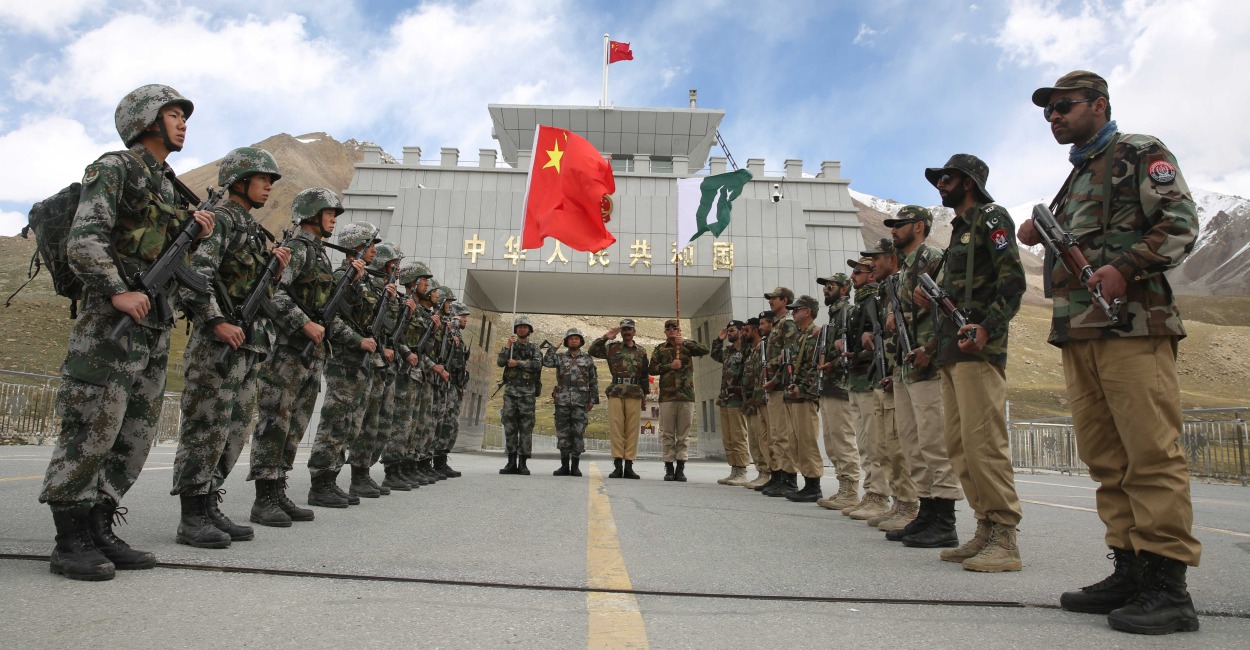
Actually, the Pakistan Army today has become an extension of the Chinese PLA. It is fully integrated with Chinese systems through PLA interoperability, greater coordination, intelligence sharing, and strategic integration.
Pakistan today imports more than 81 percent of its defense equipment from China, showing how deeply integrated it has become. This has been reinforced by the recent SIPRI data, which states that China supplied nearly 81 percent of Pakistan’s arms imports during the last five years, including fighter aircraft, submarines, frigates, missile systems, drones, tanks, and air defense systems.
In fact, reflecting the extent of this deep integration, Pakistan is increasingly viewed as a “live lab” for Chinese military technologies, where China not only supplies platforms but also tests, refines, and showcases its systems under real-world conflict conditions.
China also sees Pakistan as a route and a medium through which it can expand sales of its military equipment in the changing West Asian region. Pakistan has already signed a mutual defense pact with Saudi Arabia and may deepen similar strategic engagements with other regional countries.
China, therefore, sees Pakistan as a strategic channel through which it can market, promote, and potentially sell its military platforms to these countries by using Pakistan as an intermediary and gateway.
Recently, there has also been growing news that Pakistan will soon receive the export version of China’s fifth-generation stealth fighter jet, the J-35AE, and Pakistan is expected to become the first foreign country to acquire it. Reports also suggest that Pakistani pilots are already undergoing training in China for the platform.
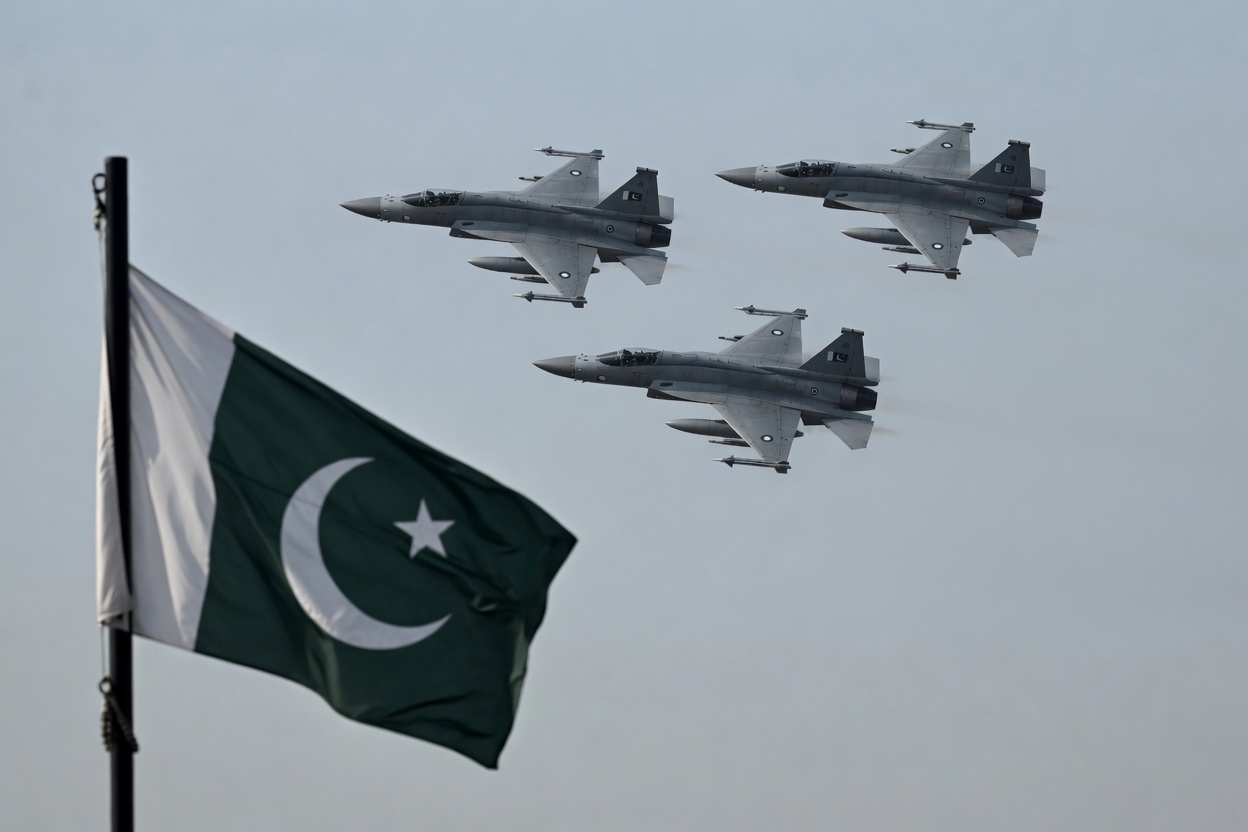
Besides this, both countries are already co-producing and co-developing several military platforms together, most notably the JF-17 fighter aircraft program, which has become a major symbol of deep China-Pakistan defense cooperation. China has also recently supplied advanced Hangor-class submarines to Pakistan under a technology transfer arrangement, with some of the submarines built in Pakistan itself. In addition, both countries are operating across multiple military domains with increasing coordination, interoperability, technology transfer, joint production, and strategic integration, reflecting how deeply embedded the China-Pakistan military partnership has become.
During Operation Sindoor, China also amplified and supported Pakistan’s propaganda and information warfare against India through its state-controlled media, experts, and news outlets around the world, funded by it. It used this propaganda to damage India’s capabilities and promote its own weapon platforms. At that time, many newspaper articles, commentaries, and narratives emerged portraying Chinese-origin systems such as the J-10C, PL-15 missiles, and other platforms as having performed better against India, while simultaneously questioning the effectiveness of India’s weapon platforms.
Why China Continues to Back Pakistan Against India?
Now the question is: why does China always support Pakistan, given that they have so many differences? Right now, they have several divergences. For example, China is unhappy with Pakistan regarding the progress of CPEC and the corruption associated with it. It has, in fact, slowed or halted major funding for some CPEC projects.
Similarly, it is dissatisfied with the security situation in Pakistan, especially with Chinese workers being killed there and Pakistani forces failing to ensure the security of Chinese personnel and investments. China is also unhappy with the way Pakistan has dealt with Afghanistan, which has contributed to instability in the region.
This instability is not in China’s interests, given how much it has invested there and how it sees instability as a threat that could spill over into its Xinjiang territory. Recently, China had also initiated talks between Pakistan and Afghanistan at Urumqi, but Pakistan did not fully follow that, and recently again escalated tensions by carrying out attacks in eastern Afghanistan’s Kunar province, including targeting the Sayed Jamaluddin Afghani University.
Importantly, China is also uneasy about Field Marshal Asim Munir’s growing personal bonhomie with Trump, as he is increasingly pursuing American interests in the region and undermining CPEC and other Chinese interests.
Now, given these divergences, why then has China been so generous toward Pakistan by providing all these military platforms and boosting its capabilities?
The answer is India. China sees India as a potential rival and a rising geopolitical threat. In fact, it sees boosting Pakistan’s capabilities as indirectly strengthening its own strategic position vis-à-vis India. China’s defense budget is roughly four times India’s, yet it still views India as a long-term challenger within its sphere of influence.
It is not only Pakistan that China supports; it will support any country, whether Pakistan, Turkey, or another neighboring state, if doing so helps constrain, destabilize, or degrade India’s capabilities. China sees India as the only, in fact, the only civilizational power in the region that could ultimately challenge its dominance.
This perception is further shaped by China’s enduring “Middle Kingdom syndrome,” which reinforces a hierarchical worldview in which China sees itself as the natural center of order in Asia. As the Chinese saying goes, “Two tigers cannot live on one mountain.” It believes in spheres of influence and thinks that two countries cannot rise in the same geographic area where their territories overlap.
This is the primary reason, and China is willing to use different instruments, both conventional and non-conventional, to counter India. This can include support to non-state actors, destabilizing India’s Northeast, claiming India’s territory, creating problems for India in the Indian Ocean, and using other strategic tools. China will also do everything possible to restrict India’s global rise and damage its international image, as was also seen during the G20 Summit and the COVID-19 pandemic.
Sun Tzu, Strategic Deception, and China’s Long Game
But there is one more thing that often deceives countries: China’s diplomatic massaging. China often uses soft language and rhetoric at the international level about global cooperation, peaceful coexistence among countries, the Asian century in this region, and living together harmoniously with its neighbors.
China repeatedly uses such rhetoric; for example, before attacking India in 1962, it signed the Panchsheel Agreement (Five Principles of Peaceful Coexistence), which emphasized cooperation and harmony. Similarly, Chinese diplomats appear soft-spoken and friendly, but behind the scenes, they play strategic chess.
On one side, they tell India that both countries should prosper together and that this is the Asian century, while on the other side, they support Pakistan and other rivals of India to undermine it. This is part of China’s strategic playbook, and it has to be understood carefully. If one relies solely on the language one speaks, one risks being misled.
China has deeply incorporated strategic deception into its thinking, influenced by the great strategist Sun Tzu and his work The Art of War, which emphasizes deception in warfare. As Sun Tzu states, “All warfare is based on deception.
Hence, when we are able to attack, we must seem unable; when using our forces, we must appear inactive; when we are near, we must make the enemy believe we are far away.” Deception is therefore embedded in its strategic tactics. China thinks long-term, and its strategic culture encourages long-term planning.
Many countries misunderstand China because of its outwardly polite behavior and rhetoric. On the surface, it may appear cooperative and peaceful, but behind that image, it pursues tricky games and hard strategic objectives.
One can easily be distracted by its language and diplomatic style, but ultimately, its actions speak louder than its words. Therefore, any serious assessment of China’s behavior must account for both its diplomatic messaging and its underlying strategic logic.
- THIS IS AN OPINION ARTICLE. VIEWS PERSONAL OF THE AUTHOR
- Dr. Imran Khurshid is an Associate Research Fellow at the International Center for Peace Studies (ICPS), New Delhi. He specializes in India-US relations, Indo-Pacific studies, and South Asian security issues.