Outgoing Director of National Intelligence (DNI) Tulsi Gabbard has released declassified documents showing evidence of US funding for more than 120 biolabs in over 30 countries, including Ukraine, where research on biological pathogens, some of which are dangerous, is conducted.
Further, the documents reveal that these biolabs also engaged in ‘highly controversial’ and risky ‘Gain-of-Function’ research.
“These biolabs include labs in Ukraine, which may be at risk of compromise due to the ongoing Russia-Ukraine war,” the DNI’s office said in a statement on June 12.
“For example, the Intelligence Community previously warned that a US-funded biolab in Ukraine likely housed dangerous pathogens and remained vulnerable to longstanding threats of Russian attack, seizure, or damage,” it added.
The declassified documents confirm long-standing accusations by many, including by Gabbard herself, that the US has been funding such secret biolabs around the world.
“Until now, evidence regarding the full existence and funding of these laboratories had been knowingly withheld from the American people,” it said.
Further, the statement accused “powerful people,” likely a reference to the previous Biden administration, of deliberately misleading the US citizens on the existence of such biolabs.
“The information surrounding the existence, history, locations, and funding of these US-funded biolabs has been intentionally covered up by powerful people falsely, claiming that they do not exist and accusing anyone who says otherwise to be foreign assets and traitors to America.”
“Despite the obvious potential for catastrophic global impact research on dangerous pathogens in biolabs can have, politicians, so-called health professionals like Dr. Fauci, and entities within the Biden administration’s national security team lied to the American people about the existence of U.S.-funded and supported biolabs, and threatened those who attempted to expose the truth,” Gabbard said in a press release.
Today, I’m releasing never before seen intelligence revealing new evidence of past US government funding for more than 120 biolabs in over 30 countries, including Ukraine.
In support of President Trump‘s Executive Order to end federal funding of dangerous gain of function… pic.twitter.com/RkPHnAbka9
— DNI Tulsi Gabbard (@DNIGabbard) June 12, 2026
Further, it said that some of the labs were vulnerable because of the ongoing Russia-Ukraine war, but had been intentionally covered up by previous administrations.
Notably, the topic gained traction during the 2022 Russian invasion of Ukraine as Moscow repeatedly accused the US government of running biolabs in Ukraine, handling dangerous pathogens, and even developing offensive biological weapons.
The report highlights how the existence of such biolabs in Ukraine could also be used for information warfare by Russia.
What the Declassified Documents Tell Us?
The documents reveal that nearly 40 such biolabs exist in Ukraine and are at least in part supported by the US government.
In particular, the report mentions the Institute of Experimental and Clinical Veterinary Medicine (IECVM) in Kharkiv.
It “probably houses at least some dangerous pathogens and almost certainly remains vulnerable to long-standing Russian information operations, seizure, or damage.
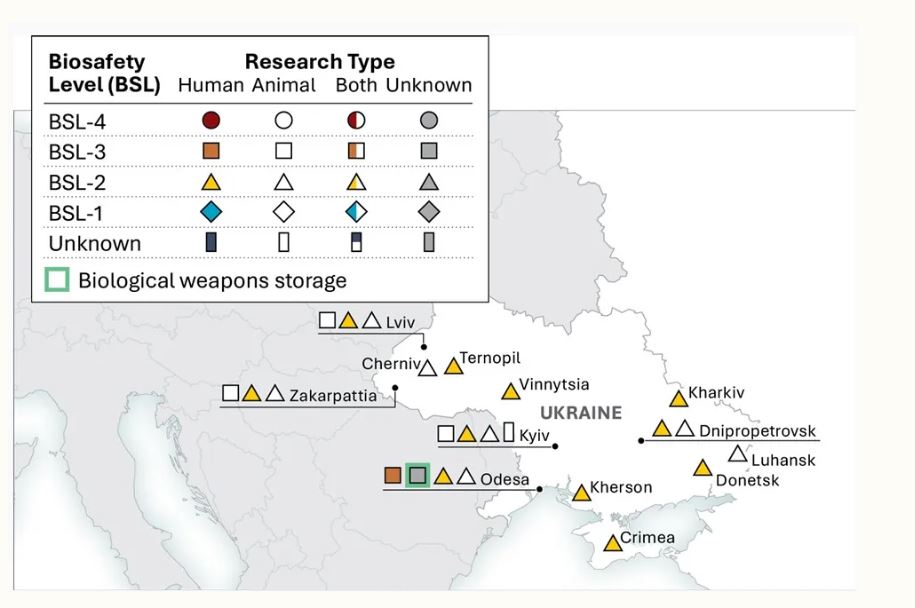
There are also concerns that the facility had biosafety deficiencies, especially in areas handling Brucella bacteria, and that a virology building basement exists.
Some of the pathogens handled or stored at the labs included anthrax, Ebola, and swine fever.
The fact that the facility lies in a war zone adds additional risks, as it could lead to the accidental release of dangerous pathogens into the atmosphere.
While the documents reveal US-funding of such biolabs handling dangerous pathogens all around the world, they did not show any evidence of these labs working on any offensive biological weapons.
However, it must be noted that the released documents are heavily retracted.
The documents further confirm that these biolabs also engaged in highly controversial Gain-of-Function research.
“Many of these U.S. government-funded biolabs are currently or have previously engaged in research using hazardous and highly contagious pathogens, in some cases to include dangerous Gain-of-Function research, with very little visibility or oversight,” the DNI press release said.
“President Trump understands the serious threat dangerous Gain-of-Function research poses to the American people, which is why he took decisive action on May 25, 2025, signing EO 14292 to end federal funding of Gain-of-Function research around the world,” it added.
What is Gain-of-Function Research & Why Is It So Dangerous?
According to the US Congress, Gain-of-function (GOF) research is a broad area of scientific inquiry that examines how and why an organism gains a new property or an existing property is altered. The terms gain of function and loss of function refer to any genetic mutation in an organism that, respectively, confers a new or enhanced ability or causes the loss of an ability.
Such changes often occur naturally. Additionally, scientists can induce some changes to organisms through experimentation.
So, in simple words, the Gain-of-Function (GoF) research involves genetically altering an organism, typically a virus, bacterium, or other pathogen, to enhance or add new biological functions, such as increased transmissibility, virulence (ability to cause disease), host range (types of organisms it can infect), or replication efficiency.
The goal is usually to understand how pathogens evolve, predict emerging threats, develop vaccines or treatments, or study virus-host interactions.
For instance, making a bird flu virus transmissible in ferrets (a mammal model) can reveal genetic changes that might allow it to jump to humans.
Some argue that GOF research may improve understanding of human-pathogen interactions, aid in assessments of potential pandemic pathogens, and further public health preparedness. Others have raised concerns that studies aimed at understanding how viruses might evolve may generate pathogens that affect humans and could cause a pandemic.
However, not all Gain-of-Function (GoF) research is controversial. Much of it is routine, such as developing vaccines for new strains.
To distinguish it from the more controversial or risky research, that subset of studies is called GOF research of concern (GOFROC); enhanced potential pandemic pathogens; and, most recently, pathogens with enhanced pandemic potential (PEPPs), including influenza, SARS, and MERS viruses.
There are many risks involved with such research. Topmost among them is biosafety, as these dangerous and highly contagious viruses, pathogens, and bacteria can leak from labs, either accidentally or due to neglect of safety protocols, which could lead to disease or even epidemics for which the world is unprepared.
Enhanced pathogens could escape containment and spark outbreaks or pandemics.
Labs handling them operate under high biosafety levels (BSL-3 or BSL-4), but human error, equipment failure, or inadequate protocols could still lead to accidental leaks.

Two teams, led by Ron Fouchier in the Netherlands and Yoshihiro Kawaoka in the US, engineered highly pathogenic avian influenza (H5N1, “bird flu”) to become airborne-transmissible in ferrets.
This highlighted pandemic risks. Their publication was temporarily halted by the US National Science Advisory Board for Biosecurity due to biosecurity concerns.
Again, there is an incident from 2015, when the US Army’s Dugway Proving Ground lab in Utah was supposed to ship inactivated (dead) anthrax samples for research and training on detection methods. Instead, due to a failure in the irradiation (radiation-killing) process, live anthrax spores were sent out.
Later investigation by the Pentagon highlighted flaws in inactivation procedures and lab safety protocols.
Similarly, in 1979, the Sverdlovsk anthrax outbreak in the USSR killed over 60 people after an accidental aerosol release from a military bioweapons facility.
Such incidents underscore the inherent risks of this research.
Another concern is biosecurity, that is, the intentional use/misuse of these pathogens for making offensive biological weapons, or for bioterrorism.
Such incidents of bio-terrorism are not unheard of. For instance, in 2001, Anthrax-laced letters were deliberately mailed to media outlets and senators, killing 5 people and sickening 17.
Due to these incidents and rising public criticism, the Obama administration paused federal funding for certain GoF on influenza, SARS, and MERS. However, it was lifted in 2017 with new oversight frameworks.
During the COVID-19 pandemic, these debates on G-o-F research were reignited as many people linked the coronavirus to research at the Wuhan Institute of Virology, suggesting that the virus leaked from the lab accidentally and caused a global pandemic.
China has rejected these claims.
While there are many advantages to GoF research, there are valid concerns regarding biosafety and biosecurity.
Therefore, governments must not only establish strict oversight and safety protocols but also ensure full transparency regarding such research.
When governments do such work in secret and hide information from the public, it fuels paranoia and disinformation campaigns from vested interests.
For instance, Russia has often accused the US of secretly working on offensive biological weapons in the Ukraine biolabs.
The fact that the US was indeed financing work in nearly 40 such biolabs all across Ukraine will add credibility to Russian disinformation campaigns.
The Director of National Intelligence’s release of declassified documents on US-supported biolabs is a welcome step toward greater transparency. While critics will justifiably note that the files are heavily redacted and appear to conceal more than they reveal, this disclosure still represents meaningful progress in the right direction.
- Sumit Ahlawat has over a decade of experience in news media. He has worked with Press Trust of India, Times Now, Zee News, Economic Times, and Microsoft News. He holds a Master’s Degree in International Media and Modern History from the University of Sheffield, UK.
- This is an Opinion Article. Views Personal of the Author
- He can be reached at ahlawat.sumit85 (at) gmail.com