Two Russian-designed military aircraft crashed on consecutive days in Pakistan and India this week, killing at least 27 personnel and highlighting the challenges of operating aging Soviet-era fleets.
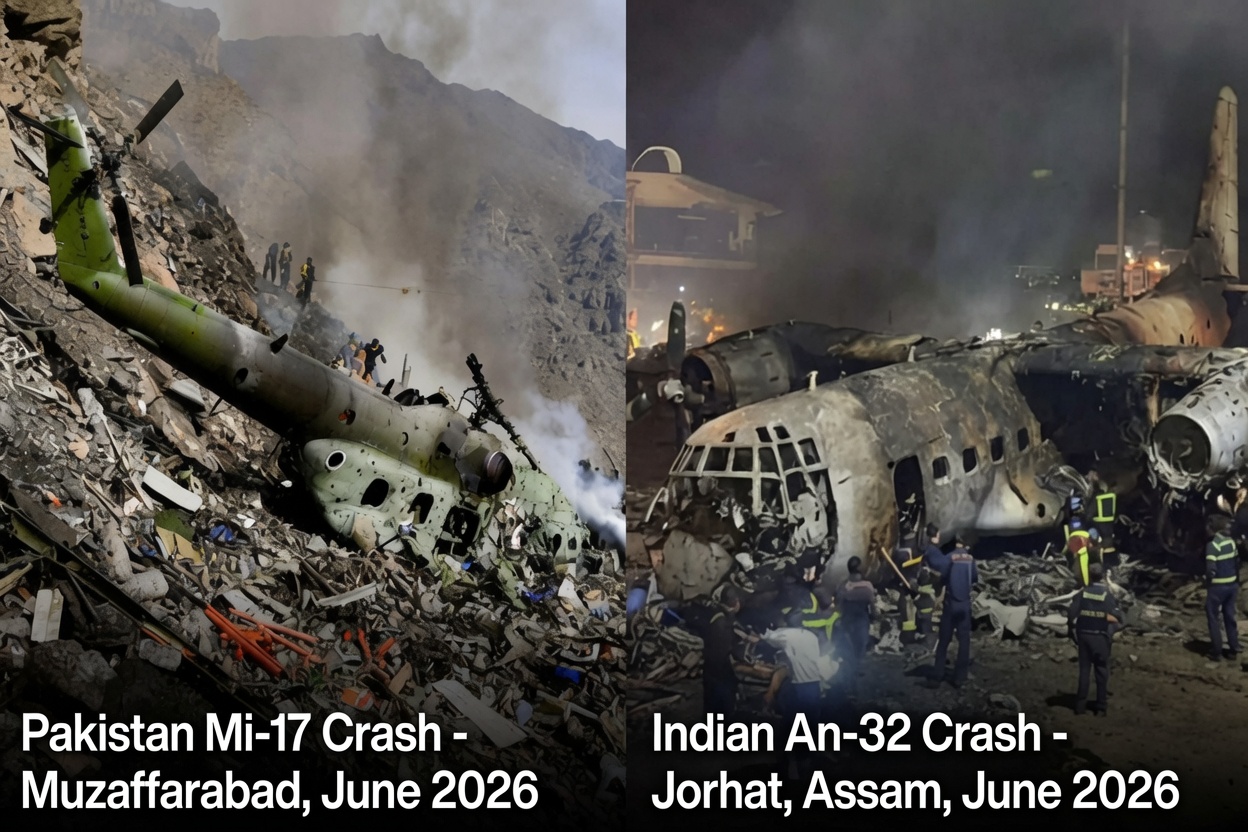
A Pakistan Army Mi-17 helicopter crashed shortly after takeoff near Muzaffarabad in Pakistan-controlled Kashmir on Wednesday due to a technical fault, the military’s Inter-Services Public Relations (ISPR) said.
According to reports, at least 22 soldiers, including senior officials, died in the incident.
The Russian-built Mi-17 transport helicopter went down in a mountainous area amid heightened tensions in the region, where raging protests had been ongoing. Islamabad confirmed there was no link to the crash with the violent agitations that have reportedly killed 40 protestors while injuring 220+.
Pakistan’s military expressed condolences to the families and said a board of inquiry had been ordered to determine the exact cause. “A board of inquiry has been ordered to ascertain the exact technical cause of the accident,” the ISPR added, noting that Chief of the Army Staff, Field Marshal Asim Munir, and all ranks “express deep grief over the tragic loss of precious lives.”
The following day, an Indian Air Force Antonov An-32 transport aircraft crashed while attempting to land at the Jorhat airbase in Assam, eastern India. Five IAF personnel were killed, the IAF confirmed.
The aircraft, from the 43 Squadron and carrying cargo during a routine sortie, caught fire after the crash within the station premises around 1000 local time. The co-pilot miraculously survived and is undergoing treatment.
The Indian Air Force confirmed the loss of five personnel, including two Agniveervayu recruits, and ordered a court of inquiry.
“The Indian Air Force deeply regrets the loss of five personnel in the An-32 accident at Jorhat, Assam. Sqn Ldr Prashant Singh, Flt Lt Shubham Kumar, Sgt Jitendra Sharma, Agniveervayu Khemaram Kumawat, and Agniveervayu Danish Alam made the supreme sacrifice in the line of duty,” the IAF said in a post on X.
The Air Force also extended its condolences to the families of the deceased and said it stands firmly with them in this time of grief. “IAF deeply regrets the loss of lives and stands firmly with the bereaved families in this time of grief,” IAF wrote.
Incidentally, the accident happened nearly three months after another major IAF crash in Assam with a Russian-origin aircraft. On March 6, a Sukhoi-30MKI fighter jet, the backbone of the Indian Air Force, crashed during a training mission in the hills of Karbi Anglong district after losing radar contact shortly after taking off from Jorhat. Both pilots were killed in the crash.
Both the Mi-17 helicopter and the An-32 transport plane are Soviet-era designs that are still widely used by militaries in South Asia. India has been phasing out its Mi-17 fleet in favor of newer platforms, while Pakistan continues to rely on these helos.
Earlier this year, a Russian An-26 aircraft crashed in Crimea, killing 29 people on board. Authorities blamed a “technical failure” for the incident and reported no external damage to the aircraft, suggesting that missiles, drones, or birds were not responsible.
The An-26 is a Soviet-era aircraft mainly used in a military capacity to transport heavy cargo and small numbers of passengers over short- to medium-distance routes. It is manufactured by the Ukrainian aerospace company Antonov.
A spate of crashes involving Soviet-era aircraft in Russia, India, and Pakistan has re-ignited concerns over aging Cold War-era military platforms, with experts pointing to structural fatigue, maintenance challenges, and sanctions behind repeated accidents.
Soviet-era aircraft such as the An-32, An-26, An-22, and Mil Mi-17 form the backbone of several air forces but were largely designed and built in the 1960s-1980s. Many airframes have exceeded 40-50 years of service.
Western sanctions imposed since 2022 have severely restricted access to critical spares, avionics, and engines, particularly for Ukrainian-designed Antonov aircraft. Russia has lost direct supply chains from Ukraine since 2014 and is now believed to be relying on cannibalization, reverse-engineering, and even smuggling to keep the aircraft in flying condition.
Maintenance depots report delays and quality issues, contributing to technical failures cited in multiple incidents. High operational demands aggravate the problem.
Russia’s war in Ukraine has pushed aircraft to their limits with increased sortie rates, while operators like India and Pakistan fly them intensively in demanding high-altitude terrains.
Officials attribute crashes to “technical malfunctions” following inquiries, but repeated incidents highlight immense pressure on aging fleets. Without rapid modernization, such incidents are likely to persist.
Mail us at editor (at) eurasiantimes.com