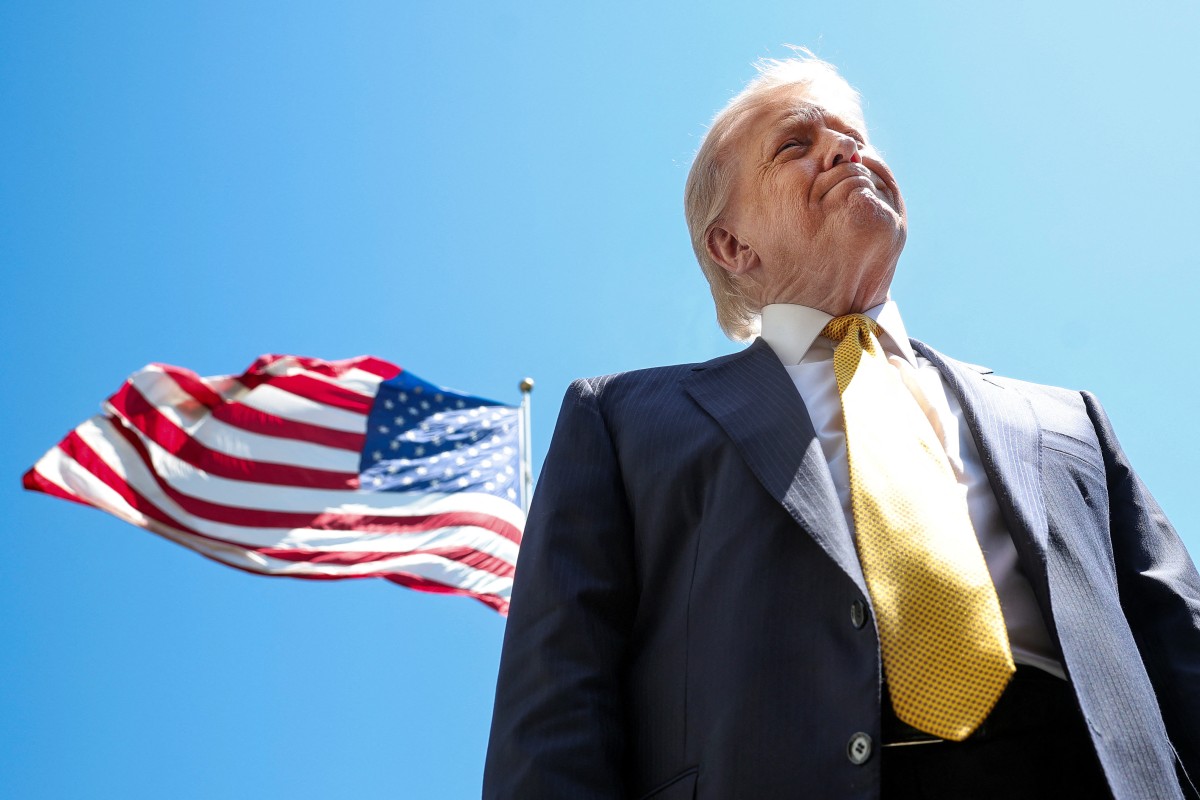
Tomorrow (April 27), King Charles of the United Kingdom will commence his four-day visit to the United States of America to mark the 250th anniversary of American independence.
It may sound ironic, given the fact that the US gained independence from none other than the UK. But then, that is history. In the last 200 years, the US must not have been as close with any other country as it has been with the UK, given their shared language, legal systems, and political traditions.
The two have always had what is called “Special Relationship” that included exceptionally close military cooperation, intelligence sharing (Five Eyes), and trade ties.
However, a leaked email on Friday (April 24) reported by Reuters seems to have clouded the US-UK affair even as King Charles and Queen Camilla are all set to land in Washington.
Apparently, the email, which has sparked intense debate in the British media over the last two days, originated at the Pentagon. It is said to have outlined options for the US to punish NATO allies such as Spain and the UK that it believes have inadequately supported American military operations in Iran.
According to the email, the Department of War (Pentagon) has suggested that the US reassess its support for European “imperial possessions,” including the Falkland Islands, and consider suspending Spain’s NATO membership.
It may be noted that the Falkland Islands became a permanent British territory in 1833, when British forces returned and reasserted control, expelling Argentine officials. Although Britain first claimed the islands in 1765 and briefly settled in 1766, it withdrew in 1774. But in 1841, it returned to officially establish the colony and maintain continuous and unbroken administration since 1833.
Argentina has never reconciled itself to the islands remaining under UK control. It, in fact, fought a war with the UK in 1982, during which the US tried to broker peace between the two countries while initially remaining neutral. But later it came out in support of Britain, offering the use of military bases and intelligence to forces attempting to retake the island from the Argentines.
The UK eventually won the war, in which some 649 Argentinian soldiers and 255 British troops died, and several ships sank with crew on board. Following a three-week ground campaign, British forces recaptured the islands’ capital, Port Stanley, on June 14, forcing the surrender of all Argentine troops.
The US has not challenged the British possession of the Falklands since then, even though Argentina has come much closer to Washington in the meantime.
It is against this background that the British government and media are aghast at the Pentagon’s reported suggestion that the US is reviewing its longstanding recognition of UK control of the islands and is considering actively supporting Argentina’s claim.
If the British media is to be believed, officials in London are trying to ascertain from their American counterparts whether Washington is really considering re-examination of its position. They believe that the Pentagon’s reported suggestions are not yet Washington’s official position.
Some reports also suggest a difference in stance between the US State Department and the Pentagon on the issue. State Department officials have reportedly told British diplomats that they were unaware of any plans by the administration to withdraw support for the UK.
However, the suspense still prevails, thanks to the remarks on Friday by the Pentagon press secretary Kingsley Wilson. When asked by the press, she, apparently, did not deny the email’s authenticity and said: “As President Trump has said, despite everything that the United States has done for our NATO allies, they were not there for us. The War Department will ensure that the President has credible options to ensure that our allies are no longer a paper tiger and instead do their part. We have no further comment on any internal deliberations to that effect.”
Expectedly, a spokesperson for UK Prime Minister Keir Starmer has expressed anguish that the US is questioning British sovereignty over the Falklands, whose people, in a 2013 referendum, had overwhelmingly voted (99.8 percent) to remain British citizens. He said that he could “not be clearer” that the islands were a sovereign British Overseas Territory and that their right to self-determination was paramount.
“Sovereignty rests with the UK, and the islands’ right to self-determination is paramount.”
Incidentally, the British position has been vindicated by a statement of the Falkland Islands government that 99.8 percent of voters on the island had cast their ballot in favor of remaining a British Overseas Territory, and that “The Falkland Islands has complete confidence in the commitment made by the UK Government to uphold and defend our right of self-determination.”
Whether all this will settle the confusion arising from the leaked Pentagon email is uncertain, given President Donald Trump’s increasing antipathy towards NATO in general and Spain and the UK in particular.
After all, Trump has been unhappy with the NATO partners due to many developments over the last one and a half years, which included differences over Ukraine, Denmark (Greenland), Israel, and Iran; alleged curtailment of free speech in Europe; and defense expenditure of the Europeans in NATO, and NATo budget.
Trump’s grudge against Spain began originally when the latter refused to meet a 5% of GDP defense spending target. This made Trump call Spain a “laggard”. He suggested expelling Spain from NATO because it was the only NATO country not to agree to this high target, despite having the capacity to do so.
Besides, Madrid has been Europe’s most vocal opponent to Trump’s war in Iran, and has repeatedly denied American forces the use of its bases or overflight rights – known as ABO ( Access, Basing, and Overflight).
The Pentagon email has, apparently, said that ABO is “just the absolute baseline for NATO ” support for Washington.
As regards the UK, President Trump and Prime Minister Starmer have had differences over many global issues, the latest being on the war in Iran. Starmer has been very clear that Britain will not be drawn into a wider war with Iran and that he wanted to see the Middle East conflict brought to an end “as quickly as possible”. He refused to accede to Trump’s demands that London send warships to reopen the Strait of Hormuz, a crucial shipping lane which Iran has effectively blockaded.
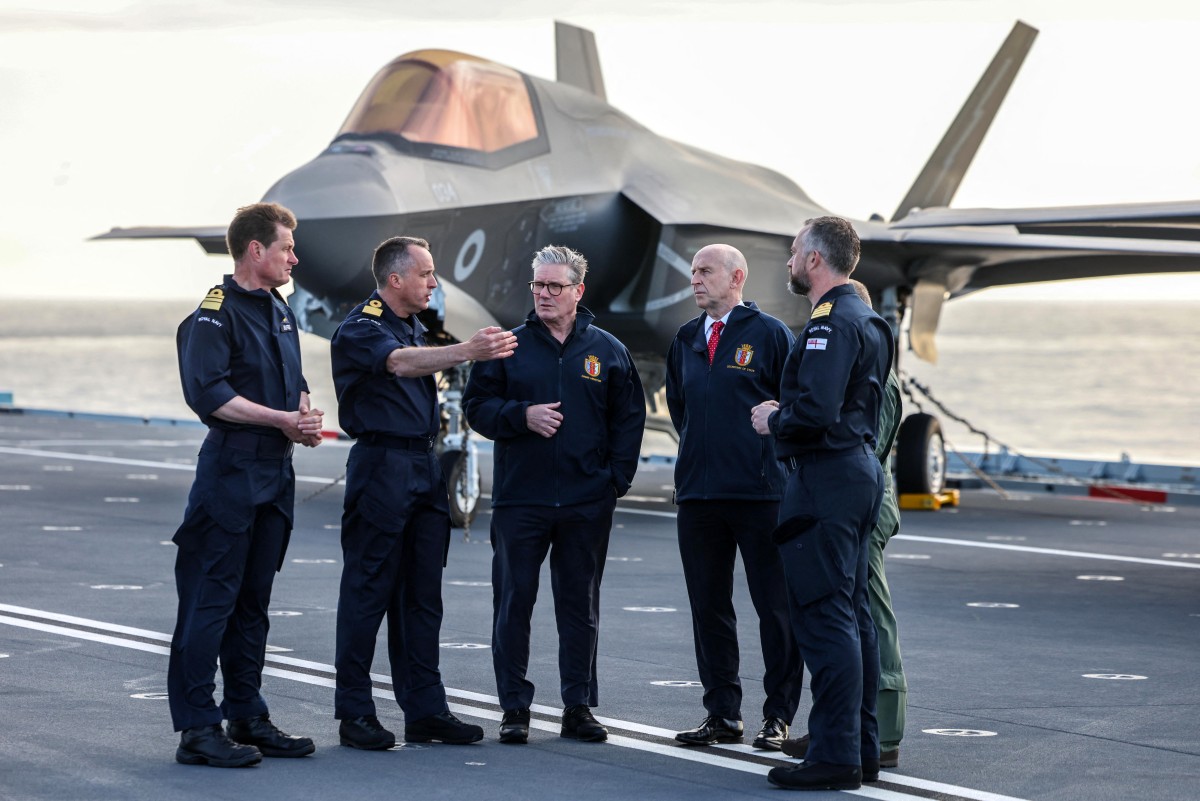
The EurAsian Times had explained earlier how Trump had not appreciated Starmer’s hesitation in allowing the US forces to use Diego Garcia in the war against Iran. Since Diego Garcia is a UK territory as of today, the US needs London’s permission to use the military base in Diego Garcia against Iran, even though, and that is an irony, it is essentially manned and controlled by Washington.
In fact, Trump has been strongly critical of Starmer’s decision to transfer sovereignty of the Chagos Islands, which include Diego Garcia, to Mauritius, while securing the continued operation of the military base there. “Shockingly, our ‘brilliant’ NATO Ally, the United Kingdom, is currently planning to give away the Island of Diego Garcia, the site of a vital U.S. Military Base, to Mauritius, and to do so FOR NO REASON WHATSOEVER,” Trump had said in January.
Incidentally, Starmer’s decision on Diego Garcia has not gone well with the British Opposition parties. In fact, Sir Grant Shapps, the former defense secretary, has said that Starmer’s decision to surrender sovereignty of the Chagos Islands to Mauritius has strengthened the arguments of those who question British sovereignty over the Falkland Islands.
He has been reported to have said, “There have now been 19 defense secretaries since John Nott offered his resignation when the Falklands were invaded in 1982. Every secretary of state, since myself included, has understood the need to pay particular attention to threats to the sovereignty of the Falkland Islands, from whatever direction those threats come. The situation today is no different….. However, after the ‘offering up’ of other British territories (like Diego Garcia), some people may have got the wrong idea about our determination to keep the Falklands British”.
Similarly, a former UK Foreign Secretary, William Hague, has been on record as saying that “Trump is right: the Chagos deal is a mistake. As foreign secretary, I would have been ashamed to back a treaty that disregards the islanders and fleeces the taxpayer. If any court judgment told us to hand over the Falklands or Gibraltar, we would reply that the self-determination of the inhabitants is the overriding consideration. In this case, of course, there are no inhabitants, and as a result, their right to self-determination has never been recognized by Britain. But the only reason they are not inhabitants is that we forcibly removed them from their homes ( most of them now live in London and wish to go back, but not as citizens of Mauritius). I do not think I could have brought myself to agree to a treaty that totally ignored their wishes”.
Considering all this, it is understandable that the British media and officials are apprehensive that Trump himself could intervene and spark a public debate over sovereignty, casting doubt on Britain’s ownership of the Falklands.
These apprehensions are all the more understandable, given that Argentina’s President Javier Milei is a vocal admirer and ally of Trump. And he also happens to be a vocal proponent of Argentina’s claim to the Falkland Islands (called “Las Malvinas” by the Argentinians). He wants to renew and renegotiate with the UK on the issue of sovereignty over the islands, stating they “were, are, and will always be Argentine”.
Argentina has since called for renewed sovereignty talks with the UK.
Incidentally, last December, the British daily The Telegraph reported that Argentina was in talks with Britain to lift a weapons ban, potentially allowing the South American country to purchase state-of-the-art military technology and threatening the Falklands.
The UK maintains a comprehensive prohibition on the sale of military components to Argentina due to the territorial dispute over the Falkland Islands. And it includes the components that are British- made in the American weapon systems.
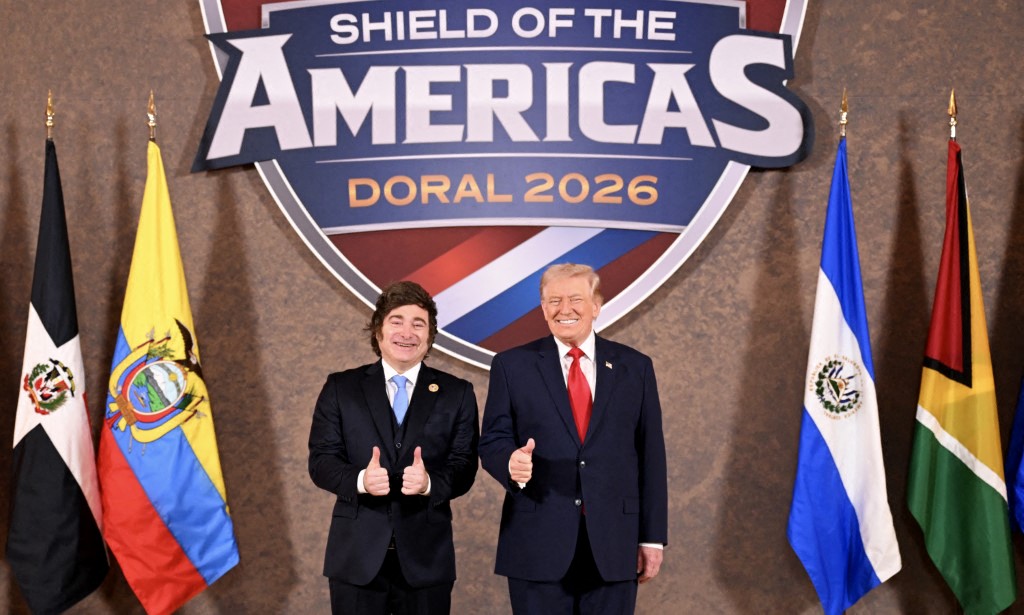
The rationale is that nothing must be sold that could “enhance Argentine military capability”. This policy has effectively prevented Argentina from purchasing military hardware containing British components, including blocking the sale of fighter jets featuring British parts. from other nations such as the United States and South Korea.
Meanwhile, Argentine President Milei wants these restrictions lifted and even has claimed that negotiations were underway to allow the purchase of military technology containing British components. But the UK government has denied holding “specific talks” to lift the ban.
Argentina signed a deal for 24 second-hand F-16 fighter jets from Denmark, with full support and approval from Washington. The deal saw the first batch of six aircraft arrive in December 2025, with the remaining jets scheduled for delivery.
Washington not only greenlit the transfer of the U.S.-origin jets but also provided $40 million in Foreign Military Financing as part of a broader $560 million support package that includes training, maintenance, and long-term sustainment. The acquisition marks Argentina’s most significant defense purchase in decades.
Incidentally, whereas fewer than 1,000 British troops are now stationed on the Falklands, Argentina is upgrading its overall military capabilities with the help of NATO allies, including the US, which is supplying missiles.
Viewed thus, today’s situation is vastly different from that of the 1980s, when the US valued its European partners, particularly the UK, far more than its South American allies.
It needs to be highlighted here that during the 1982 Falklands War, Argentina invoked the Inter-American Treaty of Reciprocal Assistance (Rio Treaty) against the United Kingdom, arguing that British military action against them was an attack on an American state. However, that did not impress the US, something the other partners did not like.
The American failure to support Argentina significantly damaged the treaty’s credibility and revealed deep divisions within the Americas. This move was seen as a betrayal by many Latin American nations, which, in turn, led many to eventually withdraw from the Treaty. Those who have left include Mexico, Bolivia, Ecuador, Nicaragua, and Venezuela.
In other words, in 1982, facing a choice between its legal obligations to defend Western Hemisphere allies under the Rio Treaty and its “Special Relationship” with the UK, the US sided with the latter, effectively rendering the Rio Treaty a “dead letter”.
In 2026, President Trump seems to be re-examining this policy, given his “America First” strategy, which suggests a reprioritization of interests, placing the two American continents and domestic concerns ahead of traditional European alliances.
Obviously, the Britishers are unhappy.