At least two former US Air Force fighter pilots are currently on trial for providing unauthorized and unlawful training to Chinese aviators and possibly exposing critical Western combat aviation tactics and fighting doctrines.
The US Justice Department’s decision to bring the former pilots to trial and press formal charges against them has raised considerable awareness within the fighter pilot community about the inherent dangers of accepting such training assignments in China.
However, far from being deterred, China has cast a wider net, now actively targeting former naval officers—not just in the United States, but in other countries as well, including India.
Further, the modus operandi has now changed.
Instead of asking the former pilots or sailors to shift to China and bring the spotlight on themselves, they’re now approached with a seemingly benign and harmless request – to write articles and research papers on issues pertaining to geopolitics, defense procurement, military exercises, and their national fighting doctrines, using their expertise, inside knowledge and access to sensitive information, in return for substantial amounts of money.
Additionally, the identification and recruitment of potential targets no longer occurs in the shadows of the dark web or through clandestine espionage networks, but in plain sight on mainstream professional platforms such as LinkedIn, Indeed, and Naukri.com.
The recruiters pose as students pursuing PhDs or interns in think tanks.
On offer is a considerable amount of money, in the range of USD 300-500, for each article, with the possibility of signing a legal contract as a consultant.
Initially, the article topics could be banal and generic; however, soon the recruiters demand articles/research papers on specific topics, covering defense doctrines, weapons systems, defense procurement mechanisms, military exercises, and human intelligence (HUMINT) on troop deployment and weapons performance.
In India, multiple journalists, scholars, and former defense officials have been approached with such offers on WhatsApp, Facebook, LinkedIn, Indeed, and other social media and job portals.
For this story, I spoke with a former Rear Admiral and a former Indian Army Colonel, both of whom have been approached with such requests and promises of hefty payments.
Besides, I was approached with a similar request for defense-related articles in exchange for payment.
Rear Admiral (R) Girish Kumar Garg was approached on LinkedIn by two Hong Kong-based students who claimed that they were PhD students at the University of Hong Kong.
The two students claimed that they’re also working with an NGO in the field of International Relations and Geopolitics, and they want to connect with “prestigious people” who have unique perspectives on defense and geopolitics.
“We seek to cooperate with you as your excellent analytical abilities and domain knowledge have made a deep impression on us,” said one of their initial LinkedIn messages.
Admiral Garg was asked to begin by writing an article on South Asian geopolitics.
The students said that after the successful completion of this article, they will “assign him certain tasks” and that he will be paid USD 300+ for each task.
Further, they can explore hiring him as a consultant and signing a legal contract with him for a fixed monthly income.
When Admiral Garg demanded details on what kind of “tasks” would be assigned to him, no clear answer was forthcoming.
The students replied only that the tasks would make good use of his strong analytical and predictive abilities in defense and geopolitics.
Upon further questioning, the students informed Admiral Garg that they were working with WTW Analysis, a private multinational company specializing in market research.
Admiral Garg wanted to check the company’s website, but he was informed it was temporarily unavailable due to maintenance.
Admiral Garg informed them that he could not associate with them unless they provided details on the tasks he would be assigned.
However, once again, he was informed that the tasks would make good use of his domain expertise, gained during his long and illustrious service with the Indian Navy, his understanding and hands-on experience with weapons systems, and his “predictive abilities” in the field of defense acquisition.
“Finding everything fishy, I told them that I am not interested and stonewalled all their further attempts to contact me,” Admiral Garg said.
However, he was approached repeatedly. He was informed that there are no time constraints, and “we can pursue our cooperation whenever you are ready.”
Notably, Admiral Garg has served in many sensitive and strategically important positions, including in the Andamans, as a defense acquisition officer, and as director general of top-secret Naval operations.
The apprehension is that, under the guise of research articles, they wanted him to divulge sensitive details about the operations of the Indian Navy, India’s defense procurement mechanisms, or strategic vulnerabilities of India in the critical Indian Ocean Region (IOR).
Admiral Garg was able to read between the lines and rightly rejected their requests; however, the danger is that he might not be the only former Indian Navy officer who has been contacted in this manner.
Similarly, I was contacted on WhatsApp from a UK-based mobile number with an offer of USD300 per article, covering topics such as defense and geopolitics.
Notably, the offer was made within months of when I started covering the defense sector.
However, when I submitted an article, I was told that the article should not be based on Open Source Intelligence (OSINT), but should provide some information that is not in the public domain, in other words, some inside information about defense deals.
I was told that since I cover defense, I must have developed sources in India’s defense establishment. I was asked to use those sources to provide some inside information on potential future defense deals.

When I informed them that if I had any such information, I would rather share it with my editor and publish it, they replied that they could pay much more for such information. When I rejected their offer, they replied that I can contact them if I ever change my mind.
Another Delhi-based former Indian Army Colonel, who does not wish to be identified, was approached on LinkedIn with a similar offer for writing research papers on the combat doctrines of the Indian Army by Hong Kong-based students who claimed to be working with a think tank covering South Asia.
Apparently, so many former defense officials, journalists, and scholars have been approached that the matter has even reached Indian government authorities, which, in January this year, released an advisory to all universities, warning against such operations and advising caution while dealing with such requests.
The advisory was also circulated by the Indian Navy (IN) and shared with the IN veterans organization.
On January 22, the University Grants Commission (UGC) issued an advisory to Higher Education Institutions drawing attention to inputs received from the Ministry of Education regarding attempts by vested foreign entities to collect sensitive information linked to India’s national security, defense establishments, critical infrastructure, and government functioning.
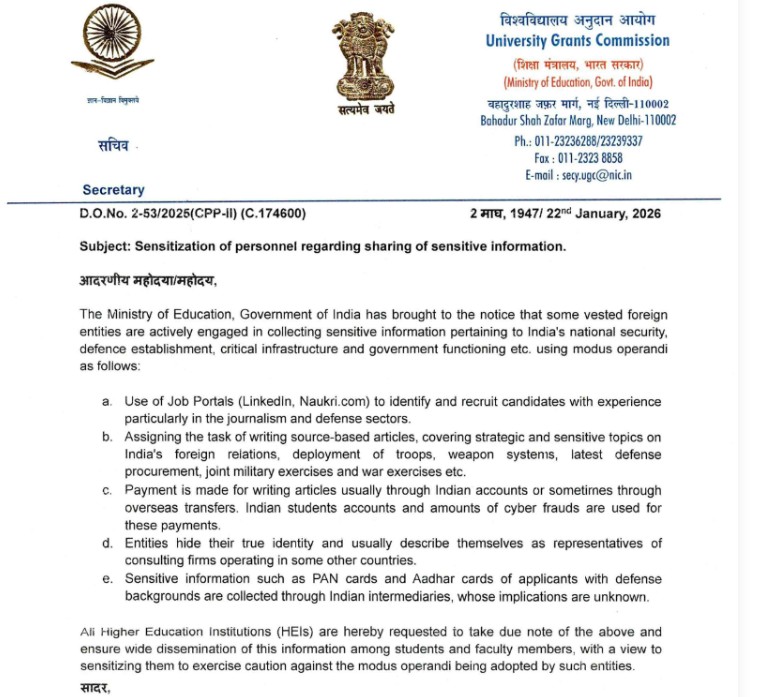
The advisory, titled “Sensitization of personnel regarding sharing of sensitive information,” highlighted that such entities are reportedly using job portals and professional networking platforms to identify individuals—especially those with journalism and defence-related backgrounds—and engaging them to prepare articles on sensitive topics such as troop deployment, defense procurement, weapon systems, military exercises and foreign relations, with payments routed through Indian or overseas channels and intermediaries.
“All Higher Education Institutions (HEIs) have been advised to ensure wide dissemination of this advisory among students and faculty to sensitize them to exercise due caution, avoid sharing sensitive personal or official information, and remain alert to suspicious recruitment or consultancy approaches,” the advisory added.
The advisory also described the modus operandi of these people, as using Job Portals (LinkedIn, Naukri.com) to “identify and recruit candidates with experience particularly in the journalism and defense sectors.”
Further, these people assign the task of writing source-based articles, “covering strategic and sensitive topics on India’s foreign relations, deployment of troops, weapon systems, latest defense procurement, joint military exercises, and war exercises, etc.”
The advisory cautions that these people often “hide their true identity and usually describe themselves as representatives of consulting firms operating in some other countries.”
While initially intended for higher educational institutions, the advisory has also been circulated by the Indian defense forces to the veterans’ organization to raise their awareness of such clandestine operations aimed at ensnaring former defense officials in anti-national activities.
However, given the large number of former defense officials being approached with such offers, there is an urgent need to disseminate this information on a much wider scale.
Since the former defense officials are approached on mainstream platforms such as LinkedIn and Naukri and are asked to write research papers for foreign-based think tanks and consulting firms, the process appears harmless.
Many people could get the impression that they are engaging in routine scholarly and academic activities. They might even feel they are helping the Indian defense and security ecosystem by sharing their expertise and domain knowledge; however, in the process, they might divulge sensitive and critical information, including top-secret information such as troop deployments, to foreign adversaries.
It is critical to recognize this emerging pattern of covert influence operations by foreign entities, and to urgently raise awareness among journalists and former defense officials about the serious risks involved.
The Government of India should, therefore, circulate such advisories widely among the veteran organizations and media personnel.
- Sumit Ahlawat has over a decade of experience in news media. He has worked with Press Trust of India, Times Now, Zee News, Economic Times, and Microsoft News. He holds a Master’s Degree in International Media and Modern History from the University of Sheffield, UK.
- VIEWS PERSONAL OF THE AUTHOR.
- He can be reached at ahlawat.sumit85 (at) gmail.com