For Ukraine, the Iranian-origin Shahed-class drones—developed, produced, and repackaged as the Geran-class by Russia—have been the most persistent and pressing challenge in the war that is now in its fifth year.
The early impact of Shahed-class drones, produced in Russia as the Geran-2, demonstrated the value of attritable, mass-produced kamikaze drones in modern warfare and prompted a global strategic rethink and a visible doctrinal shift.
Due to their low production cost of roughly $20,000–$50,000 per unit, their simple and rugged design, and their effectiveness when used in large swarms, these drones are widely known as the “poor man’s cruise missile.”
These low-cost, one-way attack drones create a painful asymmetry on the battlefield because defending against them often requires firing multimillion-dollar interceptors, as the EurAsian Times explained earlier.
The ongoing Ukraine War has been akin to a live lab for Russian weapons that have been developed and improved to adjust to the combat realities. The Geran-class drones feature prominently amongst this list.
Initially adapted from the Iranian Shahed-136, these drones have evolved over the past four years.
This includes replacing Iranian components with Russian and Chinese ones, adding electronic-warfare innovations to defeat battlefield threats, equipping the drone with Soviet-era missiles, and creating jet-powered versions of the Geran-2 drone, such as the Geran-3, Geran-4, and Geran-5.
A new report by the US-based think tank Center for Strategic and International Studies (CSIS) states that Russia has treated the Iranian Shahed design as a continuously evolving platform since acquiring it in September 2022—rapidly modifying navigation, communications, payloads, propulsion, and tactics in response to Ukrainian defenses.
“The defining challenge posed by Russia’s Geran program is the speed at which Russia can learn and adapt. Since acquiring the original Shahed design, Russia has treated the Geran as a continuously evolving platform, rapidly modifying its navigation, communications, payloads, propulsion, and tactics in response to changing Ukrainian defenses. Improvised modifications are tested in combat, successful solutions are standardized and scaled, and unsuccessful experiments are quickly discarded,” the CSIS report stated.
“This creates a continuous adaptation cycle in which battlefield feedback drives production decisions at a cadence measured in weeks rather than years,” it added.
The Shahed Evolved To Geran & Onwards
First used in combat by Iran-backed Houthi rebels against Saudi Arabia, these drones gained global attention when Russia began deploying the Shahed-136 and Shahed-131 variants to strike key infrastructure in Ukraine in September 2022.
The first wreckage of the Russia-deployed Geran recovered by Ukraine was labeled Geran-M and was made of predominantly Iranian components, the report stated. However, just two months later, Russia struck a $1.75 billion deal with Iran, authorizing production of the drone at the Alabuga Special Economic Zone (SEZ) in the country.
When production at the Alabuga facility began, the first batch of Gerans produced was nearly identical to the “M” variant sourced from Iran.
In addition to Alabuga, Russia began parallel production of the drone in 2023 at JSC Izhevsk Electromechanical Plant Kupol (Almaz-Antey), producing the “K” (Garpiya) variant with greater emphasis on reducing reliance on imported parts. Here, the Geran-2 underwent several design changes, primarily to reduce reliance on imported parts.
Russia has since consistently localized components.
“The Iranian Mado engine was swapped for one of two Chinese copies of the same German Limbach design in a supply-chain hedge, while the Iranian Nasir satellite receiver was replaced with Russia’s Kometa-M4, integrated into a larger B-105 navigation module and moved inside the airframe. The original Iranian flight controller, comprising eight layers of circuit boards, was replaced with the Russian B-101, a four-layer design with 3D-printed supports and an integrated inertial measurement unit. The warhead shifted from the Iranian penetrator to the Russian BSF-50, a fragmentation-high-explosive design wrapped in tungsten balls for additional shrapnel,” the CSIS report detailed.
It’s unclear how the two production locations relate and whether they work together or compete. However, the report notes that the Izhevsk-built drones are often of superior production quality, whilst Alabuga models are typically less robust and equipped with ad hoc fixes for combat issues.
Over time, both factories produced a widening range of variants, sometimes converging on the same solutions and sometimes pursuing parallel paths.

Resilience Against Ukraine’s Electronic Warfare
“The single clearest illustration of the Geran’s rapid development cycle is the progression of its satellite-navigation antennas to make it increasingly resilient to methods of electronic warfare (EW),” states the CSIS report.
As widely reported, the Ukrainian electronic warfare has proven highly effective against Geran drones, with claims that jamming and spoofing can neutralize nearly half of the drones launched in some night attacks.
Russia’s primary technical response against this threat has been the progressive upgrading of controlled reception pattern antennas (CRPAs).
These multi-element antennas allow the drone to reject interference from multiple directions. “Units such as the Kometa-M, Russia’s homegrown CRPA series, use several antenna elements to neutralize signal interference from multiple directions. EW resilience scales linearly with the number of elements: The four-element Kometa-M4 can resist three sources of interference, the eight-element Kometa-M8 can resist seven, and so on.”
Evolving geometries from side-by-side to circular, dual-ring, and grid layouts. The pace of these changes tracked improvements in Ukrainian jamming almost in real time, demonstrating how quickly both Russian factories responded to battlefield pressure.
Geran Went From Fire-and-Forget to Operator-Controlled
“Ukraine’s anti-air defenses were not limited to EW tactics, and Russia’s attempts to thwart these defenses did not stop at CRPAs. While some Russian engineers were experimenting with increased antenna counts, others were trying out new ways of communicating with the drone mid-flight,” the CSIS report highlighted.
Earlier, the Geran drones operated purely as fire-and-forget munitions. They followed preprogrammed routes and couldn’t receive new commands mid-flight or report back on developments.
However, by the end of 2023, experimental drones began appearing fitted with 4G modems and cameras taped or bolted onto the airframe. This enabled limited telemetry and visual feedback.
At the time, Ukrainian analysts postulated that the module was intended to relay the drone’s location over a Ukrainian cellular network mid-flight.
If the transmission stopped before the drone reached its target, Russian operators could deduce the presence of anti-air defenses at the last broadcast location and instruct future Gerans to fly around the area.
By 2025, most Geran drones carried standardized telemetry modules based on a Raspberry Pi computer and dual Chinese cellular modems equipped with both Russian and Ukrainian SIM cards. The modules eventually moved from external attachments into the airframe itself, the CSIS explained.
A further leap came in the summer of 2025 with the introduction of Chinese mesh-network radios, the report noted. This allowed the operators to control drones in real time, receive live video, and redirect them mid-mission.
A variety of cameras were paired with modems and connected to the Geran in various ways. From low-cost commercial security cameras to the advanced Honpho TS130C-01 with long-wave infrared capabilities, a two-mile laser rangefinder, and integrated computer vision, the Geran could carry a variety of camera models.
Some drones even carried air-to-air missiles for self-defense against interceptors.
As a result, the Geran evolved from a simple one-way munition into a remotely piloted strike platform capable of loitering, observing, and adapting during flight.
Geran’s Payload Expanded & It Took On New Roles
Over time, the warheads on these one-way attack drones grew heavier and more varied. The original Iranian penetrator was replaced by Russian fragmentation, shaped-charge, thermobaric, and combined-effect designs. Some later variants carried nearly 200-pound warheads or stacked dual charges.
In addition to the primary warhead, engineers began adding secondary munitions. The CSIS report states, “In 2025, Russia began experimenting with auxiliary munitions attached to the Geran for mid-flight release. Some, including the PTM-3 anti-tank mines carried under the wings, seemed intended to attack secondary targets en route to the final destination.”
“Others, such as the R-60 air-to-air missile mounted on the drone’s fuselage, or the Verba man-portable air defense missile carried in addition to a primary warhead, were used to fend off anti-aircraft helicopters and interceptors,” it added.
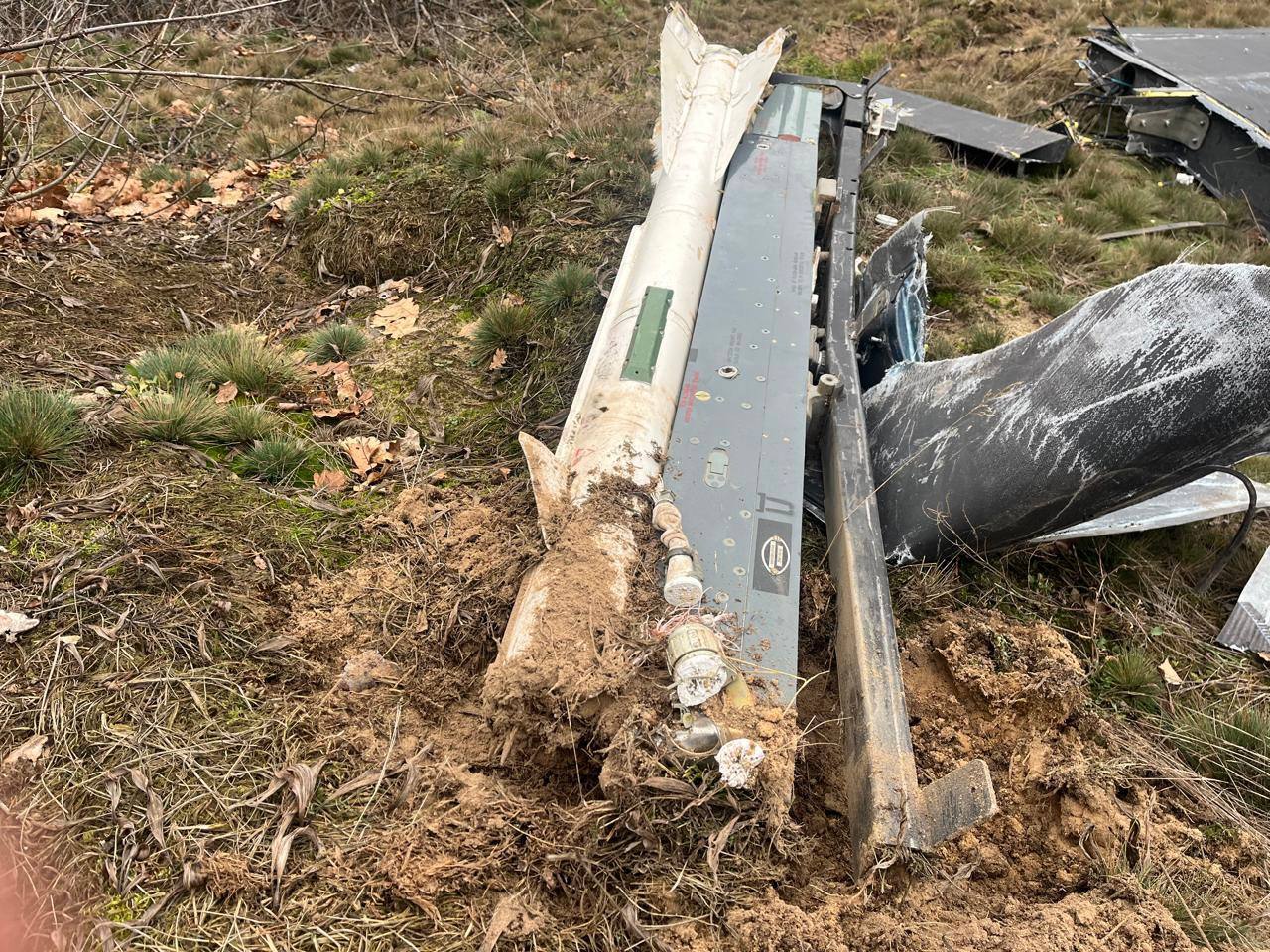
These new payloads quickly spurred further improvisation. Within four months of the first R-60 being mounted on a Geran, drones began flying with decoy missiles to further complicate Ukrainian threat assessment.
In perhaps the most unusual case, in March 2026, a Geran was spotted carrying two first-person-view drones on top of its airframe for mid-flight release.
Breaking the Airframe Ceiling
For years, nearly all modifications were made within the original Iranian delta-wing airframe, enabling rapid parallel experimentation. However, it eventually imposed performance limits, especially when Russia sought higher speeds to outrun Ukrainian interceptors.
“This trade-off became particularly evident in Russia’s efforts to increase the Geran’s flight speed. As with many of the changes described above, the upgrade was motivated by increasingly effective Ukrainian anti-aircraft defenses. A faster Geran, powered by a turbojet engine, could outrun interceptors and present a smaller window for Ukrainian defenses to respond,” the CSIS report highlighted in the report.
Jet-powered versions first appeared as the Iranian Shahed-238, as EurAsian Times reported earlier, followed by the Russian Geran-3, equipped with a Chinese turbojet capable of up to 300 miles per hour—double the speed of the piston-engine models.
However, the original airframe lacked the structural strength to handle the associated G-loads.
“To continue to innovate its way out of Ukrainian defenses, it would need to redesign the Iranian airframe. To scale production of the new model, it would have to upend its production lines. That is exactly what it did. The result was the Geran-4 and Geran-5,” the CSIS explained in the report.
You can read a detailed EurAsian Times report on how Ukraine has been struggling to down Russia’s jet-powered Geran drones here.
Three Patterns
In conclusion, CSIS identifies three clear patterns:
- Modifications typically begin as low-cost experiments with commercial off-the-shelf parts. Successful ones are standardized and scaled, whereas failures are discarded.
- Iteration is driven by battlefield feedback rather than formal long-term requirements
- The operator-to-engineer feedback loop is extremely short—drones move from production line to combat in roughly a week.
This steady stream of feedback into real production and delivery has made the drone more powerful, making it a constant nightmare for the Ukrainians.
- Contact the author at sakshi.tiwari13 (at) outlook.com
- Follow EurAsian Times on Google News