Amid fears of a direct conflict between Russia and NATO, the Polish foreign minister has made an astonishing statement.
Speaking in Kyiv, at the annual Yalta European Strategy (YES), Polish Foreign Minister Radosław Sikorski said, “If Russia attacked us and we took our gloves off, I think we would defeat Russia quite quickly. We have overwhelming superiority over Russia in air power. General, correct me if I’m wrong, but it’s something like 2,500 aircraft.”
He further said that even without US support, European powers will easily defeat Russia.
“Even without the US, it’s still overwhelming, and I haven’t checked recently how many F-35s and JASSMs and all the deep-strike capabilities we have. But if the Ukrainians have knocked out half of Russia’s refining capacity in six months, we could do it in six weeks and take out the other half.”
Notably, a direct NATO–Russia war — the ultimate Cold War nightmare — is no longer far-fetched fiction. It is starting to look like a scenario governments actually plan for.
Last month, the German newspaper Bild reported that NATO is preparing for a possible Russian attack on the Baltic states with a new land-warfare concept.
So comparing Russian and NATO military and air power is no longer an abstract exercise. It is now a live question about how such a war might actually be fought.
Russia shares a border with six NATO states: Norway (sea border), Finland, Estonia, Latvia, Lithuania, and Poland. All of them are Nordic and Baltic countries in Eastern Europe.
Therefore, a Russia Vs NATO conflict will be fought in all three domains – land (mostly in Eastern Europe), sea (mostly in the Baltic and Black Seas), and in the air.
Most likely, the air war between NATO and Russia will be the most extensive.
A direct NATO vs. Russia air-power comparison shows the Polish foreign minister is not wrong to assert that the Western military bloc has overwhelming air superiority over Moscow.
NATO Vs Russia Air Power
Sikorski said that the bloc has “something like 2,500 aircraft.”
However, NATO’s fighter fleet is around 4,500 jets, compared to Russia’s 1,520 fighters. This gives NATO a 3:1 fighter advantage over Russia.
This gap becomes even starker when you factor in air force modernization.
NATO countries field nearly 1,380 fifth-generation fighter jets, including 1,200 F-35 Lightning II and 180 F-22 Raptors (in the US Air Force only).
In comparison, Russia has very few Su-57 Felon jets, giving NATO a decisive advantage in stealth jets. Most military analysts also agree that the Su-57’s stealth features are not as advanced as those of American jets.
This large stealth fleet will let NATO penetrate Russian airspace and conduct SEAD/DEAD missions, opening the airspace for fourth-generation fighter jets such as the F-15, F-16, Eurofighter Typhoon, Rafale, and Gripen.
NATO also holds an overwhelming majority in tankers (660 vs 19) and AWACS, giving it long-range operations capability and a stay-up, see-first, and fight-as-a-network capability.
So, this part of Sikorski’s statement is self-evident.
However, the second part of his statement is more controversial.
Sikorski said that even without US support, European powers will still easily defeat Russia.
‘NATO Minus US’ vs Russia
The picture changes dramatically if you remove the US from the equation.
Without the US, the remaining NATO countries have around 1,700-2,000 fighter jets, compared with Russia’s 1,550.
European NATO countries have around 200-250 F-35 fighter jets, compared with Russia’s limited number of Su-57 jets. The Su-57’s frontal stealth is excellent, so while it may not be the perfect platform for penetrating contested airspace, it can perform interception and defend its own airspace rather well.
Besides the F-35, European NATO operates high-quality jets like the Rafale, Typhoon, F-16 and Gripen, which will provide a definitive edge over the Russian Air Force.
NATO without the US has around 70 tankers. These tankers are essential, as fighter jets flying from Western and Central Europe will need aerial refueling to reach Russia.
In terms of attack helicopters, Russia and the Western bloc are evenly matched, both having around 500 combat helicopters.
Furthermore, most of the missiles and munitions for the F-35 are supplied by the US. Sikorski specifically mentioned JASSMs, which are also supplied by the US.
Again, for its air defense systems, Europe is primarily dependent on US-supplied Patriot batteries.
Patriot missiles are already in short supply due to the war with Iran, and if a conflict erupts between Russia and European NATO, the Pentagon will be slow to meet Europe’s wartime needs.
We have already seen how Kyiv is struggling to defend itself from Russian missiles without Patriot batteries.
Sikorski further said that the “Ukrainians have knocked out half of Russia’s refining capacity in six months; we could do it in six weeks and take out the other half.”
However, precision strikes deep inside Russia’s vast hinterland require Starlink connectivity. Without Starlink connectivity, Ukraine’s drone campaign against Russian facilities would have had only limited success.
Russia has one of the world’s most battle-hardened armies but is drained due to the ongoing war in Ukraine. Before that, Russia had also participated in the Syrian civil war for many years. The Russian Air Force had played a central role in supporting Bashar al-Assad’s regime in Syria.
Russian armed forces have roughly 1.1–1.32 million active military personnel in most independent estimates, versus about 2 million in NATO.
However, most of the NATO armies have not fought a single war in decades. Some NATO soldiers were involved in the Afghanistan and Iraq wars, and French armed forces have conducted some operations in Central Africa. However, that is very different from fighting an intense war of attrition.
Furthermore, the two largest standing armies in NATO are from the US and Turkey. However, Turkey cannot be relied upon in a war against Russia, as Ankara has played both sides since 2016 and has been consistently denied access to the European Union. Whether Ankara will join in to defend Europe is a tricky question.
Furthermore, NATO unity is a myth. Countries like Hungary and Slovakia are NATO members, yet they have openly supported Russia on many occasions during the Ukraine war. It is debatable how many NATO countries will mobilize their full force in a war against Russia.
Another crucial factor is that Moscow has already shifted to a full-time war economy. Ukraine is warning that Russia is already producing 140 ballistic missiles and thousands of drones every month.
Europe’s defense industrial base, at least for now, simply cannot match Russian output.
Europe is critically dependent on the US for munitions, air defense interceptors, precision-strike missiles, fighter-jet missiles, and satellite guidance systems. Russia, however, has been under heavy sanctions for years and has learned to bypass these sanctions.
Also, Russia has hundreds, if not thousands, of long-range ballistic missiles and cruise missiles. Western air defense systems are likely to struggle against Russia’s hypersonic cruise missiles, despite many shootdowns by Ukraine.
Furthermore, the elephant in the room is nuclear weapons.
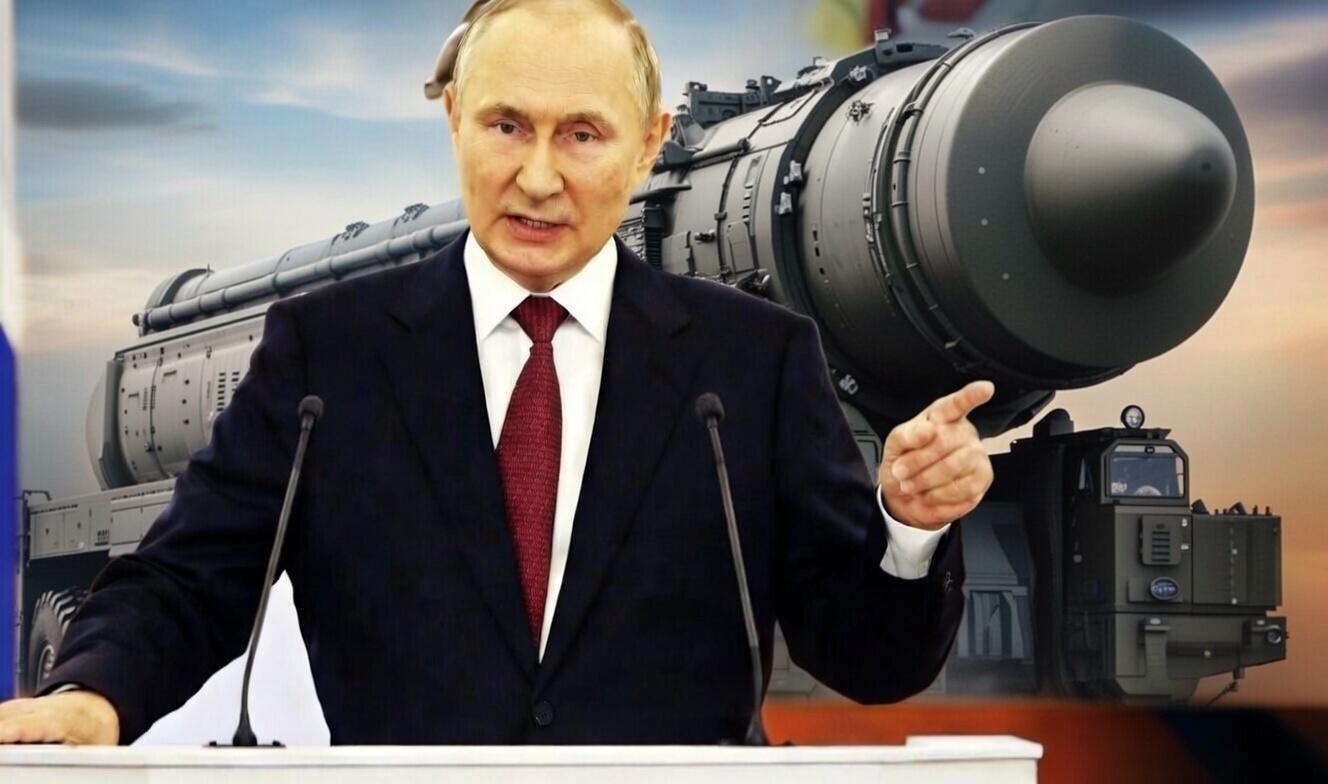
Russia is the world’s largest nuclear power. According to the latest SIPRI report, Russia has 4,309 nuclear warheads, the highest in the world.
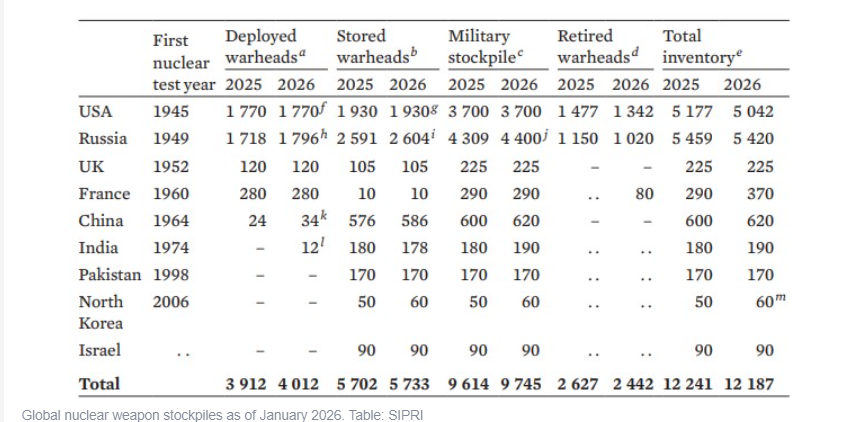
Russia also has a complete nuclear triad. Russia can launch nuclear weapons in three components: land-based intercontinental ballistic missiles (ICBMs), submarine-launched ballistic missiles (SLBMs), and strategic bombers capable of delivering nuclear weapons. This configuration is designed to ensure a country’s ability to retaliate with nuclear weapons even after a first strike, thus deterring potential adversaries.
History also offers a sobering lesson.
When Russia fights a war for its survival, as it did against Napoleon in the 19th century and against Hitler in the 20th century, it is willing to risk anything and everything.
Russia cannot fight a unified NATO. However, if NATO is divided and without the US, Russia can threaten, coerce, exploit differences in the bloc, and pressure the more exposed Baltic and Nordic states, even if it can not overrun the whole of Europe.
Without the US, NATO Europe would lose the biggest single source of airlift, tanker aircraft, intelligence/surveillance, munitions depth, missile defense inventory, and nuclear umbrella.
It has become fashionable in Europe to suggest that they can defeat Russia even without US help.
Earlier, the European Union’s (EU) top diplomat, Kaja Kallas, warned that Russia does not “stand a chance” against NATO and the EU if the alliance “sticks together” in the face of a belligerent Moscow.
“Today, against NATO and the EU, Russia doesn’t stand a chance. But we must stick together,” Kallas told the European Parliament in Strasbourg in June last year.
As it appears, it is unlikely, not impossible, for Europe to clash with Russia sans the United States, especially with Trump at the helm.
- Sumit Ahlawat has over a decade of experience in news media. He has worked with Press Trust of India, Times Now, Zee News, Economic Times, and Microsoft News. He holds a Master’s Degree in International Media and Modern History from the University of Sheffield, UK.
- He can be reached at ahlawat.sumit85 (at) gmail.com