China test-fired a submarine-launched ballistic missile (SLBM) in the South Pacific in a rare display of muscle flexing. Incidentally, the test came just hours after Australia announced a surprise defense agreement with Fiji on July 6, 2026.
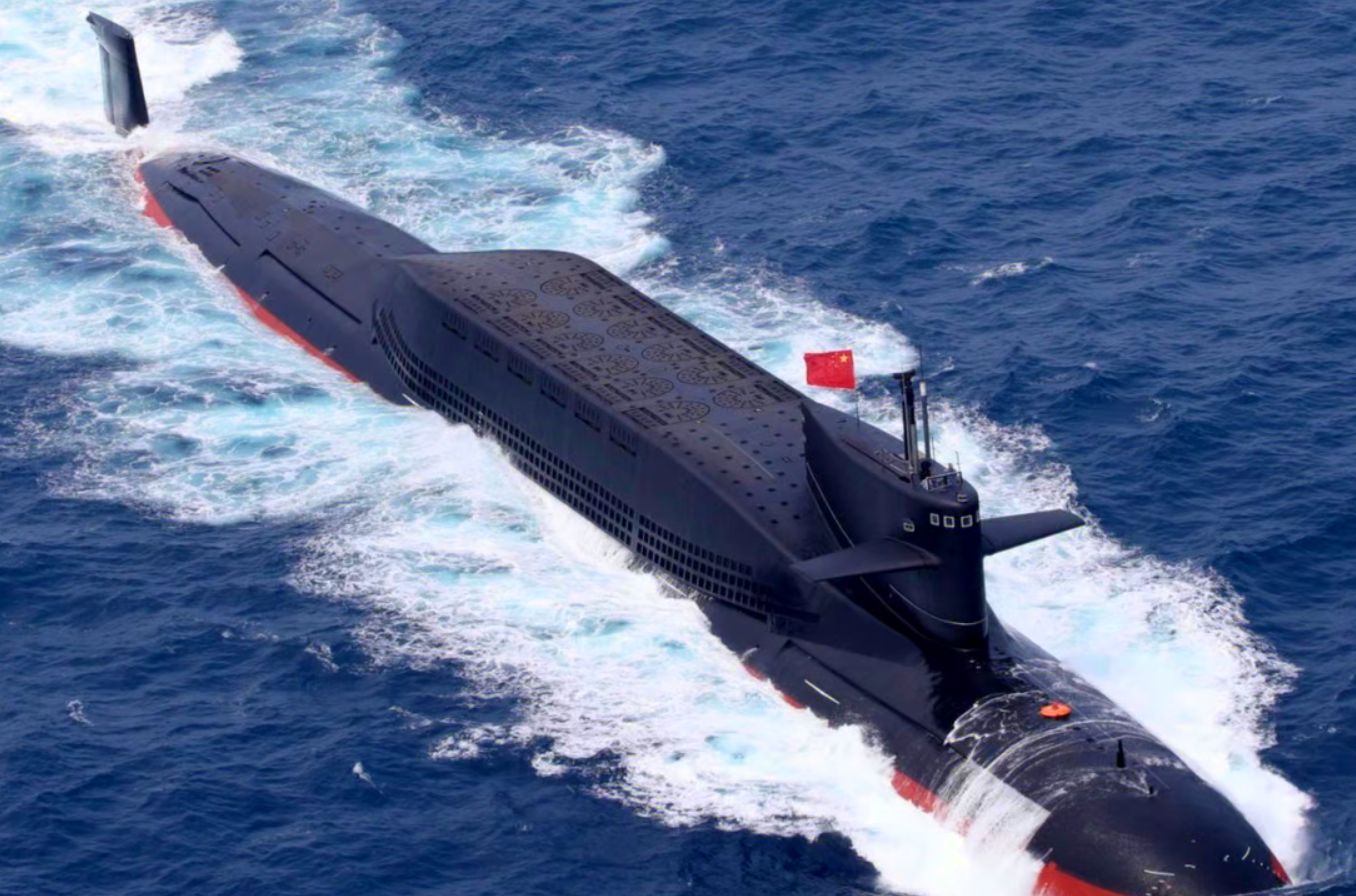
A nuclear submarine of the People’s Liberation Army Navy (PLAN) “launched a strategic missile carrying a dummy warhead toward relevant high seas of the Pacific Ocean, which landed precisely within the designated waters,” Senior Capt. Wang Xuemeng, a spokesperson for the PLA Navy, said in an official statement on July 6, 2026.
“This test launch was a routine part of China’s annual military training schedule,” Wang stated, adding that the “relevant nations” were informed in advance about the test. “The operation was in accordance with international law and practice, targeting no specific country or objective,” he added.
The last time it conducted such a test in international waters was in the 1980s, reports noted, adding that the PLAN’s official statement is a rare acknowledgment, as Beijing typically conceals details about its sophisticated weapon systems and missile launches.
The statement did not disclose which submarine-launched ballistic missile was launched, from which location, or from which platform. However, we know that the PLAN operates two missiles of this type: the JL-2, with a range of 7,200 to 9,000 kilometers, and the JL-3, with a range of over 10,000 kilometers, enough to reach the continental US, as previously noted by the EurAsian Times.
Taiwan identified the missile as a JL-2.
The JL-2 (Ju Lang-2 or “Giant Wave-2”) is a second-generation intercontinental-range submarine-launched ballistic missile. Developed as the submarine variant of the DF-31 road-mobile ICBM, the JL-2 replaced the shorter-range JL-1 on China’s earlier (and now retired) Type 092 Xia-class submarine. It significantly enhances China’s ability to conduct second-strike nuclear operations from stealthy, submerged platforms.
Strategically, the JL-2 gives China a more credible second-strike capability by allowing its SSBNs to operate from relatively protected waters while still reaching distant targets.
While the newer JL-3 offers greater range and is gradually supplementing or replacing it on upgraded platforms, the JL-2 remains a cornerstone of China’s current naval nuclear forces. Its development marked a major leap forward in solid-fuel technology, miniaturization, and submarine integration for the People’s Liberation Army Navy. 2 web pages
Meanwhile, New Zealand Foreign Affairs Minister Winston Peters said China launched the missile into the South Pacific Nuclear Free Zone, established in 1986 by the Treaty of Rarotonga. The Protocol II of this treaty calls on signatories not to use or threaten to use nuclear weapons against other states or their territory within the zone, whereas Protocol III outlaws nuclear testing in the zone. China has signed both protocols.
“We, like our neighbours in other Pacific countries, have no interest in China using the South Pacific as a testing site for missile capability,” Winston Peters said.
Meanwhile, Australian Foreign Minister Penny Wong condemned the Chinese move, saying the test was “destabilizing to the region.” The test must be seen “in the context of a rapid military build-up by China, which is lacking in the transparency and reassurance as to intent that the region expects,” the Australian Foreign Minister said.
The last time China sparked concern was in September 2024, when it launched a nuclear-capable DF-31B missile from Hainan Island in the South China Sea into the open Pacific close to French Polynesia.
Notably, the short notice of the latest SLBM test is reminiscent of the PLAN task group’s live-fire drills in the Tasman Sea near Australia and New Zealand in February 2025.
On its part, China dismissed all the criticism, with its Foreign Ministry spokesperson saying, “We hope that the relevant countries will avoid overinterpretation.”
Interestingly, though, the latest missile launch came just hours after Australia announced a surprise defense pact with Fiji on July 6, 2026.
Australian Prime Minister Anthony Albanese and his Fijian counterpart, Sitiveni Rabuka, signed the Ocean of Peace pact, elevating ties to a formal treaty alliance. The deal reportedly binds both countries to come to the other’s “mutual defense” in the event of a contingency. “When it comes to security issues, the Pacific family needs to look after our own security,” Albanese told reporters while announcing the upgrade in ties.
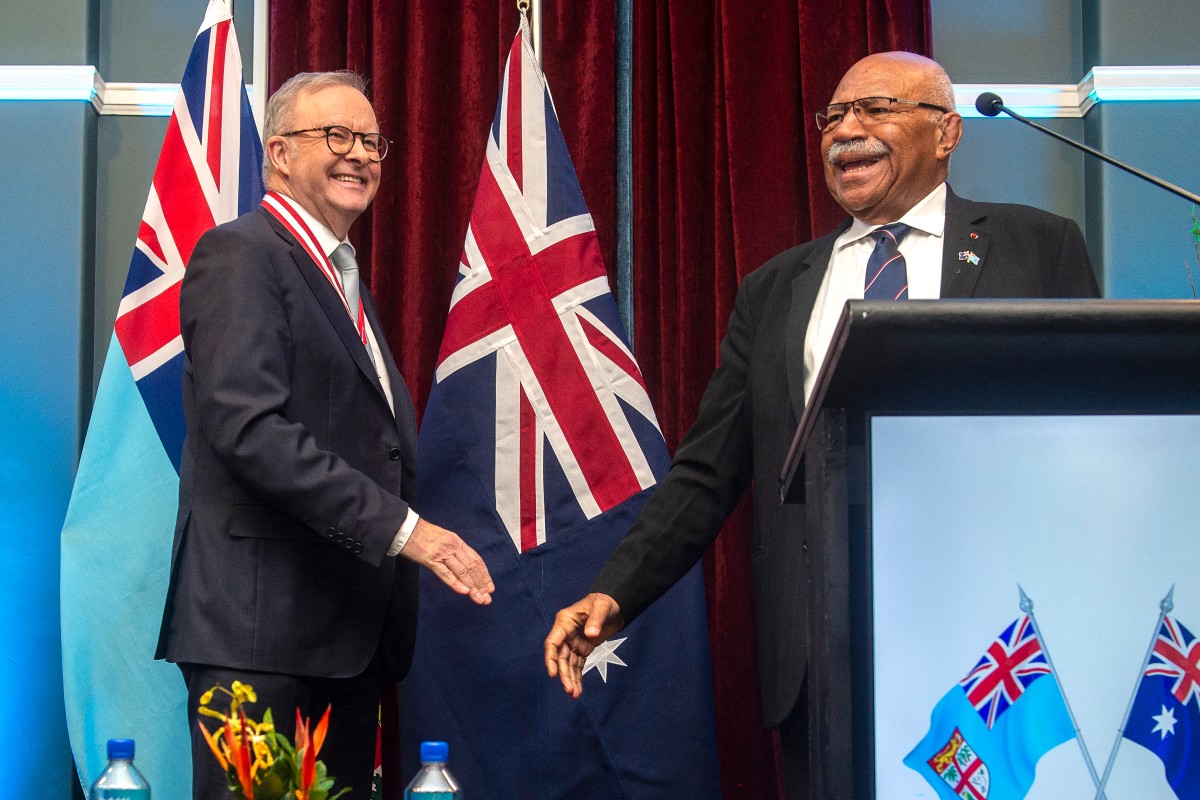
The two nations have agreed to consult each other on any “security-related development” that threatens their sovereignty under the deal. Fiji has now become only the fourth country, behind the US, New Zealand and PNG, to become Australia’s treaty ally.
The pact is seen as a setback to China’s strategy to expand into the South Pacific and forge new economic and security ties with Pacific Island Countries (PICs).
For instance, China signed a security agreement with the Solomon Islands in 2022, prompting concerns that a PLAN naval base could be established in the region. Later that year, reports surfaced that Beijing was attempting to negotiate similar pacts with other states in the region, including Kiribati, located just about 3,218 kilometers from Hawaii.
In October 2024, the Chinese Type 055 Guided-Missile Destroyer docked at Port Vila, Vanuatu (just 3,700 kilometers from Australia), unsettling Canberra. And in 2025, Beijing signed an agreement with the Cook Islands, reportedly securing a maritime presence in the region and unsettling another Pacific country, New Zealand.
However, Australia has embarked on a diplomatic blitzkrieg to retain its influence in the region. In late June, for instance, Australia signed a deal with Vanuatu called the Nakamal Agreement that will prevent foreign military bases from being built on Vanuatu’s soil.
Similarly, in October 2025, Australia signed a deal with Papua New Guinea (PNG) that effectively grants it access to the country’s military facilities and ensures China will not have the same access to infrastructure here as it does in other PICs.
Meanwhile, New Zealand signed a new pact with the Cook Islands in April this year, calling for New Zealand’s defense and security interests to be upheld, continuing to permit the New Zealand Defense Force access to the country, and engaging on any request for defense and security with NZ before engaging with other partners.
All of these agreements, often coupled with political and economic benefits, are meant as a counter to China’s expanding influence in the region.
Even Pacific Island Countries that China had previously aligned with are now hedging their positions. Solomon Islands’ new Prime Minister, Matthew Wale, announced last month that his government intends to negotiate a comprehensive strategic treaty with Australia while reviewing its security agreement with China.
The latest Australia-Fiji pact could, therefore, be yet another setback for Beijing in the Pacific.
U.S., Others Slam China’s Missile Test
The US raised an alarm after China test-fired a long-range missile into the Pacific Ocean. “At a time when the United States is working harder than ever to prevent nuclear proliferation, China is doing the opposite,” State Department spokesman Tommy Pigott said.
“Beijing’s rapid and opaque nuclear weapons buildup is of great concern to the region and the world,” he said in a statement.
The State Department urged China to “engage in meaningful arms control discussions and commit to a regularized notification arrangement for all intercontinental-range ballistic missile and space launches.”
Joseph Wu, the secretary general of Taiwan’s National Security Council, said that the missile went over the Philippines and accused China of destabilizing the region. “China just proved itself again to be a bully on the block,” he posted on X.
The Philippines, which has clashed repeatedly with China over territory in the disputed South China Sea, denounced the test as a “reckless display of military power.”
“This launch serves no peaceful purpose and is a calculated act of taunting and provocation against those who reject China’s illegal expansionism and coercive conduct,” the country’s defense department said in a statement.
Japan, which said it was informed in advance of the launch, said it had strongly urged China to reconsider and voiced “serious concerns” over Beijing’s growing military activity.
Russia, a Chinese ally, defended Beijing’s test-firing as its “sovereign right” and said that China “is not threatening anyone in the world.”
Lyle Morris, a senior fellow at the Asia Society Policy Institute, said the missile demonstrated that China had growing options beyond land-based firing. “A test of this length is a major development and would indicate that China is moving toward a significantly more survivable and longer-range sea-based nuclear deterrent capability,” he said.
It shows that China’s navy “is capable of targeting the continental United States from bastions close to Chinese waters.”
- Contact the author at sakshi.tiwari13 (at) outlook.com
- Follow EurAsian Times on Google News