The US Air Force’s A-10 Thunderbolt II, also known as “Warthog”, has once again escaped retirement, as the service unexpectedly announced that the aircraft, which was recently shot down over Iran during a search-and-rescue mission, will remain in service and operational until the 2030s.
The US Air Force (USAF) Secretary Troy E. Meink announced the decision on April 20, 2026. “In consultation with @SecWar, we will EXTEND the A-10 ‘Warthog’ platform to 2030. This preserves combat power as the Defense Industrial Base works to increase combat aircraft production. Thank you to @POTUS for your unwavering support of our warfighters and quick, decisive leadership as we equip our force. More to come,” he wrote on platform X.
Interestingly, the move follows the shuttering of depot maintenance on the “Warthog” at Hill Air Force Base, Utah, in February this year, and the graduation of the last batch of new A-10C Thunderbolt II pilots earlier this month. Both moves had earlier given the impression that the A-10 was in the last leg of its service in the USAF.
The decision to keep the combat-hardened aircraft in service is a major about-face by the USAF, which has been earnestly working to retire the A-10 since 1984, the year production of the aircraft ceased, according to a 2015 Congressional Research Service report.
In recent years, the USAF has repeatedly complained that the A-10 is too slow and too expensive to maintain, arguing that the billions of dollars spent on its upkeep could be diverted to other modern programs, including the B-21 Raider stealth bomber, the next-generation F-47 fighter, and hypersonic missiles.
Long live the Warthog. https://t.co/D5TRMIXAFF
— Pete Hegseth (@PeteHegseth) April 20, 2026
In fact, the USAF’s 2026 spending package included a request for US$57 million to retire all 162 remaining A-10 Warthog fighter jets by the end of Fiscal Year 2026, two years ahead of schedule, as reported by the EurAsian Times at the time.
However, the USAF’s attempts to divest A-10s have been consistently blocked by the US Congress, citing concerns that the retirement would leave the service without a close-support aircraft in its inventory. For reference, the National Defense Authorization Act (NDAA) of December 2025 rejected the plan to retire all 162 A-10 aircraft and strictly prohibited the use of funding to retire, prepare to retire, or divest A-10s below a fleet of 103 aircraft at least until 30 September 2026.
It has come as a surprise that the USAF has decided not to rally to cut the A-10 numbers or push for its retirement for the first time in decades. Intriguingly, the move comes ahead of the release of the 2027 spending plan, which was earlier expected to include a call again for the A-10’s retirement.
During this mammoth and extremely complex rescue effort, one of the A-10s deployed over Iran was struck by enemy fire. However, the pilot managed to steer the aircraft away from the Iranian airspace and ejected over the Persian Gulf, from where he was safely recovered by the US forces.
Despite the loss, the A-10 had largely proved its combat prowess before the incident. For instance, the photos of the aircraft released by the US Central Command (CENTCOM) in mid-March showed the aircraft equipped with APKWS (Advanced Precision Kill Weapon System) rockets for swatting drones as it flew missions against Iran-backed militias in Iraq and Jordan, prompting military experts to state that the deployment should serve as a wake-up call for USAF officials who support the aircraft’s divestment.
Not just that, the A-10s were also deployed to attack boats in the Straits of Hormuz, which were placed under a de facto closure by Iran. “The A-10 Warthog is now in the fight across the southern flank and is hunting and killing fast-attack watercraft in the Straits of Hormuz,” General Dan Caine, chairman of the Joint Chiefs of Staff, announced last month.
The war in Iran has potentially demonstrated to the USAF that it does not have another aircraft that could perform the duties of the Warthog or assist the troops in a rescue operation.
The Warthogs and their pilots are particularly well-versed in operating in close cooperation with the ground troops. “They understand how to talk to them and how close they can get to them,” retired Air Force Col. John Venable, now a senior resident fellow at the Mitchell Institute for Aerospace Studies, earlier told Air and Space Forces Magazine. “They have the trust to come in and strafe from 100 feet, 50 feet in front of them with a 30mm cannon.”
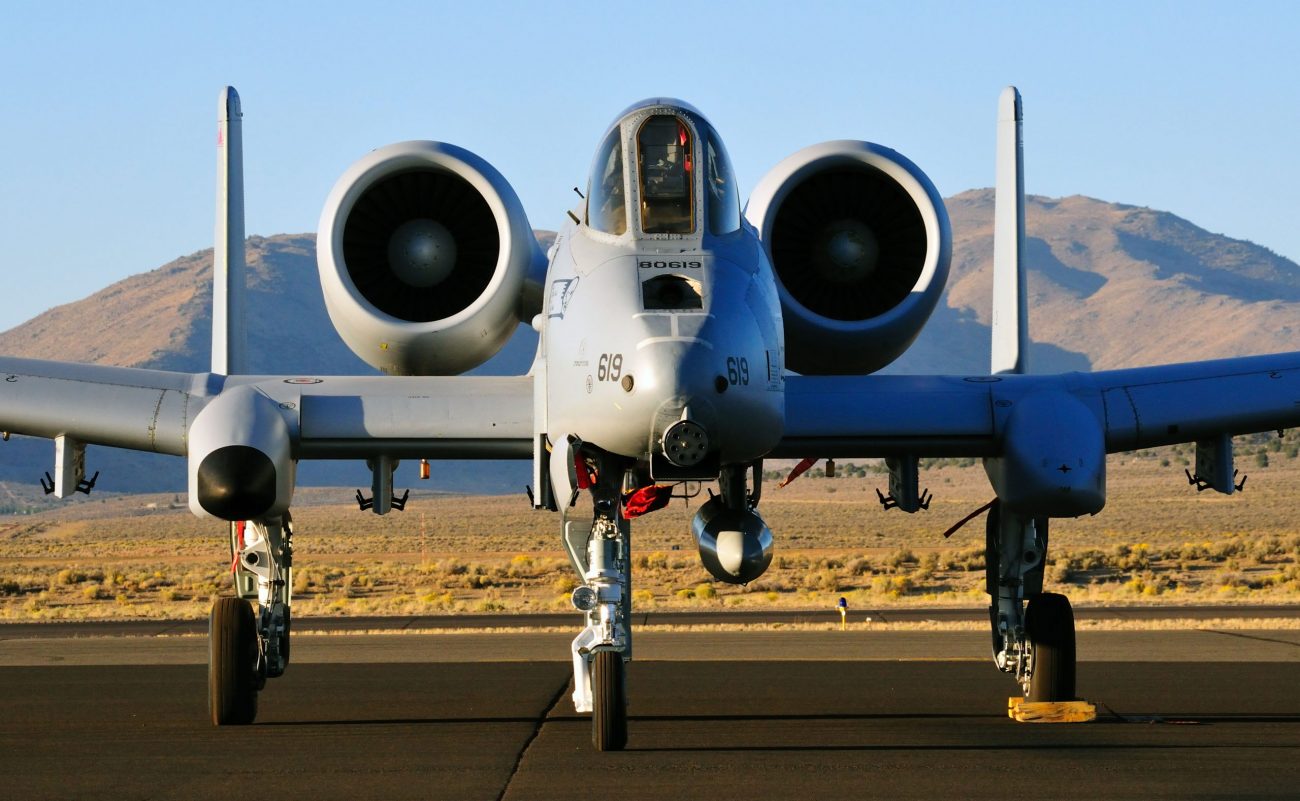
A-10 Warthogs Live Another Day
Designed for close air support (CAS), targeting tanks, armored vehicles, and ground forces with unmatched precision and lethality, the A-10 was inducted into the USAF in 1976, at the height of the Cold War.
The A-10’s sturdy design, which includes a titanium-armored cockpit, allows it to sustain significant combat damage. One of the most striking features of this aircraft was its GAU-8 Avenger, a 30mm seven-barrel Gatling cannon.
Notably, its low-flying, slow-speed characteristics, remarkable air-to-ground precision, and loitering capability make it a highly effective force-protection platform.
It can fire up to 3,900 rounds per minute using high-explosive incendiary shells or armor-piercing depleted uranium. With remarkable accuracy, it can destroy main battle tanks from approximately 4,000 feet, earning it the moniker “Tank buster.” Additionally, the A-10s are capable of launching rockets, bombs, and AGM-65 Maverick missiles, among other air-to-ground missiles.
The A-10 can also perform short takeoff and landing (STOL), allowing it to operate on short, uneven runways and increasing its battlefield versatility.
Furthermore, it can operate from forward bases with minimal assistance and is highly maneuverable at low speeds and altitudes. This is a significant feature because faster air superiority fighters cannot choose their ground targets or fly slowly enough to observe what they are striking. In fact, even the most advanced electro-optical targeting systems cannot discriminate between allies and adversaries in air-to-ground operations.
Notably, its low-flying, slow-speed characteristics, remarkable air-to-ground precision, and loitering capability make it a highly effective force-protection platform. The addition of APKWS II transforms this legacy close-air-support platform into a formidable counter-unmanned aerial system (C-UAS) asset, as explained in detail by the EurAsian Times.
Between 1975 and 1984, more than 700 A-10s were manufactured. Over the years, the aircraft received several upgrades, including modern avionics, precision-guided weapons, and digital displays. Interestingly, the aircraft has participated in nearly every significant US combat, including the Gulf War, the Balkan Wars, the Afghanistan War, Iraq, and Syria.
Following its success in Operation Desert Storm in Iraq, the aircraft was given several nicknames, including “Warthog.”
Despite its remarkable ground-attack capabilities, this slow-flying aircraft is getting outdated. While it could operate in an uncontested airspace like Afghanistan, it is unlikely to have a chance in a saturated airspace. The USAF authorities say these aircraft could not survive the sophisticated air defenses of near-peer adversaries such as China and Russia and were unfit for modern combat conditions.
However, for now, we know the Warthogs will remain in service well beyond the end of 2026, as previously envisioned by the US Air Force.
- Contact the author at sakshi.tiwari13 (at) outlook.com
- Follow EurAsian Times on Google News