As the US turned 251, a familiar ritual repeated this year as American politicians lined up to toast the Navy with patriotic messages and, interestingly, images of Indian and Russian warships.
The US Navy celebrates its birthday every year on October 13, marking the day the Second Continental Congress authorized the outfitting of two armed vessels to intercept British supply ships during the American Revolution—the decision that created the Continental Navy, a force that eventually grew into the United States Navy.
As US Navy birthday wishes poured in on October 13, several US lawmakers joined the rush to pay their homage, resulting in a series of social media misfires.
For instance, Georgia Governor Brian P. Kemp posted a message with an image of three sleek gray warships steaming in formation.
At first glance, the post seems routine, but a closer look reveals the warships are Indian Navy vessels, as Dave Brown, the Deputy Washington Bureau Chief at The Wall Street Journal, and military observers pointed out.
The ships have since been identified as INS Godavari, INS Brahmaputra, and INS Beas, although a community note on Kemp’s post flags them as Kolkata-class guided-missile destroyers.
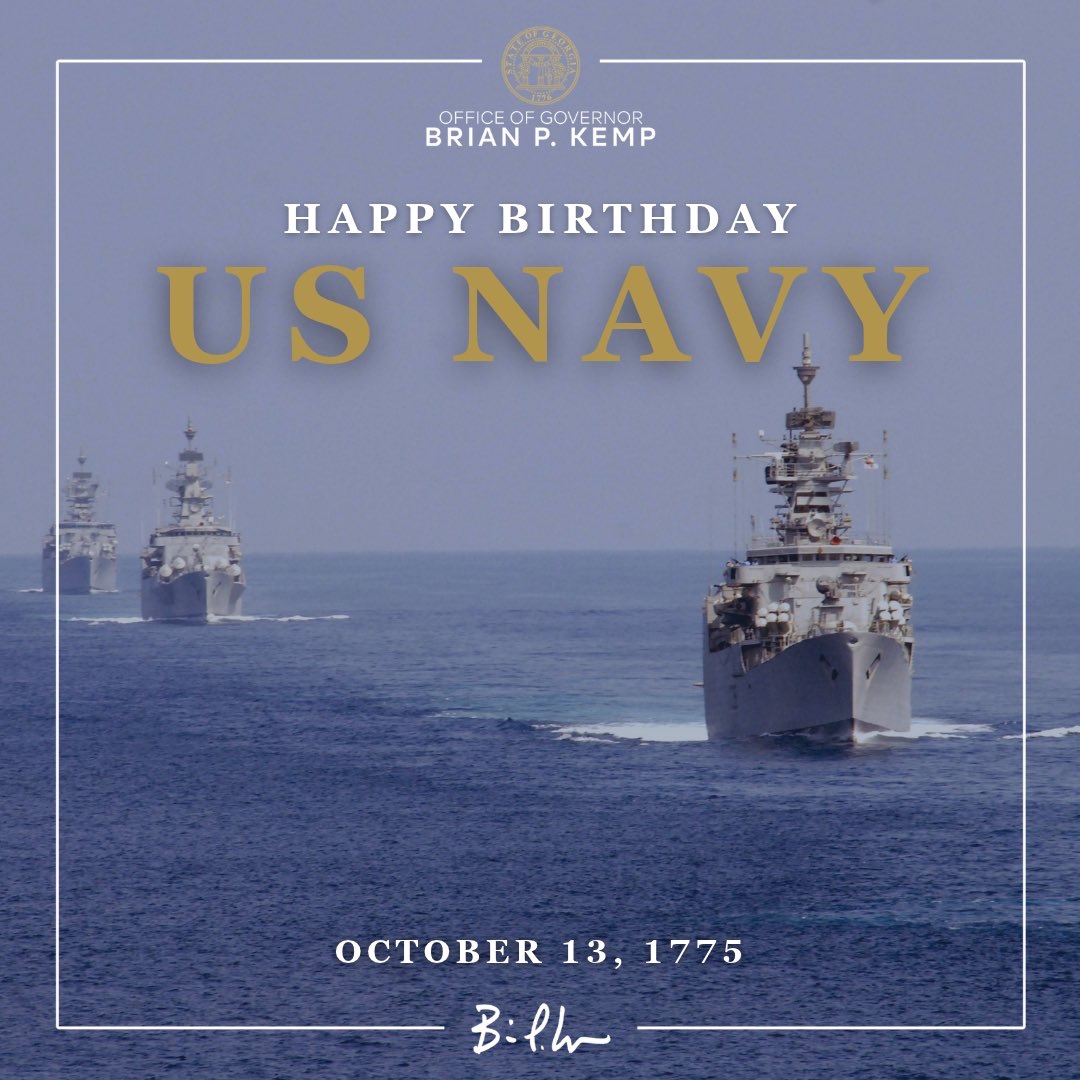
Despite criticism, Kemp has not taken down the post.
Another lawmaker, Ohio State Representative Mike Dovilla, paid his respects on X, saying: “Happy Birthday, U.S. Navy. I am proud of my service in naval intelligence and grateful to all who serve our nation with honor, courage, and commitment. To our sailors, veterans, and their families, thank you.”
Interestingly, though, Dovilla used an image of a Russian warship instead of a US one, a move that drew scrutiny, given that the lawmaker is a Navy Reserve commander and has previously served as a lieutenant commander in the Navy.
Dovilla deleted the post after observers pointed out the error.

Meanwhile, San Diego Mayor Todd Gloria posted images of what has been identified as the Soviet-era cruiser Mikhail Kutuzov, now a museum ship based in Novorossiysk, Russia.
To make matters worse, Gloria wrote: “San Diego is a proud military town. Sailors and their families are a part of the fabric of our community. For 251 years, sailors have answered our nation’s call with courage,” further emphasizing his ignorance.

In another goof-up, the Republican-aligned think tank Freedom Caucus Foundation jumped on the bandwagon of errors by using a picture of the Indian Navy ship INS Trikand.
A Mistake That Keeps Repeating
In 2025, the US Navy’s SEAL Museum posted an image of a Russian missile cruiser to mark the US Navy’s 250th birthday. Meanwhile, several elected representatives and public accounts used images of Indian and Russian Navy warships to mark the service’s birthday.
Representative Kyle Donahue, Representative Arvind Venkat, and Representative Andy Harris used images of Indian warships in their posts, while Senator Jim Boyd used an image of a Russian battleship cruiser to pay tribute to the US Navy for its birthday.
These are just a few of the many social media faux pas that were flagged last year.
Similarly, in 2023, Representative Cory Mills and Representative David Trone’s birthday greetings featured images of a Russian warship. On the other hand, the SEAL Legacy Foundation, which supports families of wounded and fallen United States Navy SEALs, used a Russian ship to mark the occasion, whereas the official X page of Homeland Security used the image depicting a Canadian frigate.
Things weren’t much different in 2021, when Senator Jim Risch published a heartfelt wish for the USN’s birthday, but used a photo of what was later identified as a Pattani-class offshore patrol vessel belonging to the Royal Thai Navy, potentially built by China.
While ship identification may not be a strong suit for many in the United States, it is not much different for combat aircraft.
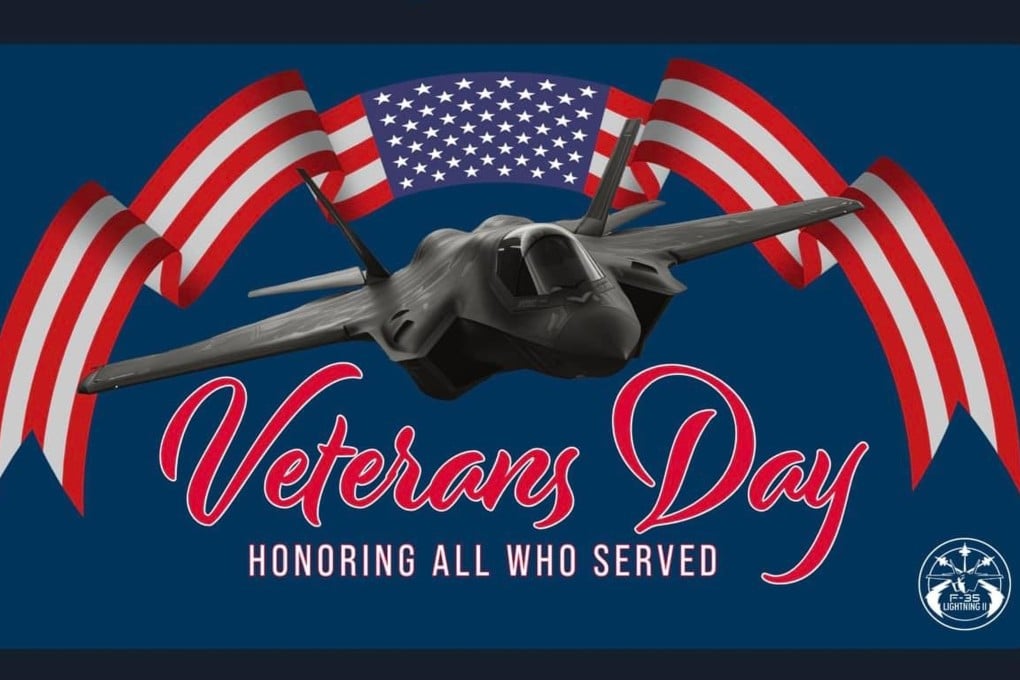
In a major embarrassment last year, the Pentagon’s Joint Program Office (JPO) posted an image of the Chinese J-35A stealth fighter instead of the US F-35 Joint Strike Fighter in a Veterans Day homage post. “Today, and every day, we thank all Veterans and those currently serving for their service and sacrifice,” the Pentagon official’s post stated. However, the office took the post down as criticism mounted over the bizarre mistake.
In 2023, Rep. Anna Paulina Luna—an Air Force (USAF) veteran herself—posted birthday graphics for the US Air Force (USAF) on X and Instagram that used silhouettes of Russian MiG-29 fighters. Air Force historians and defense analysts immediately flagged the image, after which the politician took it down and blamed a junior staffer for the error.
In 2021, Sen. Cindy Hyde-Smith of Mississippi made a similar error when she congratulated the US Air Force Reserve Command on its birthday with a graphic showing Russian Su-34 Fullback strike aircraft. “Happy 73rd Birthday to the @USAFReserve! Thankful for all the reservists who are constantly on the ready to serve our nation,” Hyde-Smith said on X, along with a graphic showing four Su-34 jets in flight.
Needless to say, she deleted the post after netizens mocked her for the error.
However, Dr. Rob Lee of King’s College in London, who specializes in war studies, joked at the time that Hyde-Smith’s post was part of the “national pastime of mistaking Russian weapons for our own” among Americans.
In an even more ridiculous mistake in 2021, the official Southern Command (SOUTHCOM) account posted a birthday graphic for the US Air Force that featured silhouettes of Russian Sukhoi Su-27 fighter jets.
Meanwhile, one of the accounts connected to “Operation Inherent Resolve” posted a picture of two US Navy Boeing F/A-18E/F Super Hornets with best wishes to the air force, creating another embarrassing situation.
Similarly, Donald Trump’s 2020 reelection campaign released a “Support Our Troops” advertisement accompanied by a photo of Russian MiG-29 fighter jets flying over troops with Kalashnikov-pattern rifles. Unsurprisingly, aviation experts widely mocked it, saying it clearly wasn’t American.
Defense analysts have long noted the mechanics behind these recurring errors. For example, modern warships and fighters share enough visual DNA- gray paint, angular superstructures, and similar radar masts- that non-specialists struggle to tell them apart at a glance.
Staffers working under deadline pressure rarely pause to verify hull numbers or distinctive features, making it a low-stakes but revealing ritual.
- Contact the author at sakshi.tiwari13 (at) outlook.com
- Follow EurAsian Times on Google News